TOK has finished a 23-billion-yen photoresist building in Koriyama. Its 2023 and 2026 releases mention neither AI nor capacity; its earnings documents show how demand and the start date shifted in between.
Square Enix offers 300 million yen for first place and 1 billion yen across 15 games. Only Japan residents can enter, of any nationality, and winners transfer half their copyright with no release guaranteed.
Yamaha releases VOCALOID7 on November 11, 2026, with an AI Megpoid based on Megumi Nakajima's voice. Vocaloid voices have come from real people. In an age of AI cloning, what is a voice with a known owner worth?
Godot has moved on Japan with a CRI Middleware partnership. Why an engine at 5% in GDC's 2026 survey gets called the third engine, why its MIT licence stops at the console door, and what Unity and Unreal actually cost.
KDDI's Buffmee and SoftBank's GaranAI launched in July 2026 on the same premise: use only licensed material, meter how much gets used, and pay publishers back. One sells to readers, the other to AI developers.
Design-sector bankruptcies in Japan reached 40 in the first half of 2026, up 166.6% year on year and the highest in 14 years. Tokyo Shoko Research names three forces, and generative AI runs through one.
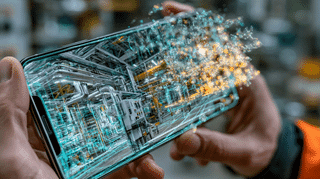
NEC and Keio AI Center have developed a technique that turns ordinary smartphone video into a high-fidelity 3D model in as little as one minute. By pairing Gaussian splatting with its own AI, NEC cut generation time to one-tenth and taught the system to erase workers caught on camera. Commercial launch is targeted within fiscal 2027.
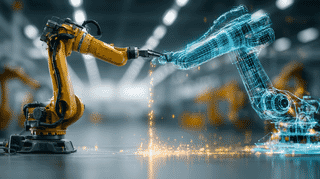
FANUC, Yaskawa and Kawasaki are teaming up with Fujitsu and NVIDIA to bring Physical AI to factories, warehouses and hospitals. What each firm is really after, how they plan to bridge simulation and real machines, and whether Japan can keep its lead against US and Chinese humanoid makers.
Photo blur is usually a mistake to avoid. But a University of Osaka team uses the shape of that blur to read how far away objects are, recovering depth from a single camera with help from a physics-guided AI. Errors stay within about a centimeter at four meters, with uses in robotics and inspection.
Sony is ending Japan sales of its aibo robot dog (ERS-1000), then said it isn't quitting and teased a next-gen model. Here is the panic, the history of AIBO funerals, and Sony's physical-AI plan.
The first theatrical trailer for Sekiro: No Defeat is here. We break down the hand-drawn 2D look, the story of Wolf and Kuro, the no-AI pledge, Ryuichi Sakamoto's theme song, and how (and where) the rest of the world can watch it on Crunchyroll.
RIKEN unveiled two supercomputers on the same day: RIKYU for AI for Science and ROQUO for quantum-HPC. Both are Japan's first to run GB200 NVL4 and Quantum-X800 InfiniBand. We compare them with US efforts like xAI's Colossus and the DOE Genesis Mission, and China, to read Japan's bet on purpose over scale.
In 2004, a University of Tokyo brain scientist said humans are born wired for grammar. In 2022, ChatGPT learned language without any such wiring. The half-century debate Chomsky started is wide open again.
On June 5, Capcom published the Q&A summary from its May 13 earnings briefing. Executives said they are weighing a sequel to Pragmata, the brand-new IP that sold 2 million copies in 16 days, restated their line that creativity stays in human hands while AI handles routine work, explained why console price hikes aren't in their plan, and detailed the catalog strategy behind a Resident Evil series that just passed 200 million lifetime units.
SBI is rolling Claude out across its entire financial group and bolting it onto the on-chain finance rails it has spent years building. Unlike NEC or Fujitsu, this is a user, not a vendor. We compare how Japan, the US and the EU are wiring AI into finance, regulation included.
On May 27, Fujitsu announced partnerships with two US AI labs at once, Anthropic and OpenAI. We unpack what this dual strategy means versus NEC's single bet, the Forward Deployed Engineer model, and how Japanese IT giants differ from Microsoft-OpenAI and SoftBank.
OpenAI is moving to offer its newest cyber-focused AI model, GPT-5.5 Cyber, to the Japanese government and industry. Former NSA Director Paul Nakasone, now an OpenAI board member, flew to Tokyo to pitch critical-infrastructure cooperation. We unpack the contrast with Anthropic's tightly controlled Claude Mythos, the China-threat framing, and what it means that OpenAI wants Japan as its first international partner.
Two key Capcom executives explained their AI strategy to 4Gamer: 3,000 hours of QA collapsed to 72 hours by AI, 30,000+ hours of monthly autonomous playtesting, and a three-layer architecture combining Google's Gemini with Capcom's own art-director models. As the DLSS 5 backlash and ResetEra debates continue, here's why Capcom insists AI is for releasing creator potential, not making art, and why its no-AI-assets pledge predates the Nvidia row rather than answering it.
SoftBank Group has posted a record 5 trillion yen ($32 billion) net profit for the fiscal year ended March 2026, becoming the first Japanese company to ever cross the 5 trillion yen line. We unpack the 6.7 trillion yen OpenAI windfall, the Vision Fund comeback, the role of Arm as collateral, and how the figure stacks up against US Big Tech.
Japan's largest megabank MUFG partnered with Google on May 7, 2026, to build 'agentic banking' — AI agents that autonomously select products, choose the best payment method, and execute transactions. Unlike JPMorgan's employee-facing LLM Suite or BNP Paribas's sovereignty approach, MUFG is betting on consumer-facing autonomous finance.