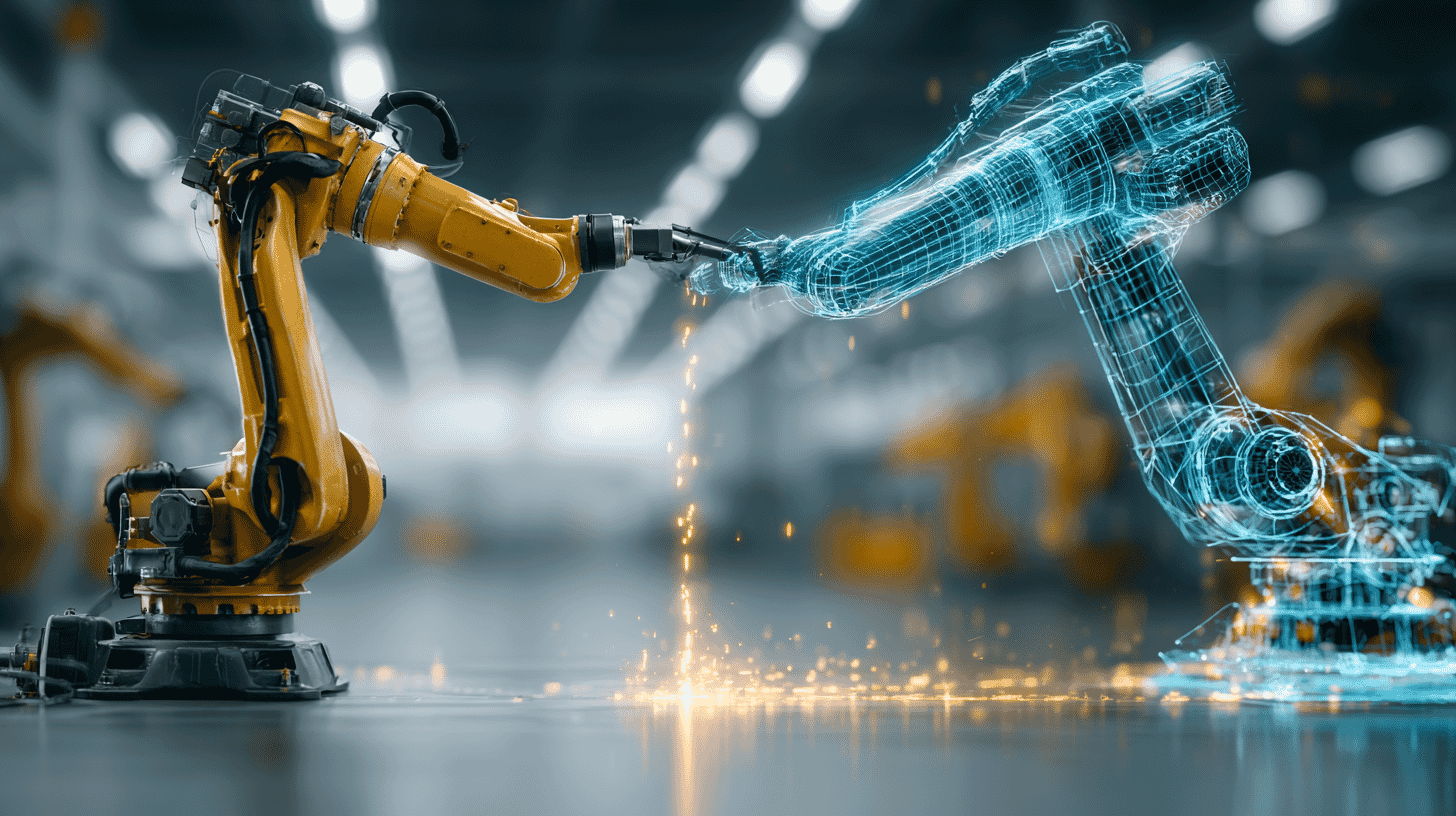
🤖 Three companies that spend most of their lives competing for the same factory contracts just walked onto the same Tokyo stage. Between them stood Jensen Huang of NVIDIA, who told the room that the next industrial revolution's "Physical AI" would be born in Japan. FANUC, Yaskawa and Kawasaki all signed on. But listen closely, and each of them wants something quite different.
What actually got announced
On July 16, 2026, Japan's three big robot makers said they would work together to make Physical AI practical, using technology from Fujitsu and NVIDIA. Fujitsu takes the lead role. The plan is to build a shared control platform that links the digital world of AI models to the physical world of machines, then push it into manufacturing, logistics and healthcare.
This is not a vague memorandum. Fujitsu says it will start a pilot in September at its Kasashima plant in Kahoku, Ishikawa Prefecture, roll out version 1 of the platform to the three robot makers within 2026, and follow with version 2 in 2027. Fujitsu president Takahito Tokita framed the goal as a new kind of shared infrastructure where people and robots work side by side across industries.
The idea, and the wall it keeps hitting
A traditional factory robot is precise but dumb. It repeats one motion, bolted to one spot, and it panics if a part arrives a centimeter off. Physical AI is the attempt to give robots the kind of general intelligence that language models brought to text. Instead of following a fixed script, the robot looks at its surroundings, reasons about what it sees, and decides how to move. The technical name for the "brain" is a foundation model, trained on huge amounts of data, now aimed at the physical world rather than a chat window.
The obvious problem is how you train it. Teaching a robot by trial and error on a real factory floor is slow, expensive and occasionally dangerous. So the industry trains robots inside simulations instead: a virtual copy of the factory where a robot can practice a task millions of times overnight, at almost no cost.
Then comes the wall. A robot that has mastered a job in simulation often fumbles the moment it tries the same job with real steel and real friction. Engineers call this the sim-to-real gap, and it remains the single biggest unsolved problem in the field. The virtual world is never a perfect copy. Lighting shifts, a gripper slips, a cable has more give than the model assumed, and the learned behavior falls apart.
This is exactly where NVIDIA's tools come in, and why Huang was standing in the middle of the photo. NVIDIA sells the layers underneath: Isaac Sim for building the virtual factory, Isaac Lab for training robot behaviors at scale on its chips, and Cosmos, a set of models that generate physics-aware synthetic footage and can nudge simulated images closer to how a real camera would see them. On the robot itself, an NVIDIA chip runs the model in real time.
One finding from recent research reframes the whole problem in a useful way. Bridging the gap depends less on making the simulation physically perfect and more on making the training data diverse. A robot that has practiced under thousands of slightly different conditions, wrong lighting, odd angles, imperfect physics, copes better with the messy real world than one trained in a flawless but narrow simulation. The bottleneck, in other words, shifted from clever algorithms to sheer variety of data. That is what a shared platform is good at producing.
Same table, three different bets
Here is where the alliance gets interesting, because "we will all use one platform" hides three genuinely different strategies.
FANUC, the maker of the yellow arms that dominate the world's factories, wants openness above all. Its pitch is a Physical AI system flexible enough that almost anyone can use it, combining its own robots with Fujitsu's AI platform and NVIDIA's technology underneath. President Kenji Yamaguchi tied it directly to Japan's labor shortage: get usable AI onto the factory floor quickly, so smaller operators without armies of specialist engineers can automate too. For a company once famous for keeping its software locked shut, that is a real turn.
Yaskawa arrives from a head start. It already put a robot on the market, the MOTOMAN NEXT, with an NVIDIA graphics chip built in as standard. Its senior executive Masahiro Ogawa argued that the era of robots that move, think and actually get a job done has only just begun, and that the point of a shared platform is to keep the industry pulling in one direction. His phrase for it translates roughly as "coordination and synchronization," a hint that Yaskawa sees the real prize not in one clever robot but in many machines working as a system.
Kawasaki is the outlier, and deliberately so. It has spent more than a decade pushing robots into healthcare rather than only factories. Its bet here is to connect its surgical and nursing-support robots with Fujitsu's IT systems, including electronic medical records. President Yasuhiko Hashimoto talked about one-stop solutions for hospitals and support for elderly people living alone, a market that has almost nothing to do with automotive assembly lines and everything to do with Japan's aging population.
So the alliance is less a merger of ambitions than a shared road with three exits. Factories, systems, hospitals.
Why Japan is doing it this way
Japan can afford to bet on industrial robots because it still leads there. FANUC and Yaskawa are two of the four firms that supply well over half the world's industrial robots, and together the two Japanese makers account for close to a third of global shipments. Counting where the machines are actually built, Japan produces something like 45% of the planet's industrial robots. Government money is flowing in behind the companies, with a national Physical AI program worth ¥20.5 billion (roughly $130 million) through NEDO.
But notice what Japan is not chasing. The loudest robotics story of the past two years has been the humanoid: a general-purpose machine shaped like a person. That race is being run mostly in the United States and China. Tesla's Optimus is still, by Elon Musk's own admission, in an R&D phase, generating training data inside Tesla factories rather than doing paid work, with volume production at its Fremont plant not yet started as of mid-2026 and targeted for late summer. Figure has one of the strongest verified records, running its Figure 03 robots on BMW's assembly line in South Carolina. Boston Dynamics began building its electric Atlas this year, with its 2026 output committed to Hyundai and Google DeepMind.
China competes on price and volume. Unitree ships more humanoids than any Western rival, at roughly a tenth of the cost, with its G1 listed for as little as around $17,000. It sold more than 5,000 units last year and is aiming far higher this year, even as its most recent quarterly profit fell by half. AgiBot is close behind on volume.
Japan's three giants are pointedly not entering that fight. Their bet is that the surer money is in putting AI onto proven industrial arms, machines that already run reliably in real factories, rather than on humanoids that still stumble on the sim-to-real gap in front of investors.
The question underneath the handshake
The awkward part is visible in the photo itself. The robot bodies are Japanese, but the AI brains, the simulation stack and the chips are largely NVIDIA's, an American company whose CEO stood at the center of the announcement. Fujitsu is building the coordination layer precisely to own more of that stack, and pooling three rivals' expertise is an attempt to keep the intelligence, not just the hardware, on the Japanese side.
Whether that works is the real story to watch. In the AI era, value has a habit of flowing to whoever owns the platform rather than whoever builds the best hardware. Japan owns the bodies and, for now, some of the most reliable ones in the world. The open question is whether it ends up owning the nervous system too, or becomes a very good supplier inside someone else's.
Japan's answer, at least for now, is to skip the humanoid spectacle and wire intelligence into the machines it already dominates. Does that sound like the safe bet or the timid one? And in your country, are the robots that show up in factories, warehouses and hospitals built at home, or imported with someone else's AI inside?





Global Discussion
4 comments