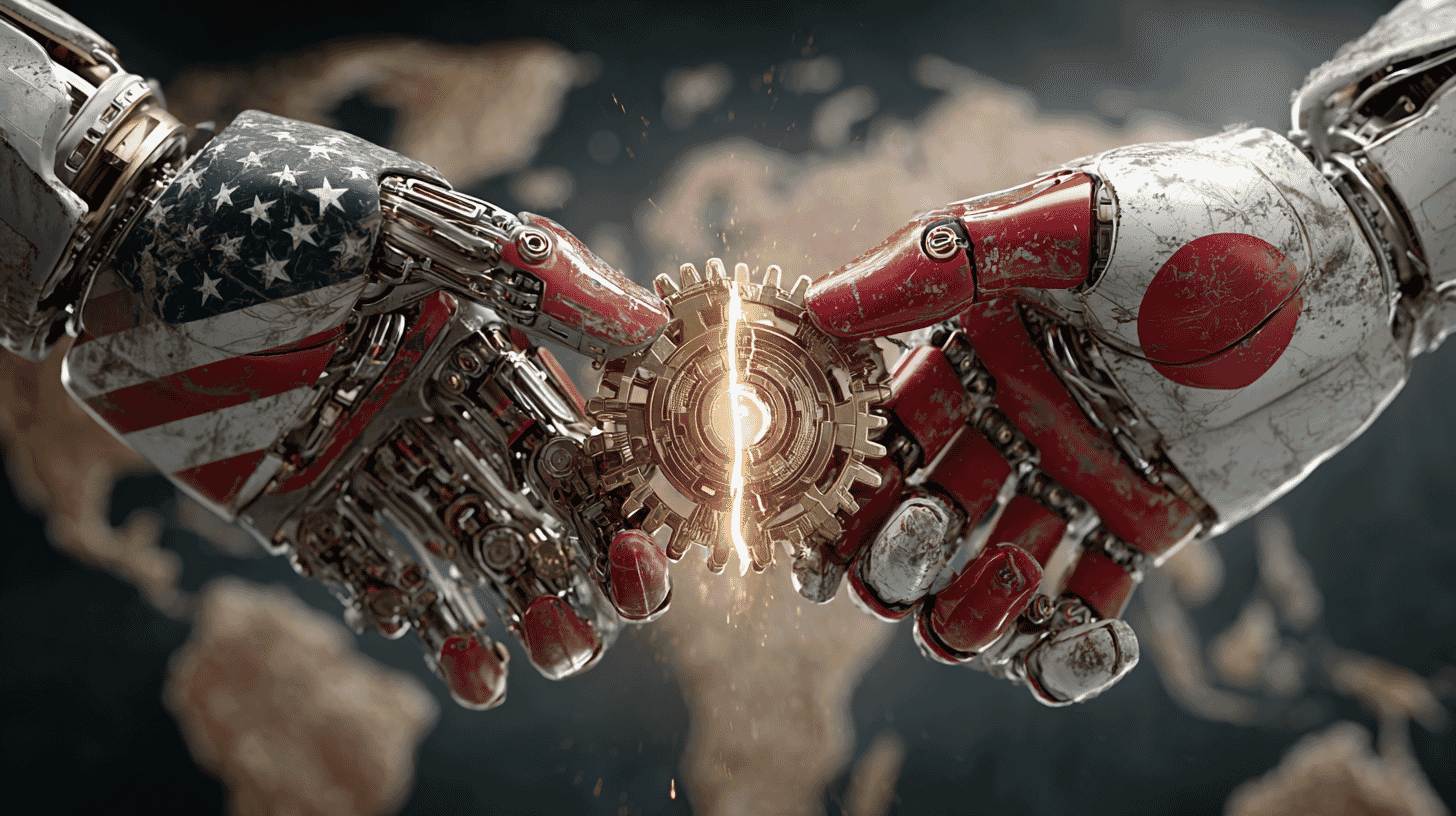
What decides the performance of a humanoid robot? Not AI. Not cameras. It's the joints. A single humanoid needs more than 50 actuators, the mechanical "joints" that account for up to 60% of manufacturing cost, and their precision sets the quality of every movement. In precision gear reducers, the heart of those joints, two Japanese firms, Harmonic Drive Systems and Nabtesco, each hold a majority of the world market in their own segment. Tesla, Chinese manufacturers, Korean conglomerates: none of them can finish a humanoid without Japanese-made reducers. The real battlefield for robot dominance lies inside the joints.
Why "Joints" Determine the Fate of Humanoid Robots
Humanoid robots walk, grasp objects, and maintain balance, movements that seem deceptively simple. To achieve them, a robot's body needs dozens of "joints." In robotics engineering, the components that serve as these joints are called actuators.
An actuator is an integrated drive unit combining a motor, gear reducer, controller, and sensors. It converts electrical energy into rotational or linear motion, controlling force, speed, and angle in real time to precisely move a robot's fingers, arms, and legs.
If AI is the "brain" and cameras are the "eyes," then actuators are the "muscles and joints" themselves. No matter how brilliant the brain, a body that can't move as intended is useless.
Tesla CEO Elon Musk stated in November 2024 that future robots will feature "an extremely complex structure with over 50 actuators." When Tesla first unveiled Optimus in 2022, it had 28 actuators. In just two years, that number nearly doubled. As robots become smarter, the number and precision of joints they require keeps growing.
Actuators Dominate Robot Costs
The significance of actuators isn't just technical, the economic impact is enormous.
UK market research firm Interact Analysis estimates that actuators account for 30–50% of a humanoid robot's bill of materials (BOM). Some industry insiders put the figure closer to 60%. For a robot priced at roughly $13,000, that means $4,000–$8,000 goes to joint components alone.
Market growth is equally staggering. According to research firm Valuates, the global humanoid actuator market is projected to explode from $150 million in 2024 to $9.86 billion by 2031, an annual growth rate of approximately 80%, exceptional even by tech industry standards.
Whoever controls actuators controls the robot industry. This dynamic is driving global mega-corporations into a fierce battle for joint technology.
Japan's "Joint Hegemony": Harmonic Drive and Nabtesco
The most critical component determining actuator performance is the precision gear reducer. A gear reducer converts a motor's high-speed rotation into low-speed, high-torque output, governing the smoothness, accuracy, and durability of a robot's movements.
In this market, Japanese companies hold an overwhelming position.
Harmonic Drive Systems (Tokyo) commands approximately 50% of the global market with its proprietary "strain wave gear" technology. It achieves zero backlash (no gear play) and a positioning accuracy of ±1 arc-second, an extraordinary level of precision. Its compact, lightweight design delivers high reduction ratios, making it indispensable for delicate movements in robot wrists and fingers. The company's reducers are used in Tesla's Optimus and Xpeng's IRON. Harmonic Drive has committed approximately $180 million in capital investment for 2024–2026, with roughly $65 million allocated specifically to humanoid robot applications.
Nabtesco (Tokyo) dominates with approximately 60% of the global market for RV (rotary vector) reducers. Combining high torque density with exceptional longevity, the company has shipped over 7 million units with a failure rate below 0.01%. Its reducers are widely used in the heavy-load joints of robot shoulders and hips.
Between them, these two companies dominate the premium precision-reducer segment, each leading its own reducer type. Regardless of which country's manufacturer builds a humanoid robot, Japanese precision reducers remain essential.
Additionally, THK (Tokyo) holds 55% of the global market for linear motion systems, achieving positioning accuracy at the 0.1-micrometer level. The company also offers its "SEED Solutions" robot platform. Nidec is transferring EV motor technology to robot joints, pursuing both mass production capability and quality.
Japan's component manufacturers effectively dominate the "nerves and muscles" of humanoid robots.
Global Giants Flood the Joint Market
Major corporations worldwide are rushing into this massive growth market.
Korean companies are leading the charge. LG Electronics unveiled its home robot "CLOiD" at CES 2026 and launched "Axium," a robot actuator brand, alongside it. Its weapon is decades of motor design and mass production from the appliance business, which turns out roughly 45 million motors a year. Hyundai Mobis agreed to supply actuators for Boston Dynamics' next-generation "Atlas," and puts actuators at more than 60% of a humanoid's material cost. As part of a $26 billion US investment, Hyundai Motor Group plans to build and deploy tens of thousands of robots over the next few years. Samsung Electro-Mechanics has said it is evaluating entry into the actuator market.
[Update] At the March 2026 shareholders' meeting, LG Electronics CEO Lyu Jae-cheol called 2026 the "inaugural year" of the company's humanoid robotics business and said a mass-production system for Axium would be in place within the year, with CLOiD moving into proof-of-concept deployment the following year. (As of August 2026)
China's pursuit is equally intense. Approximately 90% of humanoid robots shipped globally in 2025 were Chinese-made, with companies like Unitree and Agibot outselling Tesla. Chinese firms are rapidly localizing planetary roller screws and gear reducers for their domestic supply chains. However, industry consensus holds that Chinese components still lag behind Japanese products in durability and precision.
Tesla pursues a vertically integrated model, developing and manufacturing its own actuators while leveraging EV battery technology to drive costs sharply lower at scale.
European precision engineering firms like Maxon Motor (Switzerland) and Wittenstein (Germany) also maintain strong positions in the high-end segment.
Geopolitical Risk and Opportunity from US-China Tensions
The humanoid robot hegemony race extends beyond pure technology. US-China tech rivalry is reshaping supply chain dynamics.
US political media outlet Politico reported that the US government is considering an executive order on robot industry regulations within 2026. The "China exclusion" trend that reshaped the semiconductor industry could extend to robot components.
For Japan, this could be a tailwind. As supply chains that exclude Chinese components are mandated, demand for Japanese precision components would surge further. However, risks include constraints on China-bound business and intensifying competition with Korean and Taiwanese suppliers.
A KB Securities analyst noted that as demands grow for China-free supply chains while humanoid robot demand surges, the single-supplier model cannot handle volumes, accelerating the search for multiple simultaneous suppliers. Japanese companies face both the challenge and opportunity of rapidly scaling production capacity.
The Future Hegemony Race: Can Japan Defend Its "Joint Throne"?
The humanoid robot market is projected to expand from $2.9 billion in 2025 to over $15.2 billion by 2030, at an annual growth rate of roughly 39%. Amid this explosive growth, Japan's "joint hegemony" faces three tests.
First, mass production capability. Tesla starts Optimus 3 production at Fremont in the summer of 2026, though Musk himself has said the initial rate will be "extremely slow" and has given no 2026 target. The line is nonetheless designed to scale toward a million units a year, and Chinese makers are building capacity in the tens of thousands. Japanese component suppliers have to meet that surge. Harmonic Drive's strategic investment of roughly $65 million reflects this urgency.
Second, next-generation technology. Joint research by the University of Tokyo and the Tokyo Institute of Technology (now the Institute of Science Tokyo) has developed artificial muscles using shape-memory alloys that achieve equivalent force at one-tenth the power consumption. Kawasaki Heavy Industries is exploring hydraulic actuators for its Kaleido humanoid. Today's gear reducer technology may not remain dominant forever.
Third, expansion into finished products. Japan has been the "component king" but remained largely invisible in finished humanoid robots. This is changing, Kawasaki's Kaleido has evolved to its 9th generation, and the Kyoto Humanoid Association (KyoHA), whose members include Murata Manufacturing, Sumitomo Heavy Industries, and Renesas Electronics, aims to complete a prototype within 2026.
During the Gold Rush, those who profited most were the ones selling pickaxes. Japan currently holds the world's finest pickaxe, precision gear reducers. But in an era where mining methods themselves are changing, pickaxes alone may not be enough to prevail. Japan is balancing pride in its component technology against anxiety about falling behind in finished products.
How is the robot industry developing in your country? Which matters more, controlling critical core components like joints, or leading the market with finished products? We'd love to hear your thoughts.
References
- https://news.yahoo.co.jp/articles/1398aed05078dad8bbbd24a2cc2619a8363ff4c1
- https://biz-journal.jp/company/post_393103.html
- https://kabutan.jp/news/marketnews/?b=n202501281006
- https://kawasakirobotics.com/jp/blog/2012-01/
- https://restofworld.org/2026/china-humanoid-robots-unitree-agibot-tesla-optimus/






Global Discussion
14 comments