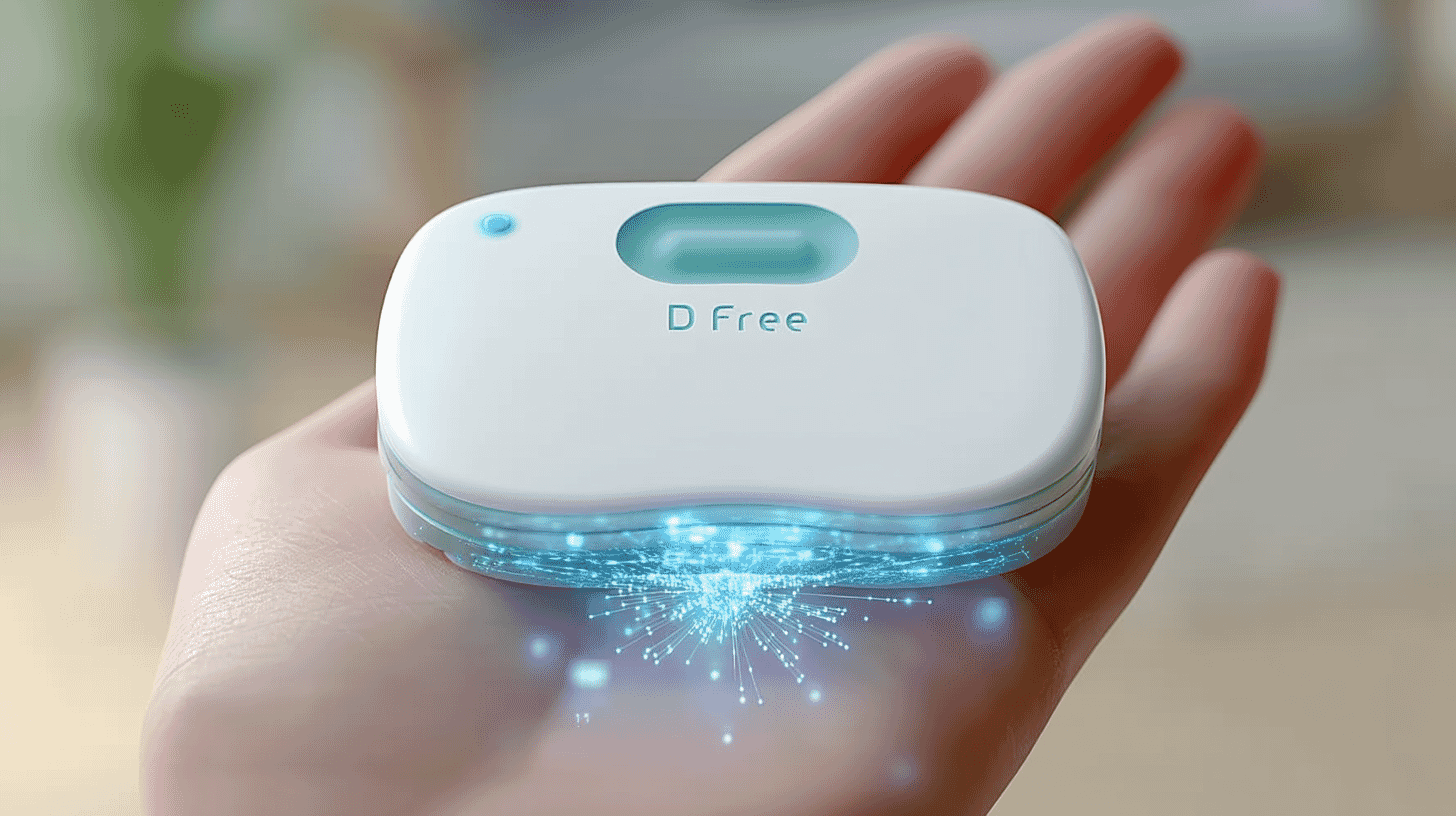
"Time to head to the bathroom." Imagine that notification arriving on your phone, sent by a 20-gram ultrasound sensor reading your bladder in real time. For most people with urinary issues the only answer has been diapers. A wearable device born in Japan is offering another option, and it has just won a category grand prize for its impact on children with disabilities.
What Is DFree? The World's First Excretion Prediction Wearable
DFree (short for "Diaper Free") is an IoT wearable device developed by DFree Inc. (formerly Triple W Japan), a Tokyo-based startup. The device uses ultrasound, the same technology behind medical echo examinations, to monitor bladder fullness in real time and notify users via a smartphone app when it is time to use the toilet.
The unit measures 51mm wide, 36mm deep and 12mm tall, and weighs 20 grams. It is washable and runs about 40 hours per charge. It attaches to the lower abdomen just above the pubic bone, where its ultrasound sensor detects the bladder expanding as urine accumulates. Fullness is displayed on a 0 to 10 scale, and when it crosses a user-defined threshold the app sends an alert.
The origin story is as memorable as the product. Founder Atsushi Nakanishi came up with the idea while studying at UC Berkeley in California after a mortifying experience: he couldn't find a public restroom in time and had an accident. That moment of lost dignity became the catalyst for a company whose mission statement reads simply: "Move the world one step forward." The Japanese entity was incorporated in February 2015.
Grand Prize at BabyTech Awards 2025-26
On February 12, 2026, DFree was awarded the Grand Prize in the Developmental Support Tools category at the BabyTech Awards 2025-26. The BabyTech Awards recognises childcare-focused ICT and IoT products distributed in Japan. Now in its seventh year, the 2025-26 edition judged 13 categories, received 60 entries, certified 42 products in an initial screening, and named hall-of-fame products plus grand and excellence prizes per category in a second round.
The judges specifically recognized DFree's contribution to easing the burden of toilet training for children with disabilities and supporting their independence and quality of life (QOL). For families with children who have intellectual or physical disabilities, toilet training can be an exhausting, multi-year challenge. DFree makes the invisible visible, showing caregivers when a child's bladder is filling and when to guide them to the toilet.
Awards, Markets, and Insurance Coverage
This is not DFree's first trophy. At CES 2019 in Las Vegas it collected three awards, including a CES Innovation Award, alongside recognition from IHS Markit and Engadget.
The company launched its service for nursing care facilities in Japan in 2017, expanded to individual consumers and to the United States and Europe in 2018, and added services for medical institutions in 2019. By the company's own count, DFree has been used at roughly 300 care and medical facilities by around 10,000 users.
A policy milestone came in April 2022, when "excretion prediction support devices" were added as a new item eligible for purchase under Japan's long-term care insurance system, bringing DFree within scope. Several municipalities have since added the device to their daily living aid programmes as well.
Japan's Aging Society and the Excretion Care Crisis
Japan offers a window into the future for countries grappling with aging populations. In a Cabinet Office survey conducted in the 2010s, the hardest part of caring for an elderly relative was excretion care, cited by 62.5% of respondents, ahead of bathing at 58.3%.
The adult diaper market tells its own story. Unicharm's adult diaper sales overtook its baby diaper sales for the first time in the fiscal year ending March 2013, and the domestic market as a whole crossed over in 2012. The annual diaper cost per nursing home resident is estimated at approximately 72,000 yen (about $480), and some facilities using DFree have reported reductions in diaper usage.
But DFree's real impact goes beyond economics. Care sites have reported fewer incontinence episodes among users, and the deeper value is harder to put a number on: dignity. Japanese folk tradition in various regions holds that hanging a hydrangea upside down near the toilet keeps you from ever needing help with your bodily functions. The superstition says something about how deep the wish runs to stay independent in this most private of activities, right to the end.
Transforming Lives of Children with Disabilities
The BabyTech Award specifically highlighted DFree's impact on children with developmental or physical disabilities. Many children with intellectual disabilities struggle to recognize the sensation of a full bladder, and those with physical disabilities may have difficulty getting to the toilet independently.
One parent, five years into toilet training a fourth-grade son with Down syndrome, described the change plainly: she could forget about scheduled toilet trips entirely and simply wait for the alert, and accidents dropped to zero. A user with a spinal cord injury who performs self-catheterisation reported that being able to see bladder volume on screen sharply reduced the psychological strain.
To mark the award, DFree Inc. opened a free trial programme for the first 30 facilities to apply nationwide, aimed at child development support centres, after-school day services, and special needs schools. Individual users could extend the standard one-week free trial to two weeks with a promotional code through March 12, 2026.
Technology That Protects Human Dignity
The challenge of excretion care is universal. The company puts the global figure at roughly 500 million people living with some form of urinary difficulty, and that number will grow as populations age. What DFree demonstrates is that technology can support one of the most basic and most private biological functions, and that dignity need not depend on age, disability, or physical condition.
The company's philosophy challenges an entrenched default: that diapers are the only answer. This award was a domestic one, but the significance lies elsewhere. A device that made its name in elderly care has now been judged on its merits in child development support.
Aging societies and disability support are universal challenges. What technologies are used for continence care in your country?
Update: what happened next (as of July 2026)
- The two-week free trial campaign for individuals ended on March 12, 2026. The facility monitor programme was capped at the first 30 applicants.
- In December 2025, DFree Inc. received the METI Minister's Award at the Well-being & Age-tech 2025 Awards run by the Well-Aging Economy Forum.
- In February 2026 the company completed an integration with Paramount Bed's "Nemuri CONNECT" sleep monitoring system, allowing sleep and excretion data to be read together when planning care.
- In January 2026 DFree also announced "DFree HapPee Buddy," a project in which a stuffed toy voices a child's physical condition back to their parents.








Global Discussion
15 comments