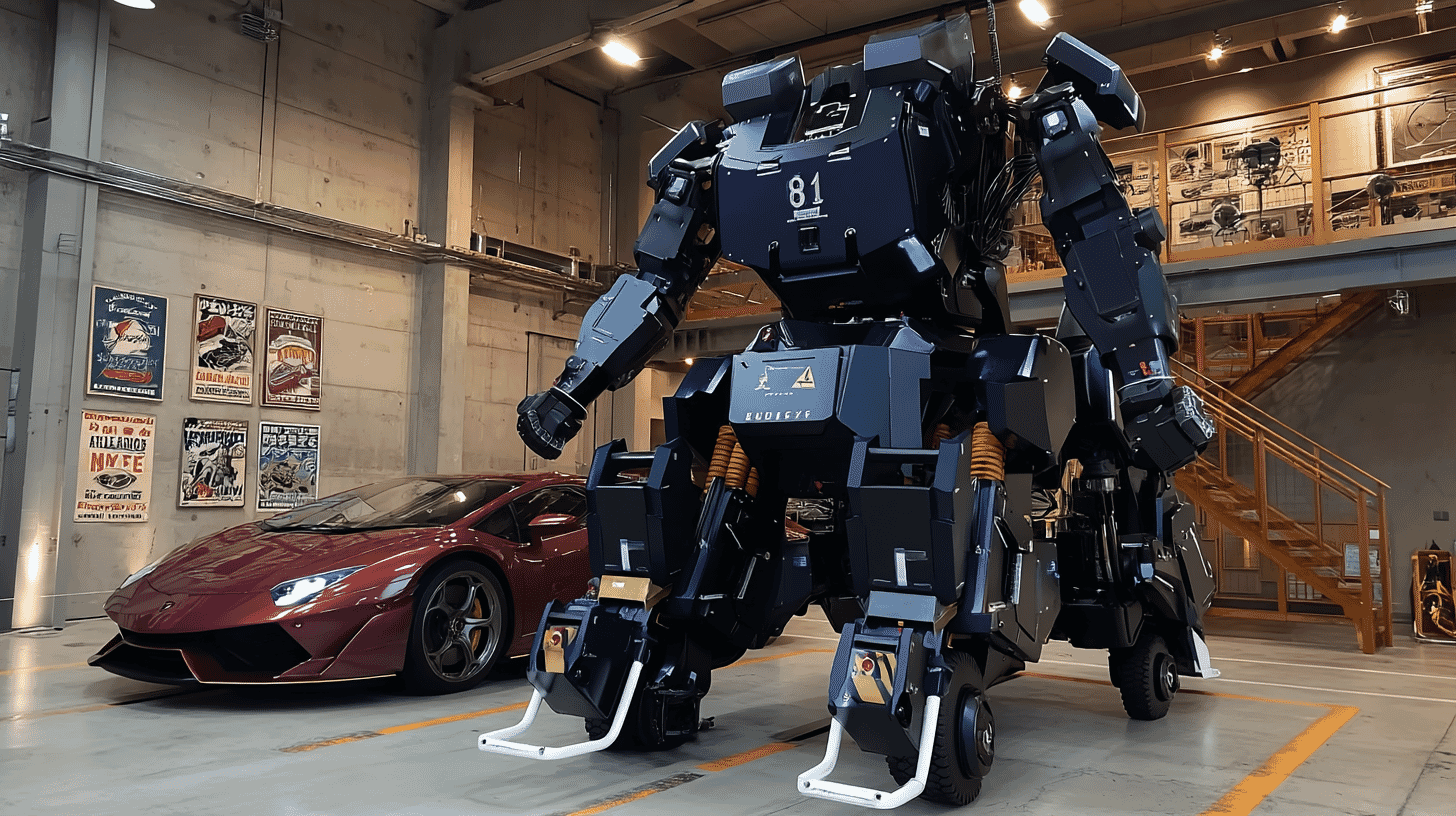
Gundam, Macross, Evangelion. Japanese anime has spent decades drawing the dream of climbing into a giant robot and piloting it. A small Japanese startup went and built one.
Tsubame Industries' Archax is a 4.5-meter-tall, 3.5-ton piloted robot that transforms between Robot Mode and Vehicle Mode. Footage of the full transformation sequence lights up mecha fans across the globe every time it surfaces. The price is 400 million yen, or 440 million with tax, which works out to roughly $2.45 million at the July 2026 rate of about 163 yen to the dollar. Yes, it's actually for sale. Yes, you really can climb inside.
Tsubame Industries Co., Ltd.
What Exactly Is the Archax?
The Archax is a piloted operating robot developed by Tsubame Industries Co., Ltd., a startup based in Edogawa, Tokyo and founded in August 2021 with a small engineering team. Despite the scale, the mission is enormous: "Bringing science fiction into science reality." The name ARCHAX comes from Archaeopteryx, the first bird, a nod to this being the first of its kind.
The specifications read like a feature list pulled straight from a mecha anime model kit:
| Specification | Detail |
|---|---|
| Height | 4.5 m (about 15 ft) |
| Weight | 3.5 tons |
| Joint degrees of freedom | 26 |
| Modes | Robot Mode / Vehicle Mode |
| Top speed | 10 km/h (in Vehicle Mode) |
| Power | Battery-driven (DC 300V) |
| Cameras | 9 wide-angle cameras feeding 4 cockpit displays |
| Controls | 2 joysticks, 2 pedals, touch panel |
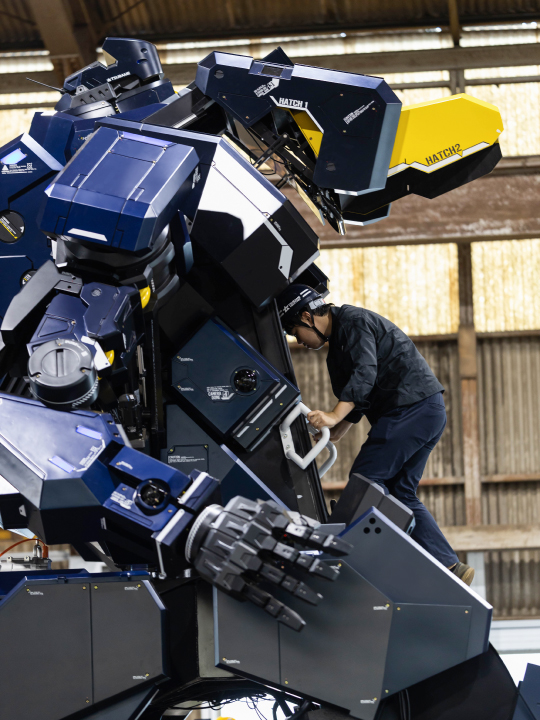
The pilot enters through a chest-mounted hatch that opens with a coordinated four-panel link mechanism. The cockpit has no windows, instead, four displays surround the pilot showing real-time feeds from nine cameras placed around the chassis. Joysticks control the arms, pedals manage forward/backward motion and rotation. There's even an industrial air conditioner inside, so summer operation stays comfortable.

Tsubame Industries Co., Ltd.
The Star Feature: Real Transformation
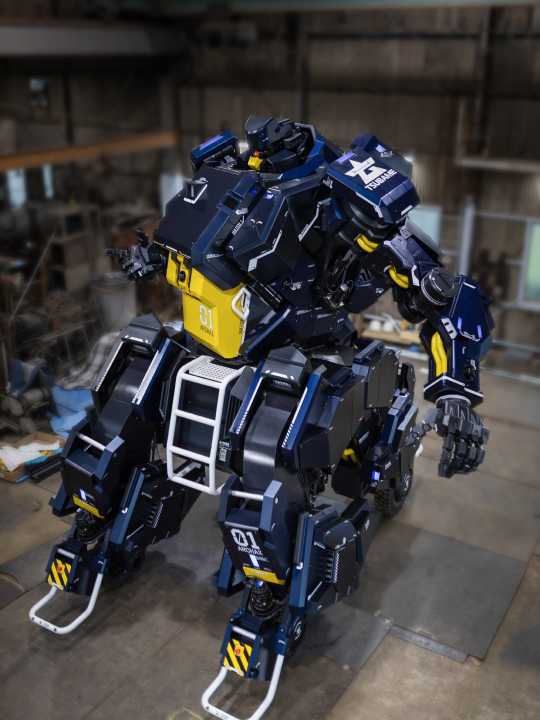
What sets the Archax apart from every other "real-life giant robot" project is its transformation mechanism. The bipedal-looking Robot Mode reconfigures into a low-slung four-wheeled Vehicle Mode in roughly 15 seconds, with electric motors throughout the chassis lifting and lowering the 3.5-ton frame.
In Vehicle Mode, the four legs splay outward, the center of gravity drops, and the machine rolls on industrial Yokohama tires (front-wheel steering, rear-wheel drive). It tops out at 10 km/h, not fast, but for a transforming three-and-a-half-ton mech, it's enough to cross an event hall under its own power.
The robot doesn't actually walk on two legs. Two-legged walking at this weight is still beyond practical engineering, and the company prioritized safety and operability over visual purity. The legs end in wheels, not feet, a deliberate compromise that mecha purists might grumble about but engineers will recognize as the right call.

Tsubame Industries Co., Ltd.
Built by the Engineer Behind Yokohama's Real-Life Gundam
The CTO of Tsubame Industries is Hironori Ishii, a name that mecha fans in Japan instantly recognize. Ishii spent nearly 20 years developing dual-arm heavy machinery at a major construction equipment manufacturer, then served as Technical Director of the moving 18-meter Gundam statue at GUNDAM FACTORY YOKOHAMA.
Yes, that Gundam. The full-size, walking, kneeling, pointing icon that drew thousands of pilgrims to Yamashita Pier from 2020 to 2024. The same engineer who made an 18-meter Mobile Suit move on stage is now CTO of the company building piloted 4.5-meter mechs.
Tsubame's CEO Tatsuo Yoshida comes from a different track. His grandfather ran an iron foundry, instilling a love of machines from childhood; he studied robot hand technology in university and founded Tsubame Industries to build the giant robots he'd dreamed of as a kid.
Yoshida frames the project this way: "We packed in everything Japan does best, robotics, animation and games, heavy machinery, automotive, to create a 'This is Japan' product to send to the world."
The Price Tag
Pricing is set at 400 million yen per unit, 440 million including tax, for the initial production run of 5 units, with one year of maintenance included. At the July 2026 rate of roughly 163 yen to the dollar, that's about $2.45 million. Delivery takes 12 to 18 months from order.
The benchmark market isn't industrial robotics, it's the supercar collector market for vehicles priced above 150 million yen ($955,000+). Think Bugatti, Pagani, custom Ferrari and Lamborghini units that wealthy collectors buy and store in private garages. Yoshida explicitly compares the Archax to "the kind of car that gets bought, never registered, and parked in a garage." The point is to give the same demographic something even more interesting to put in that garage.
Custom paint and design tweaks are available. Some delivered units have been finished in colors evocative of famous anime mecha, red, blue, green, though Tsubame is careful to avoid direct trademark conflicts.
In 2024, an Archax unit even appeared on SBX Cars, the supercar-focused auction platform run by Supercar Blondie's media empire. International ultra-high-net-worth individuals were the bidders.
Macross Director Designs a Special Edition
In September 2023, Tsubame announced a creative partnership: Shoji Kawamori, the mecha designer behind The Super Dimension Fortress Macross, Aquarion, and Armored Core, would design a special edition Archax. The design was unveiled at the Japan Mobility Show in October 2023, and global sales of the Kawamori edition opened that December. The Archax carries its structural load on an internal steel frame, so the outer shell isn't load-bearing and can be swapped, which is what made the collaboration physically possible.
This is a remarkable inversion of the usual industry flow. Normally, a real-world product inspires fictional designs (think the Toyota Camry inspiring some background mech). Here, the fictional mecha designer is designing a real, mass-produced machine. It's a small but historically interesting moment in the relationship between Japanese animation and Japanese manufacturing.
Tsubame Industries Co., Ltd.
Where You Can Actually See One
For the overwhelming majority of readers who can't drop a few million dollars on a transforming robot, here's the good news: Tsubame Industries launched a lease business in June 2024, renting Archax units for events, exhibitions, and corporate demonstrations.
The Archax has been displayed at multiple international events:
- Japan Mobility Show (Tokyo Big Sight)
- SusHi Tech Tokyo (Ariake Arena)
- Various trade shows, brand activations, and auto-related events
Lease demonstrations include:
- Live transformation between Robot Mode and Vehicle Mode
- Remote operation by Tsubame's pilots
- Cockpit operation by Tsubame's pilots (visitor cockpit experience is not offered)
- Limited driving demonstrations within the venue
- Bilingual narration (Japanese and English)
In other words, if you're visiting Japan and there's a robotics, gaming, or automotive event happening, check the exhibitor list, there's a real chance you can witness the Archax transform in person. For Japan-focused YouTubers and travel vloggers, capturing live transformation footage would almost certainly go viral.
The big future news: Tsubame plans to open a piloted-robot experience facility near Haneda Airport in 2028. If that opens as planned, international travelers will be able to land in Tokyo and immediately try a hands-on giant-robot piloting experience. It could become a marquee Japan tourism attraction alongside Akihabara and Odaiba.
Why Mecha Fans Worldwide Are Losing Their Minds
The Archax keeps trending overseas not just because "big robot moves", it's because Japanese robot anime has been a globally shared dream for two generations. On r/mecha, r/Gundam, and similar communities, every Archax video brings the same refrains:
- "Armored Core just became real."
- "Japan literally built a Pacific Rim Jaeger."
- "This is the closest we've ever come to a real Valkyrie."
- "I would sell organs."
For Western fans who grew up on Robotech (the North American Macross adaptation), Voltron, and Gundam Wing in the 1980s and '90s, the Archax represents childhood imagination made manifest.
How It Compares With China's Robots
In recent years, humanoid robotics has been led by Chinese players including AGIBOT, Unitree, and Fourier Intelligence, plus Korea's Hyundai-owned Boston Dynamics. They pursue volume production of bipedal humanoids aimed at industrial deployment, with entry models starting around $6,000. Unitree listed on the Shanghai Stock Exchange's STAR Market on June 1, 2026.
The Archax has always represented the opposite strategy:
- Limited, not mass-produced: 5 units in the initial run
- Experience over function: Romance and pilot feel, not productivity
- Luxury, not commodity: a multi-million-dollar high-end market
- Transformation, not walking: variable mecha, not bipedal humanoid
That line blurred in 2026. On May 12, Unitree unveiled GD01, a manned transformable mecha. It's a headless humanoid with a lattice-framed torso the pilot sits inside; the demo showed it walking upright, then reconfiguring into a quadruped. The official video claimed it was ready for mass production. Price starts at $650,000, and total weight including the pilot is around 500 kg, roughly a tenth of the Archax's price and a seventh of its weight.
The genre of "rideable transforming mecha" is no longer a Japanese monopoly. What still distinguishes the Archax is less the transformation itself than the framing: a luxury object designed as an extension of otaku, garage-kit, and custom-car culture.
What's Next
CEO Yoshida has spoken about the next-generation Archax already in development. Working with Nabtesco, the precision reducer manufacturer supplying the RV gearboxes in the current Archax, the next generation is planned to use Mecanum drive units for omnidirectional movement and add joints for more complex motion.
Beyond entertainment, Tsubame is exploring industrial and even residential applications. Whether the Archax stays a toy for the ultra-wealthy or becomes the foundation of a new robotics category remains to be seen.
What About in Your Country?
For years, the category of an actually pilotable transforming mecha sold as a product barely existed outside Japan. MegaBots in the US wound down. Russia has had military prototypes. China had small entertainment piloted robots. Unitree's GD01 has now changed that picture, which makes the question of what each country builds, and why, more interesting rather than less.
Does your country have companies serious enough about childhood mecha dreams to actually build them? Or does practicality always win out before such projects can ship? If you make it to Japan, keep an eye on the major exhibition calendar, and if you spot an Archax demo, it's worth the trip alone.







Global Discussion
14 comments