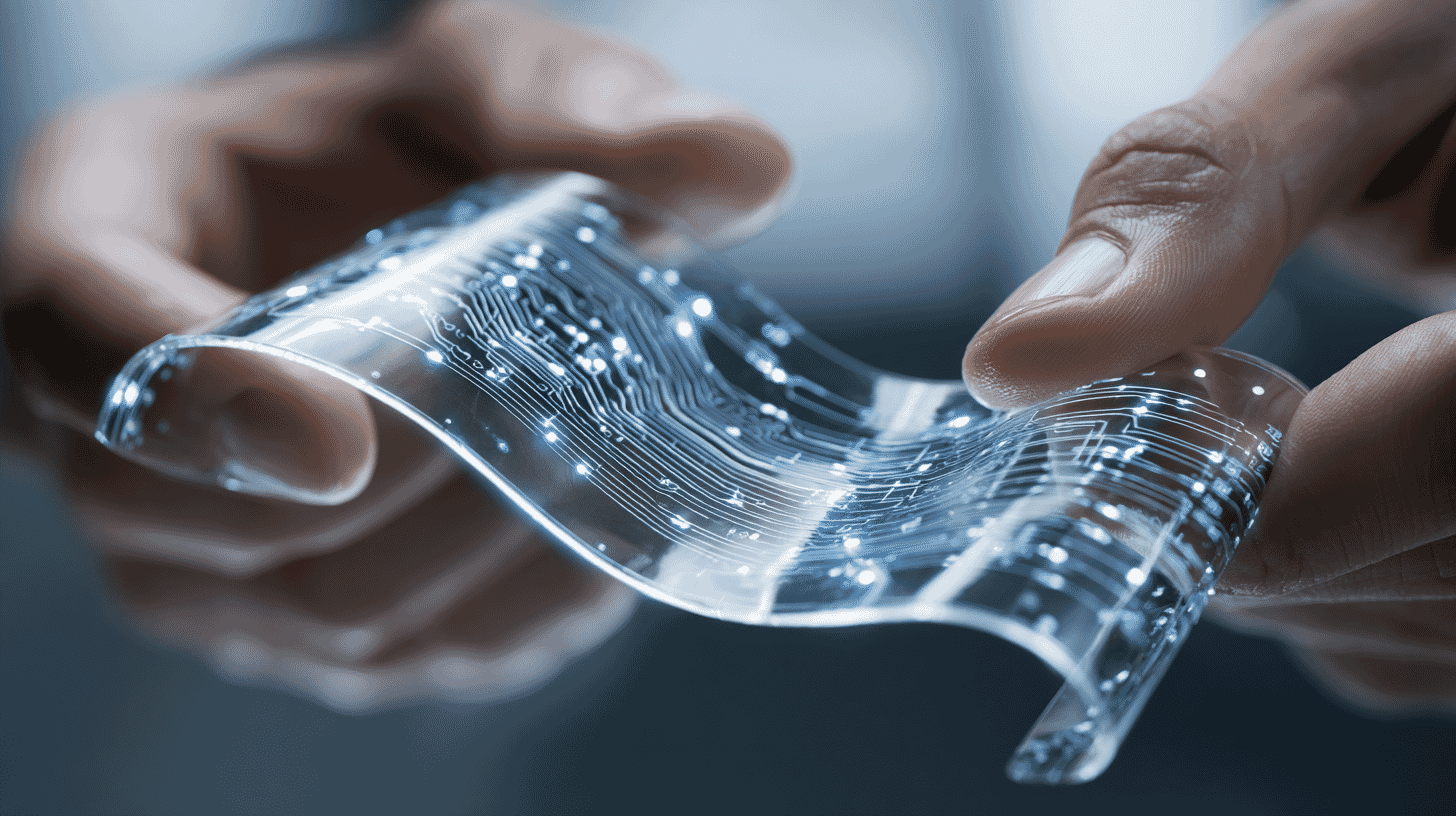
What if electronic circuits could stretch like rubber, and heal themselves when cracked? An Osaka-based circuit board manufacturer spent nearly a decade developing a "liquid metal stretchable circuit board" that has now been officially adopted as a commercial medical product. From lab prototype to market-ready biosignal electrode, here is how stretchable circuits are shaping the future.
A Circuit Board That Stretches Like Rubber
The circuit board inside your phone or laptop is a flat, rigid plate with metal pathways carrying electrical signals. It does not bend, and stretching it is out of the question.
Satosen Co., Ltd., a printed circuit board manufacturer based in Osaka, Japan, has developed technology that completely upends this paradigm. Their "stretchable circuit board" uses liquid metal to form electrical pathways on a soft elastomer (a rubber-like elastic material) sheet. The board can be stretched up to approximately 50% of its original size and maintains stable electrical conductivity through more than 250,000 stretch-and-release cycles.
The "liquid metal" used here is a gallium-based alloy. Gallium is a remarkable metal that becomes liquid at room temperature, and unlike mercury, it has very low toxicity and is considered safe for contact with the human body. Satosen's proprietary structure first creates the circuit base using silver paste, then layers gallium-based liquid metal on top to achieve a circuit that resists damage from stretching and deformation.
The second feature is self-healing. When microscopic cracks form in the wiring, the liquid metal flows into the gaps and restores conductivity. The circuit repairs itself.
How Liquid Metal Broke the Durability Ceiling
Satosen began developing stretchable circuit boards around 2016, anticipating growing demand for wearable devices. Originally a manufacturer of conventional rigid printed circuit boards, the company recognized the need for softer, more body-conforming substrates as wristwatch-type and ring-type wearable devices proliferated.
Early stretchable boards used metal paste alone for circuit formation, which led to wire breaks after just a few thousand to tens of thousands of stretch cycles. The introduction of liquid metal wiring shattered this barrier. When Satosen launched its new-generation liquid metal stretchable boards commercially in July 2024, the technology attracted significant attention within the electronics industry.
The manufacturing process differs too. Conventional board production relies on a "subtractive method" that uses large amounts of water to wash away excess metal. Satosen instead employs an "additive method" that places circuit materials only where needed. This entirely dry, water-free process reduces the number of circuit and insulation layer steps by approximately 60% and produces zero wastewater, achieving what the Japanese call "sustainable monozukuri" (manufacturing craftsmanship with minimal environmental impact).
In July 2025, Satosen delivered invited presentations at international conferences in the United States and Singapore. Laying out a concrete path from basic research to a shipping product, rather than another lab result, drew particular interest from Western manufacturers.
Onto EMG and ECG Electrodes at ATR-Promotions
In January 2026, Satosen's stretchable circuit board won its first official product adoption. The adopting company is ATR-Promotions, Inc., based in Seika, Kyoto Prefecture.
ATR-Promotions is a member of the ATR (Advanced Telecommunications Research Institute International) group. Since 2006, it has been selling compact wireless sensors, and in 2013 launched the "TS-EMG01" biosignal measurement device. The company provides affordable, high-quality instruments for measuring electromyography (EMG, electrical signals from muscles) and electrocardiography (ECG, electrical signals from the heart), serving fields ranging from healthcare and sports to product development.
In this adoption, Satosen's stretchable board was integrated as the EMG and ECG electrode material in ATR-Promotions' products. Unlike conventional disposable electrodes, the stretchable design can be applied to areas that were previously difficult to measure, such as the tiny muscles of the fingers, toes, and facial muscles, enabling evaluation of muscle activity in locations that were once impractical.
The greatest advantage of using a stretchable board as an electrode is that no heavy equipment needs to be attached to the measurement site, and wiring management is dramatically simplified. Subjects can maintain their natural movements during measurement, with significantly reduced discomfort. This is particularly meaningful for young children and elderly individuals, who may feel bothered by conventional devices and remove them involuntarily.
ATR-Promotions' biosignal measurement amplifier "AMP-151" features exceptionally high input impedance, allowing it to maintain stable measurements despite the slight resistance changes that occur when the stretchable board is stretched. Both companies continue collaborative prototype testing, pushing toward next-generation applications.
Stretchable Displays and Soft Robotics
The applications of Satosen's stretchable circuit board extend far beyond medicine and healthcare. According to the company, evaluation for mass production is progressing in several other domains.
In the stretchable display field, the technology is expected to serve as internal wiring for curved, foldable, and shape-changing displays. Signal wiring that remains stable even as screen dimensions change dramatically expands design freedom. In November 2024, LG Display unveiled a prototype stretchable display with a 50% elongation rate, a 12-inch panel that extends to 18 inches at 100ppi. Panels like that will need wiring that stretches with them.
In robotics, applications are anticipated for joints, artificial muscles, and bellows-type structures in soft robots, components that undergo significant deformation and repetitive motion. By liberating robots from the constraints of rigid wiring, this technology enables more biomimetic, fluid movements that more closely resemble those of living creatures.
A Booming Global Market for Stretchable Electronics
Satosen's technology is gaining attention against the backdrop of explosive growth in the broader stretchable electronics market. Market research projects the global stretchable and conformal electronics market will nearly double from approximately $2.99 billion in 2025 to $6.01 billion by 2030, driven by a compound annual growth rate of around 15%. Smart wearable adoption and demand for remote health monitoring are the primary growth engines.
Globally, researchers at EPFL in Switzerland have developed liquid metal fibers that remain functional when stretched to ten times their original length, targeting smart clothing applications. DuPont has introduced stretchable conductive inks for automotive displays. Competition is intensifying, but Satosen, which bills itself as the first company to commercialize liquid metal as a circuit board material in a production product, holds a significant first-mover advantage.
An Osaka SME at the World's Cutting Edge
Satosen has capital of roughly 99.54 million yen (about $660,000) and headquarters in Osaka's Nishinari Ward. A decade of accumulated work carried it from R&D to a product someone else ships. In time, its liquid metal circuits may end up in the shirts we wear, in stick-on health monitors, and in soft robots that work alongside us.
How is wearable technology and stretchable electronics evolving in your country?









Global Discussion
16 comments