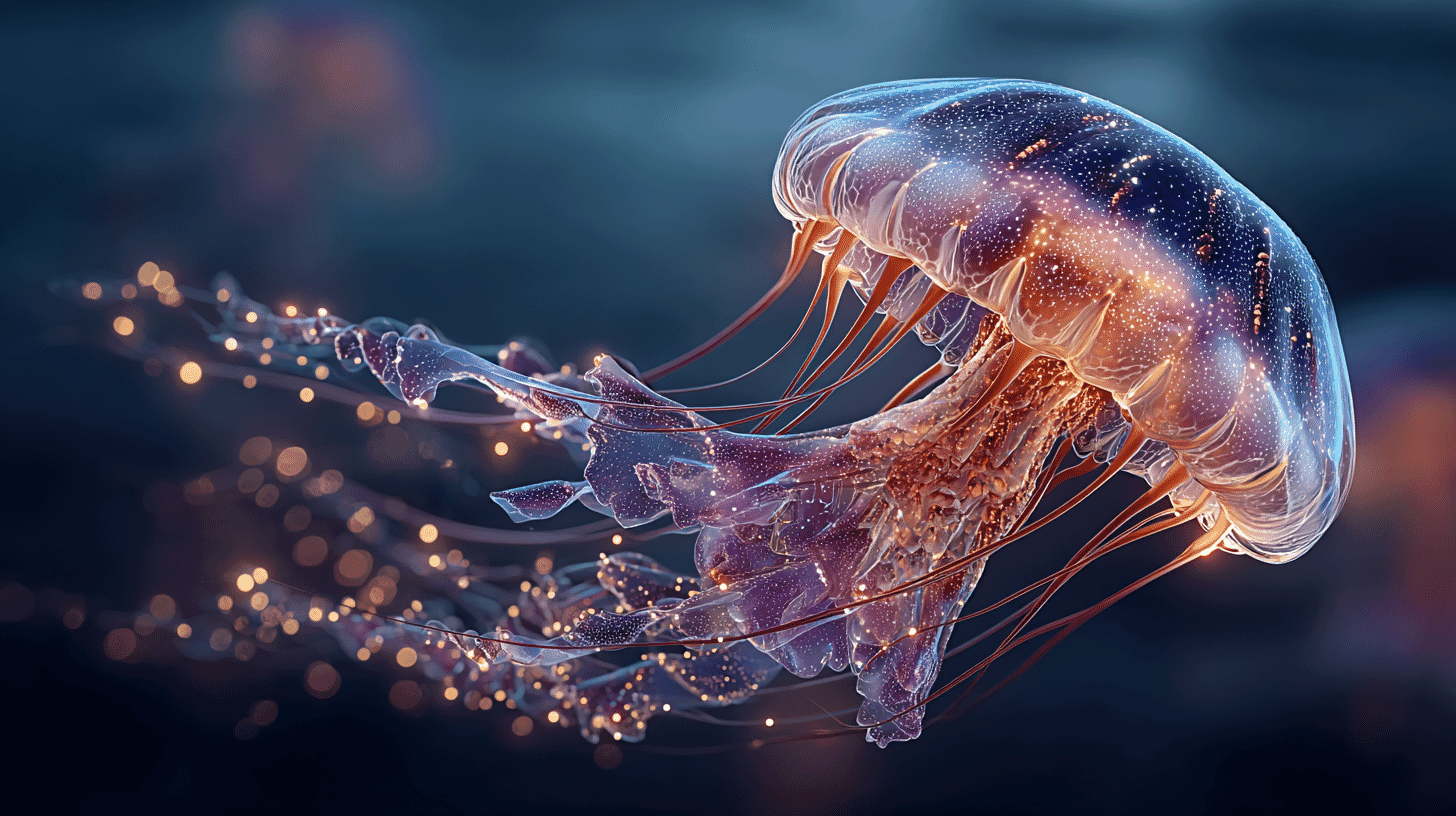
Brainless jellyfish sleep about 8 hours a day, just like us, and they even take naps. A groundbreaking discovery is overturning everything we thought we knew about why we sleep. The answer isn't "to rest our brains"; it's far more ancient than that.
The Discovery That Shocked Sleep Science
"We sleep to rest our brains." It's what most of us have always believed. And there's truth to it, sleep helps consolidate memories and flush out brain waste products. But if brain rest were the only purpose of sleep, then creatures without brains shouldn't need to sleep at all.
In 2017, three graduate students at the California Institute of Technology proved that assumption wrong. Their subject was the upside-down jellyfish (Cassiopea), a peculiar creature that sits on the ocean floor with its bell facing downward. This animal has no brain. It lacks any centralized nervous system, possessing only a diffuse nerve net, a network of neurons spread across its entire body.
And yet, it sleeps.
How Do You Prove a Brainless Animal Is Sleeping?
Since you can't measure brainwaves in an animal without a brain, the researchers used three behavioral criteria that scientists now widely accept as markers of sleep.
First, reduced activity: The jellyfish normally pulses its bell about 58 times per minute, but at night this drops to around 39 pulses. Second, decreased responsiveness: When the researchers suddenly lowered the floor of the tank during the day, the jellyfish immediately swam back down (they prefer sitting on the bottom). But at night, the jellyfish floated around in a daze for several seconds before "waking up" and swimming down, much like a person groggily reaching for their alarm clock.
The most compelling evidence was sleep rebound. When the team disrupted the jellyfish's nighttime rest every 20 minutes with water pulses, the animals were noticeably sluggish the next day, basically, they were "sleep-deprived." Importantly, the same disruptions applied during daytime had no such effect, confirming that nighttime rest was qualitatively different from daytime activity.
The story behind this discovery is charming. The three grad students hatched the idea during casual conversation and began running secret experiments without telling their advisor. As one of them put it: "When you're about to do something that sounds crazy, it's better to get data first before telling anyone." When they finally shared the results, their advisor told them to keep going.
The "Immortal" Hydra Sleeps Too
In 2020, a team at Kyushu University in Japan reported another stunning finding: the hydra, a tiny, freshwater animal barely 1 centimeter long, also sleeps.
Like jellyfish, hydra belong to the phylum Cnidaria and have no brain. Named after the many-headed serpent monster from Greek mythology, hydra are famous for their extraordinary regeneration, cut one into pieces and each fragment grows into a complete animal. They don't age, earning them the nickname "immortal organisms."
Yet even these "immortal" creatures need sleep. The researchers found that melatonin and GABA, the same chemicals that promote sleep in humans, also induced sleep-like states in hydra. While hydra lack circadian clock genes, they do possess genes that control sleep. This suggested that sleep mechanisms evolved before brains did.
January 2026: The Answer Published in Nature Communications
In January 2026, teams led by Prof. Lior Appelbaum and Prof. Oren Levy at Bar-Ilan University in Israel published their results in Nature Communications, with Dr. Raphaël Aguillon and Dr. Amir Harduf as lead authors. The work built on earlier findings from the Appelbaum lab, which had already shown in zebrafish that neurons accumulate DNA damage while awake and need sleep to recover.
Using infrared video tracking alongside cellular-level analysis, the researchers studied two cnidarians: the upside-down jellyfish (Cassiopea andromeda) and the starlet sea anemone (Nematostella vectensis).
The first result was duration. Both species sleep roughly eight hours a day, about a third of their time, the same proportion as humans. The timing differs. The jellyfish is diurnal, sleeping at night with a short nap around midday. The anemone is crepuscular, with sleep increasing from dawn through the first half of the day.
The second result was what drives that sleep. In the jellyfish, the light-dark cycle and homeostatic sleep pressure did most of the work. In the anemone, an internal circadian clock and homeostasis shared the job. The timekeeping machinery is genuinely different between the two.
The third result was the one they had in common: DNA damage accumulates in neurons during wakefulness and is reduced during sleep. Keeping the animals awake raised DNA damage and produced rebound sleep afterward. Jellyfish exposed to ultraviolet light slept longer than usual, and anemones dosed with a DNA-damaging chemotherapy drug slept about 30% longer the following night than untreated animals. Giving melatonin to promote sleep lowered DNA damage levels.
Two species, two different clocks, one shared job. What sleep was doing was not resting a brain but repairing DNA in neurons.
A 500-Million-Year-Old Maintenance System
Cnidarians first appeared on Earth over 500 million years ago, long before any creature possessed what we'd call a brain. This means sleep may have existed as a core biological function since the earliest animals developed neurons.
"Our findings suggest that the capacity of sleep to reduce neuronal DNA damage is an ancestral trait already present in one of the simplest animals with nervous systems," said Prof. Appelbaum. "Sleep may have originally evolved to provide a consolidated period for neural maintenance, a function so fundamental that it may have been preserved across the entire animal kingdom."
Think about it from an evolutionary perspective: sleeping is incredibly risky. A sleeping animal can't flee from predators, find food, or reproduce. Yet every animal with a nervous system sleeps anyway. That near-total consistency is itself the argument: this is not an optional feature.
What This Means for Human Health
This research carries direct implications for human medicine. Chronic sleep deprivation has been linked to increased risk of neurodegenerative diseases like Alzheimer's and Parkinson's. The jellyfish research helps explain why: when we don't sleep enough, our neurons can't adequately repair their DNA. Over years and decades, this accumulated damage may contribute to neuronal dysfunction and death.
Kazuhiko Kume, professor at Nagoya City University Graduate School of Pharmaceutical Sciences, makes a related point in his February 2026 book Even Brainless Jellyfish Sleep (Asahi Sensho): once you accept that brainless organisms sleep, sleep as a behavior has to predate the brain.
Octopuses, Lizards, and Cells in a Dish
The field keeps widening. Recent studies have found REM-like sleep states in octopuses and lizards. In humans REM is when we dream, so if the state is genuinely similar, something may be going on in there too.
More striking still, cultured neurons in a laboratory dish show the same low-frequency synchronized activity seen in sleeping brains. Sleep may turn out to be a property of individual cells rather than whole organisms. If so, the agreement between a jellyfish and a sea anemone is not a coincidence at all; it is what neurons do.
In Japan, the concept of suimin fusai (睡眠負債, "sleep debt") has become a major social topic, with the Ministry of Health, Labour and Welfare updating its sleep guidelines. But what jellyfish teach us is that the importance of sleep goes far beyond productivity or daytime alertness. It's about cellular survival.
What about in your country? Is "grinding through sleepless nights" considered admirable? Or is getting a full night's rest seen as common sense? We'd love to hear about sleep culture where you live.
References
- https://www.cell.com/current-biology/fulltext/S0960-9822(17)31023-0
- https://www.nature.com/articles/s41467-025-67400-5
- https://www.science.org/content/article/jellyfish-sleep-lot-us-and-same-reasons
- https://phys.org/news/2026-01-evolutionary-code-neuron-jellyfish-sea.html
- https://www.sci.kyushu-u.ac.jp/koho/qrinews/qrinews_201208.html







Global Discussion
15 comments