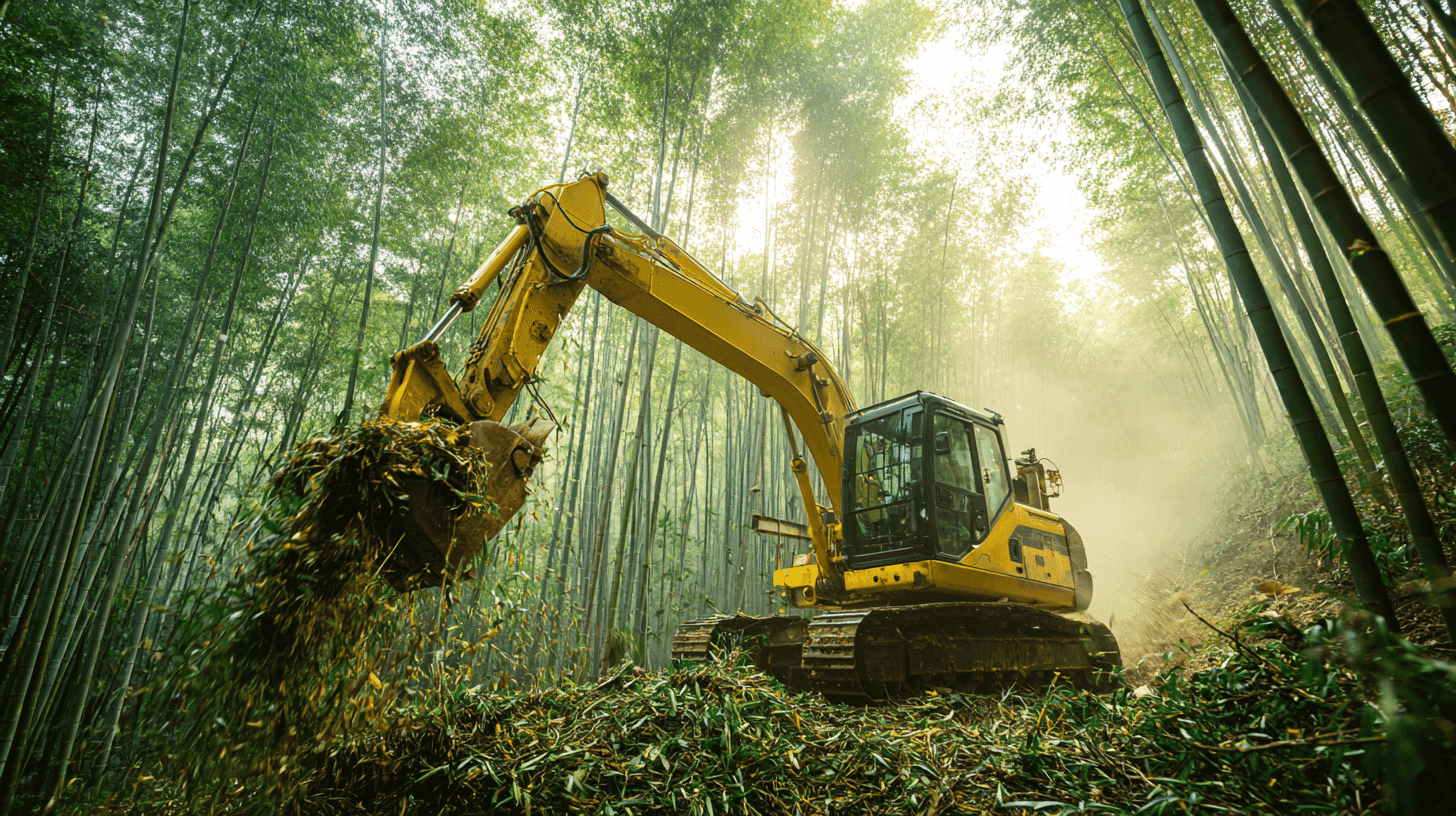
Japan has roughly 400,000 acres of bamboo forest. Once prized for everyday tools, building materials, and food, bamboo has lost its caretakers and become a "green menace" swallowing the countryside. Now an Okayama-based manufacturer is fighting back with a domestically-built mulcher that shreds bamboo, trees, and stumps in a single machine.
Abandoned Bamboo Forests: Japan's Quiet Ecological Disaster
Bamboo holds a special place in Japanese culture. Bamboo shoots (takenoko) are a beloved seasonal delicacy. Bamboo was traditionally used for everything from construction scaffolding to chopsticks and flower baskets. The famous fairy tale of Princess Kaguya begins with an old bamboo cutter discovering a tiny girl inside a glowing bamboo stalk. Bamboo groves are, quite literally, part of Japan's cultural landscape.
But that landscape is changing fast. According to Japan's Forestry Agency, bamboo forest area has reached approximately 167,000 hectares (about 413,000 acres), up from around 140,000 hectares in 1981, and still growing. Almost none of this expansion was intentional. These are unmanaged bamboo groves spreading on their own.
Three factors drove this crisis.
First, cheap imported bamboo shoots from China undercut domestic growers, removing the economic incentive to maintain bamboo groves. Second, plastic products replaced bamboo baskets, containers, and utensils that had sustained demand for bamboo timber. Third, and most critically, rural depopulation and aging left nobody to manage the groves. Japan's countryside has been losing residents for decades, and bamboo maintenance was among the first casualties.
Bamboo's Superpower Becomes Its Curse
What makes bamboo so problematic is its extraordinary growth rate. A bamboo shoot can reach over 33 feet (10 meters) in just a few months. One specimen was recorded growing nearly 4 feet (120 cm) in a single day. Underground rhizomes, root-like stems, can extend 6 to 26 feet (2–8 meters) per year, invading adjacent forests and farmland.
When abandoned bamboo groves expand, the ecological damage is severe. Dense bamboo canopy blocks sunlight, killing cedar, cypress, and broadleaf trees below. As plant diversity collapses, insects, birds, and other wildlife lose their habitats too.
The disaster risk is equally alarming. While trees like cedar and cypress send roots deep into the soil to anchor hillsides, bamboo roots only spread in a shallow layer just 4 to 12 inches (10–30 cm) below the surface. During heavy rains, entire bamboo-covered slopes can slide away, triggering massive landslides.
Abandoned bamboo groves near villages also become shelter for wild boar and deer, which then raid nearby farms, a problem known as jūgai (wildlife crop damage). Japan's Ministry of Agriculture estimates annual wildlife crop damage nationwide at approximately ¥16 billion (around $106 million).
Taguchi Industrial's Answer: The Birth of "TakeKaruGon"
Enter Taguchi Industrial Co., Ltd., a construction machinery attachment manufacturer headquartered in Okayama City, western Japan. Founded in 1962, the company specializes in attachments that mount on hydraulic excavators for demolition, forestry, and land management work.
Taguchi had already scored a hit with "KusakaruGon", a mulcher attachment designed for grass and brush clearing. The name is a playful combination of kusa (grass), karu (to cut/mow), and gon, a suffix suggesting power and toughness. Following this naming convention, the company launched "TakeKaruGon" in February 2026, take (bamboo) + karu (cut) + gon. Simple, catchy, and unmistakable.
TakeKaruGon is a forestry mulcher attachment for hydraulic excavators. Using specialized blades, it can shred bamboo, large-diameter trees, and even stumps. It has a cutting width of 1,140 mm (about 45 inches) and weighs 1,380 kg (approximately 3,042 lbs). It operates on a single hydraulic line with no drain piping required, meaning it can be mounted on a wide range of excavator brands and models, a major advantage for contractors with mixed equipment fleets.
Three Key Innovations That Set It Apart
Remote-Controlled Shutter System
TakeKaruGon's standout feature is a shutter that the operator can open and close from inside the cabin using switches and foot pedals. With the shutter open, the machine can knock down standing bamboo and trees while moving forward. Close the shutter, and it safely shreds remaining bamboo and stumps while preventing debris from scattering. Operators never need to leave the cab, a significant safety and efficiency advantage.
Four-Sided Tough Blades
The blades can be used on all four sides, so when one side wears down, you simply rotate to the next. They attach with bolt-on fittings for quick field replacement. "Bite limiters", thin metal plates positioned around the rotor, protect the rotor core from damage, significantly extending the machine's service life and reducing maintenance costs.
Quick-Change Compatibility with "One-Catch Plus"
TakeKaruGon is compatible with Taguchi's proprietary "Fully Hydraulic One-Catch Plus" quick-hitch system, Japan's first fully hydraulic quick coupler. This allows operators to swap between KusakaruGon (for grass) and TakeKaruGon (for bamboo) without leaving the excavator cabin. One machine, two roles, this dramatically increases operational flexibility on job sites where both grass clearing and bamboo demolition are needed.
Government-Certified Technology
The KusakaruGon series, including TakeKaruGon, is registered with NETIS (New Technology Information System), operated by Japan's Ministry of Land, Infrastructure, Transport and Tourism (registration number: CG-240010-VE). NETIS is a system that evaluates and catalogs innovative technologies for use in public works projects. Registration signals that the technology has been officially vetted for reliability and practical value. For local governments commissioning abandoned bamboo forest clearance as public works, NETIS-registered equipment receives preferential consideration, giving TakeKaruGon a significant leg up in market adoption.
Beyond Shredding: Japan's Search for Bamboo's "Second Life"
TakeKaruGon has the potential to revolutionize the physical removal of abandoned bamboo. But solving the bamboo crisis also requires creating demand for the harvested material, giving bamboo somewhere useful to go after it's cut down.
Across Japan, creative solutions are emerging. A nationwide movement turns overgrown bamboo shoots into menma (seasoned bamboo used as a ramen topping), with regular "Menma Summits" bringing producers together. In Miyazaki Prefecture, a company has developed bamboo-based livestock feed called "Sasa Silage" that reportedly improves meat quality in cattle and pigs. In Kagoshima, Japan's largest bamboo-producing prefecture, one firm manufactures paper made from 100% domestic bamboo. Others are exploring bamboo as biomass fuel for power generation.
When efficient clearing technology like TakeKaruGon combines with these new uses for bamboo, the abandoned bamboo forest problem can transform from an environmental burden into a circular local resource. The bamboo chips produced by mulching can also be returned directly to the soil as compost or soil amendment material.
Your Country's Invasive Plant Problem?
Japan's abandoned bamboo crisis is essentially a local version of a global phenomenon: when humans stop managing landscapes, aggressive plants can quickly take over. Australia battles Japanese knotweed. The United States fights kudzu, ironically, a plant of Japanese origin, that smothers forests across the Southeast. Parts of Europe struggle with giant hogweed and rhododendron invasions.
Taguchi Industrial's TakeKaruGon represents Japan's monozukuri (craftsmanship) tradition applied directly to an environmental crisis. Does your country face similar issues with unmanaged vegetation threatening ecosystems or communities? What technologies or approaches are being used to combat them?







Global Discussion
13 comments