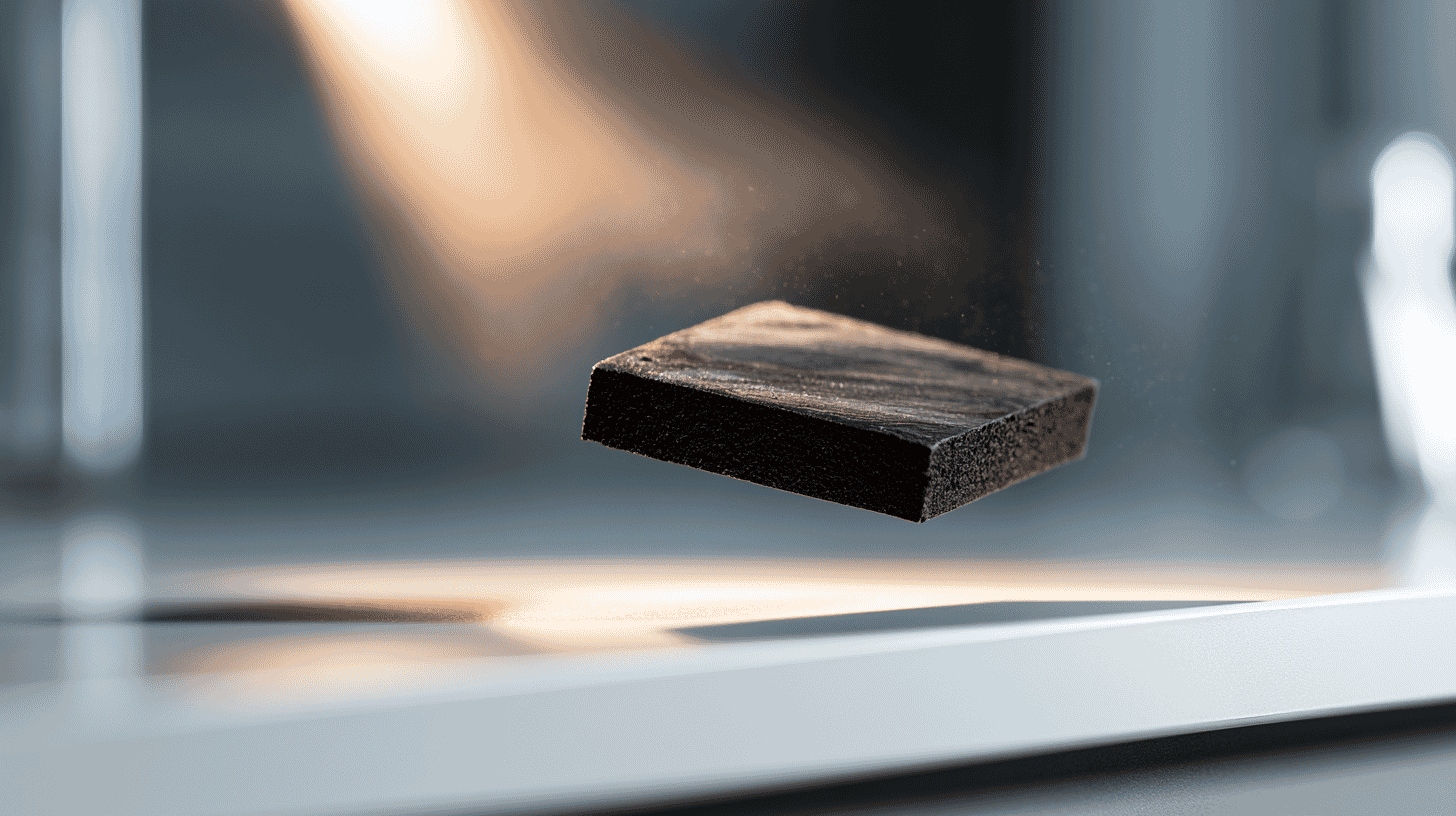
🪄 No, it's not AI-generated. No wires, no magnets, no fans. A dark, sponge-like slab the size of a paperback rises gently into the air the moment a lamp shines on it. The clip has racked up 1.8 million views in a week, and the people watching keep asking the same question: "Wait, is Japan actually inventing a flying carpet?"
The short answer is: kind of, but not the one Aladdin had in mind.
The viral clip that broke physics intuition
On May 7, Nagoya University's official X account (@NagoyaUniv_info) posted a short video shot inside one of its engineering labs. The caption was almost defensively plain: "This object that floats when heated. It's real. Not a fake video." The footage shows a black, porous block sitting on a lab bench. A researcher flicks on what looks like an ordinary work lamp. Within seconds, the slab lifts off and hovers in midair, drifting like a balloon that's shed its string. No fan. No magnet. No visible mechanism.
Within a week the post had cleared 1.8 million views, with clips and reposts bouncing across TikTok and Bluesky. By May 13, Fuji TV's evening program It! was running the footage as a featured segment, chasing, rather than starting, the virality.
The natural response, and a lot of viewers said it out loud under the original post, was to assume the footage was faked with AI. It wasn't. The slab is real, and what it does is grounded in physics that's been in textbooks for two and a half thousand years. The university felt the need to caption it "not a fake video" because that's the first thing modern timelines now ask.
Meet the man behind the floating slab
The material was developed by Tomonaga Ueno, an assistant professor at Nagoya University's Graduate School of Engineering. Ueno has been chasing one specific dream for over a decade: build a solid material lighter than air itself.
The result is a piece of engineering that almost reads like a contradiction. A block of his material weighs about 0.05 grams, light enough that it won't crush a single cherry blossom petal placed beneath it. Nagoya University describes it as "0.5 to 10 times lighter than air", with the density tunable through the mix and the process; it is less dense than expanded polystyrene. For comparison, that puts it in roughly the same neighborhood as the aerogels NASA has used as cosmic dust collectors, but optimized for a very different trick.
How a "flying carpet" actually flies
The physics is not magic, and Ueno is the first to say so. "It's air-thin," he later told Fuji TV's It! in the follow-up segment, "and in principle, it floats by the same mechanism as a hot air balloon."
Here's what's happening inside the slab. The material is made by taking carbon nanotubes, hollow single-atom-thick cylinders of carbon, discovered by Japanese researcher Sumio Iijima in 1991, and dispersing them in water along with a cellulose binder. The mixture is then freeze-dried, which leaves behind a foam riddled with microscopic pores. Think of it as the world's most precisely engineered sponge, except the holes are nanoscale.
Carbon nanotubes happen to be exceptional absorbers of light. When the lamp switches on, the slab soaks up the photons and converts them to heat almost instantly. The trapped air inside its pores warms up, expands, and gets pushed out. What's left is a structure full of less-dense hot air, Archimedes' principle, the same logic that lifts a Montgolfier balloon, just at miniature scale and triggered by light instead of a flame.
Switch the lamp off, and the slab cools and settles. Switch it on, and it rises again. The team demonstrated this on-off control in a 2021 paper in Scientific Reports.
"But can I ride it?" The question everyone asks
This is the part where the internet's hopes meet a wall of practical engineering. Ueno is candid about it. "If you're thinking about putting a person on it, it's not that simple," he told Fuji TV. "But making it carry slightly heavier objects, that's well within what we can imagine for the future."
The bottleneck is straightforward: the lift comes from the difference in density between the heated interior air and the room around it. To carry meaningful weight, you'd need an enormous volume of the material, plus a powerful and continuous heat source. A human-scale carpet is, charitably, decades away, if it's possible at all.
What is on the table is something arguably more useful, just less Instagrammable.
Why aerospace and EV companies are paying attention
The flying-carpet party trick is, for Ueno, a way of demonstrating just how extreme the material's lightness is. The real prize is what else the same structure can do once you stop trying to make it levitate.
By tweaking the recipe, the team can give the material useful side jobs: thermal insulation, sound absorption, electromagnetic-wave shielding. All three are problems that get more expensive to solve as a vehicle gets lighter and quieter. That makes the technology a natural fit for the industries Japan happens to be elbow-deep in.
- Electric vehicles need insulation around the battery pack and quieter cabins, both without adding weight that eats range. A carbon-nanotube foam can do both jobs at a fraction of the mass of conventional foams.
- eVTOL aircraft, the so-called "flying cars" that made headlines at the 2025 Osaka Expo, face a hard physics ceiling on payload. Every gram of insulation or sound-dampening saved is a gram of cargo or battery added.
- Large delivery drones are already running into noise complaints in urban tests. Ueno's group has a research thread specifically on muffling propeller noise with the material.
- Spacecraft care about electromagnetic shielding for sensitive electronics, and they care intensely about every kilogram launched.
In other words, the "flying carpet" demo is a recruiting tool. What companies actually want is a black foam that quietly cuts weight, heat, and noise out of their products.
From lab to startup: enter Sora Material
The transition from "cool lab demo" to "thing you can buy" is where most Japanese university research stalls. Ueno decided not to let that happen.
In April 2024, he co-founded a Nagoya University spinout called Sora Material, sora meaning "sky" in Japanese, to commercialize the technology. The CEO is Tomoki Osato, a former JAXA researcher who has worked on carbon nanotube composites for space applications and who, in a detail too on-the-nose to invent, was the pilot for his university's human-powered aircraft team. Ueno serves as CTO.
The company is based at STATION Ai, the new innovation hub that opened in central Nagoya in October 2024 and is now Japan's largest open-innovation campus. Its commercial material is trademarked SoramateX™. In December 2024, less than nine months after launch, Sora Material won the ILS Startup AWARD at the Innovation Leaders Summit in Tokyo. By April 2026, the material was being featured on the Japanese Prime Minister's Office YouTube channel as part of an "Innovative Materials From Japan" international PR series, meaning the viral May clip arrived after months of quiet but steady official validation, not in isolation.
The roadmap, according to public materials filed for a national R&D program, is to harden the material against real-world conditions, flame resistance and environmental durability, and prove its performance inside actual aircraft and vehicles, in partnership with Tohoku University, Chubu University, and carbon-nanotube specialist Meijo Nano Carbon.
The unglamorous truth about "magic" materials
It's worth slowing down on one thing. Ultralight carbon aerogels are not a Ueno invention in the broadest sense, researchers in China, the US, and elsewhere have been making aerogels that fall below the density of air for years, with similar light-driven levitation demos in journals going back to the late 2010s. What Ueno's lab has done is engineer the material to be functional, strong enough to hold its shape, tunable enough to absorb sound, block electromagnetic waves, or insulate against heat, depending on the recipe, and to push it toward a price point and a process where industry can actually use it.
The viral video is doing the work that viral videos always do: it's compressing a fifteen-year research arc into eight seconds of "that can't be real." It is real. It just won't be carrying anyone to work.
What it might do is sit, invisibly, inside the wall of the next quiet EV cabin you sit in, or inside the next delivery drone that doesn't keep your neighborhood awake.
In Japan, the reaction online has split roughly down the middle: dreamers thrilled that a chunk of childhood fantasy turns out to have a real physics underneath it, and skeptics demanding to know when it'll do something more useful than hover over a desk. Both reactions feel earned. Has anything from your country's research labs gone viral lately for looking like science fiction? Tell us what made you do a double-take.
References
- Nagoya University official X account (the May 7, 2026 post)
- Yahoo! News Japan: coverage of the "flying carpet" (Japanese)
- YouTube: levitation demo of the ultralight material
- Nagoya University magazine: a material lighter than air (Japanese)
- Scientific Reports (2021): light-driven levitation
- Sora Material Inc. official site (Japanese)
- PR TIMES: Sora Material press release (Japanese)
- Chizai Zukan: the ultralight material that floats (Japanese)
- STARTUP DB: Sora Material Inc. (Japanese)
- J-Stories: the ultralight material out of Nagoya









Global Discussion
4 comments