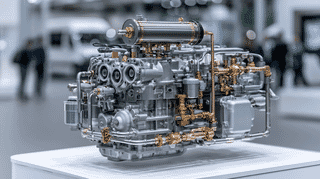
Ammonia burns slowly and needs about 500 times more ignition energy than iso-octane. Daihatsu turns part of it into hydrogen on the car. Why it starts with kei cars, and which problems it still lists as open.
On October 1, Nidec named its conventional management approach, built on expansion in every direction and short-term targets, as an internal cause of a ¥632.1 billion writedown, and agreed to sell a unit to Carlyle.
Bridgestone left F1 in 2010 and lost a bid to return in 2023. From December it supplies every Formula E car, on tyres it says are 65% recycled and renewable, a figure that partly relies on mass-balance accounting.
Prelude, Supra, Primera, Pajero: Japanese carmakers keep reviving retired nameplates. Four forces explain it, from trademark law and the EV-era heritage premium to a 1988 US import rule still moving prices in Japan.
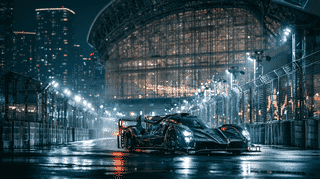
Japan's first Formula E night race had Nissan racing as a works team and Yamaha building the powertrain inside another team's car. Those roles are converging.
Kuroda Precision holds about 30% of the global market for EV drive motor-core dies. The 100-year-old firm now bets on amorphous alloy and cobalt-heavy permendur, and on a supply chain shaped by geopolitics.
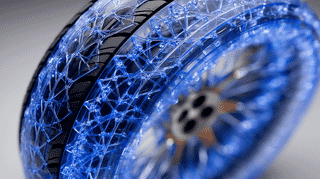
Bridgestone's airless AirFree tire is now in permanent service on an autonomous shuttle in Higashiomi, Shiga, a national first. How its puncture-proof resin-spoke design works, why driverless and MaaS fleets need it, how it contrasts with Michelin's Uptis strategy, and whether it's really Moon-bound.
Dysprosium and terbium, essential to EV magnets, were China's one unbroken monopoly. In 2025, Australia's Lynas, backed by Japan since 2011, produced them outside China for the first time. What it means, and what it doesn't.
In May 2026 Toyota canceled the Lexus LF-ZC, its next-gen EV—but it killed the car, not the tech. Why investment in gigacasting and solid-state batteries continues, compared with Tesla's own gigacasting retreat.
On May 29, 2026, Mitsubishi unveiled a mid-to-long-term vision reviving the Pajero after seven years and turning it into a series. With a ~1 trillion yen ($6.3B) investment, a hybrid pivot, and Nissan-built US vehicles to dodge tariffs, the comeback rides a global wave of heritage-SUV revivals.
China's Chery and Japan's Autobacs are among five companies behind EMTA, a new kei-class EV brand planned for 2027. Why Japan's open market looks nothing like the US or EU.
Mazda launched the third-generation CX-5 in Japan on May 21, 2026, starting at 3.3 million yen (around $20,800). With 5 million sold globally, this redesigned SUV is Mazda's bet on hybrids and combustion as the EV boom cools, and how it stacks up against Toyota RAV4, Honda CR-V, Tesla, and BYD.
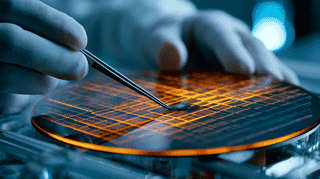
Kyoto University associate professor Mitsuaki Kaneko is commercializing SiC-based mixed-signal LSIs that work where silicon fails. His complementary JFET approach targets ADC samples in 2028-2029, opening a niche the big five SiC power players have largely ignored.
A black, sponge-like slab that floats with just lamp light has racked up 1.8 million views in a week. Developed at Nagoya University by Tomonaga Ueno, the carbon-nanotube aerogel is lighter than air and could quietly reshape EVs, eVTOL aircraft, drones and spacecraft. Here's how it actually works, and why the startup Sora Material thinks it's an industrial workhorse, not just a viral trick.
In spring 2026, Honda wrote off roughly $10 billion in EV development. That same season, US ITER closed out the supply of ITER's 1,000-tonne central solenoid, the UK's Pulsar Fusion ignited the first plasma inside a fusion rocket engine, and Kyoto Fusioneering pushed on with its integrated fusion fuel cycle test facility in Canada. Stack the candidates in watt-hours per kilo and the picture is brutal: nothing beats gasoline in a form you can put in a car, except one category up, where fusion sits at 7.8 million times the density. Win the bet and you unlock effectively free electricity, working climate reversal, Mars in two months, lunar helium-3, and the solar system as a shipping route. Honda's mistake alone covers nearly 40 percent of ITER's budget. Maybe it's time to stop arguing about EVs and just go build the sun.
Rohm posted a record 158.4 billion yen net loss for fiscal 2026 after writing down 193.6 billion yen on SiC power semiconductor assets. CEO Katsumi Azuma called it clearing out the pus, a blunt admission that Japan's biggest SiC bet was mistimed. With Wolfspeed out of Chapter 11 but smaller, Chinese rivals cutting wafer prices to a third, Denso's takeover approach withdrawn and a three-way merger under discussion, the silicon carbide gold rush has hit its reset moment.
Honda reported a 423.9 billion yen net loss for the year to March 2026, its first since listing in 1957, alongside 1.58 trillion yen in EV-related charges, most of them non-cash. The same day it unveiled a turnaround plan: 15 new hybrids by FY2029 and a 1.4 trillion yen operating profit target. We set it against Toyota's multi-pathway bet, the Tesla and BYD lead changes of 2026, and Hyundai-Kia's quiet rise.
Subaru cut its FY2026 operating profit forecast by 900 billion yen to just 40 billion yen, a 90% year-on-year plunge announced May 11. Beyond US tariffs, a North American cold wave, Middle East shipping disruptions, and EV asset impairment from Trump's environmental rollback all hit at once. Why does Subaru—with 80% North America sales reliance—suffer most among Japanese automakers?
Honda's Zero EV brand launches its first model—the 0 Alpha compact SUV—in India by early 2027, exporting back to Japan. After cancelling three North American EVs and posting record losses, Japan's #2 automaker is betting on Rajasthan over Ohio. We unpack the gamble, the rivals waiting in India, and why this could rewrite Japanese EV strategy.
Nissan, in the midst of its Re:Nissan recovery plan, will cut about 900 European jobs (10% of the regional workforce) and consolidate two production lines into one at its UK Sunderland plant. With utilization at roughly 50%, China's Chery is in talks to take over the freed-up line. We unpack what this means alongside Volkswagen and Stellantis restructuring, against the backdrop of Chinese EV pressure squeezing Europe's auto industry.