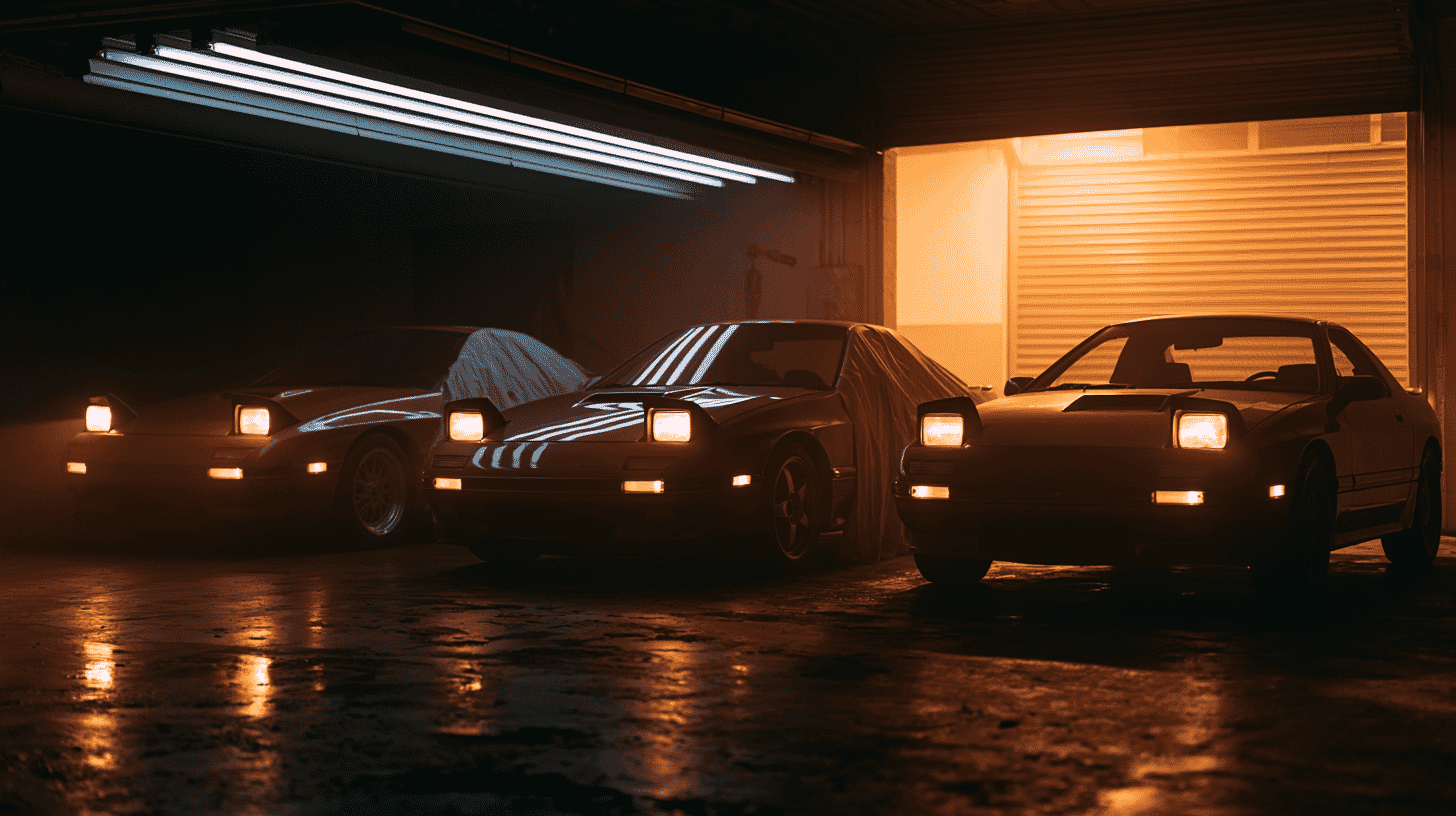
🚗 Names that died out decades ago keep coming back to Japanese showrooms. Prelude, Supra, Primera, Pajero, with Celica and RX-7 circling in the rumor mill. It reads like nostalgia, and partly it is. But four quite different forces are pushing in the same direction, and one of them is a 1988 American law that still sets prices in Japanese used-car lots today.
An unused name is an exposed name
Under Article 50 of Japan's Trademark Act, a registered trademark left unused in Japan for three consecutive years can be challenged by anyone at all. If the owner cannot prove use, the registration is cancelled for the goods in question. The law also closes the obvious escape hatch, so use hurriedly started after the owner catches wind of a challenge does not count as evidence. Filing such a challenge is not expensive either, running about 55,000 yen (roughly $350) for a single class, according to trademark practitioners.
That is one half of the pressure. The other half is scarcity. Writing for WEB CARTOP in March 2026, journalist Yoichiro Watanabe laid out the practical problem: a source with experience registering car names told him that almost every word that sounds right on a boot lid has already been claimed by somebody, and the supply of unregistered options with a decent ring to them is thin. A name the company used before is already registered, already paid for, and already yours.
None of this makes trademark law the reason a nameplate comes back, and no Japanese manufacturer has said it is. Dormancy is survivable, too. Supra went unused from 2002 to 2019, and the Japanese trademark firm Far East Patent, checking the public register, found Toyota renewing the registration in 2006 and again in 2017. Renewal keeps the paperwork alive; it does not close the three-year window. Which is why the archive is the first place a product planner looks.
Heritage turned out to be for sale
A wave of new carmakers has arrived over the past decade, most of them electric-first. BYD and a long tail of Chinese startups can build factories, hire engineers and outspend incumbents on software. What they cannot build from scratch is a badge that has been sitting in someone's memory since 1978.
Except that heritage does get bought. MG began in Britain in 1924; when MG Rover collapsed in 2005 its assets went to Nanjing Automobile, and by 2007 the marque belonged to SAIC. Business Insider Japan argues that this doubleness, a British brand's historical memory resting on a Chinese industrial base, proved decisive for Chinese carmakers moving into Europe, and that MG's assignment was never to sell Chinese cars but to open a door where buyers did not have to dwell on where the car came from. So a badge can be bought. What is not on the market is a name still held by a company that never went under.
Japanese makers have started treating that as an asset in its own right. Honda launched Honda Heritage Works in December 2025, reissuing discontinued parts and restoring first-generation NSXs. Nissan's NISMO Heritage does the same for second-generation Skyline GT-Rs. Mazda's Classic Mazda programme remakes components for the RX-7 and restores original Roadsters. Toyota runs GR Heritage Parts.
Reviving a nameplate is the marketing end of the same logic. Mitsubishi is doing it with the Pajero, an off-roader that ran through four generations and more than 3.25 million sales in over 170 countries before Japanese production stopped in 2019; as of August 2026 the new one is scheduled for a world premiere in the autumn. But the cleanest example of the pattern is also the strangest.
On June 4, 2026, at the tenth Philippine International Motor Show, Nissan unveiled the Primera EV, resurrecting a name last used around 2005. The car underneath is the N7, an electric sedan developed by Dongfeng Nissan, the company's Chinese joint venture, built in China for export. A Chinese-developed EV, wearing a Japanese name from twenty years ago, launched in Southeast Asia. WEB CARTOP summed up the reaction of longtime fans bluntly: this is not the Primera they had been waiting for.
A 1988 American law is setting prices in Japanese used-car lots
The next force is one overseas readers are personally tangled up in.
US federal rules make it very hard to register a vehicle that was never built to American safety standards, which covers most right-hand-drive Japanese cars. The exception is age: a vehicle at least 25 years old, counted from its month of manufacture, is exempt from the Federal Motor Vehicle Safety Standards. Enthusiasts call it the 25-year rule.
It exists more or less by accident. Through the 1980s a large grey market in European cars had grown up in the United States, with WEB CARTOP putting 1985 imports at more than 60,000 vehicles. Mercedes-Benz's US arm and other official importers lobbied Congress, arguing the cars did not meet American safety standards. The result was the Imported Vehicle Safety Compliance Act of 1988, which flattened the grey market. Collectors objected that historically significant cars should not be swept up with the rest, and the 25-year exemption went in as the compromise. A law aimed at German saloons became, nearly four decades later, a pipeline for Japanese sports cars.
WEB CARTOP reports that used prices for cars like the Skyline GT-R, the A80 Supra and the Lancer Evolution have climbed to several times, and in some cases more than ten times, what they once were. Kuruma News offers a concrete case: the R32 Skyline GT-R cleared the 25-year line in 2014, and where high-mileage examples could be picked up in the one-million-yen range (about $6,400) in the early 2010s, the average was running near seven million yen (about $45,000) by the start of 2025.
The 2026 door opened on cars built in 2001, among them the DC5 Integra Type R and the Lancer Evolution VII. Japan's own tax code pushes the same way: petrol cars past their thirteenth year pay roughly 15 percent more in annual vehicle tax, while several European countries give historic vehicles a break instead.
American demand thins Japanese supply, prices climb, and the badges on those cars start to look a good deal more valuable to the companies that still own them.
The name came last
Laid out like that, the whole business sounds purely calculated. The Prelude complicates it.
Honda put it back on sale on September 5, 2025, twenty-four years after the fifth generation ended in 2001, priced at 6,179,800 yen (about $39,000) with a domestic plan of 300 cars a month. In an interview published on Honda's corporate site that July, development leader Tomoyuki Yamagami said "the project did not start as a Prelude revival." The brief was a hybrid sports car for the electrification era. Only while working through what a sports car should even be in the coming years did the team look back across Honda's own history, land on the Prelude, and decide the name fitted. Prelude means the piece that opens a work, and the car was meant to open an era. The badge arrived at the end of the reasoning rather than the start of it.
It worked commercially, too. LEON reported cumulative orders of roughly 2,400 units by October 6, 2025, about eight times the monthly plan.
When the badge is too heavy
Honda's second-generation NSX arrived in 2016 as a three-motor hybrid supercar. Technically it was extraordinary. Commercially it was not. The original NSX sold around 18,000 units worldwide across fifteen years; the second had managed 2,558 by the time Honda announced the end in 2021, and production stopped in December 2022. The name promised the first NSX. Buyers were handed something else entirely.
The Prelude has a milder version of the same problem. Bubble-era Japan knew it as the definitive "date car" for young couples, and the phrase stuck to the new one on contact, to the point that Nikkei Business ran a piece in February 2026 explaining that a date-car revival was not the goal. When a headline has to argue with your product's own reputation, the name is doing work nobody asked it to do.
A badge is an asset. It is also a debt, and both come due on the same morning.
What the fans are reading as evidence
Back to the rumours, then. Mazda's next rotary sports car has been reported as arriving around 2027 as the effective successor to the RX-7, though Response notes that Mazda has announced neither the name nor the production specification. Toyota's Celica is a similar case with a louder paper trail. At Rally Japan in November 2024, Executive Vice President Hiroki Nakajima told a Best Car stage session that Toyota would do it, and according to Kuruma News, an application for "GR CELICA" was filed with Brazil's industrial property office on January 15, 2025, in Toyota's own name. There is still no official launch announcement.
What enthusiasts now treat as proof is not spy shots. It is trademark filings.
Four forces, then, landing in the same place: a law that leaves an idle name exposed, a market where history became something you can buy, an American rule from 1988, and, now and then, an engineering team that finishes a project and works out what it built.
What name from your country's past would set off this kind of noise if someone dug it up?
References
- https://global.honda/en/stories/170-2507-6th-prelude.html
- https://response.jp/article/2025/09/04/400479.html
- https://www.leon.jp/cars/317668
- https://www.webcartop.jp/2026/03/1833931/
- https://fareastpatent.com/trademark_topic/supra-trademark.html
- https://www.webcartop.jp/2026/05/1845655/
- https://www.jpo.go.jp/system/trial_appeal/shubetu-shohyo_torikeshi/document/index/shiyou-risshou.pdf
- https://www.congress.gov/bill/100th-congress/house-bill/2628
- https://kuruma-news.jp/post/996505
- https://kuruma-news.jp/post/859449
- https://www.mlit.go.jp/jidosha/content/001993314.pdf
- https://response.jp/article/2026/06/05/412299.html
- https://response.jp/article/2026/07/24/414394.html
- https://bestcarweb.jp/news/scoop/1045881
- https://kuruma-news.jp/post/875029
- https://bestcarweb.jp/feature/column/1588997
- https://www.webcg.net/articles/-/53090
- https://www.businessinsider.jp/article/2604-why-chinese-automakers-grow-in-europe/
- https://www.mitsubishi-motors.com/jp/newsroom/newsrelease/2026/20260529_2.html
- https://business.nikkei.com/atcl/gen/19/00804/020300001/
- https://www.netdenjd.com/articles/-/253644








Global Discussion
4 comments