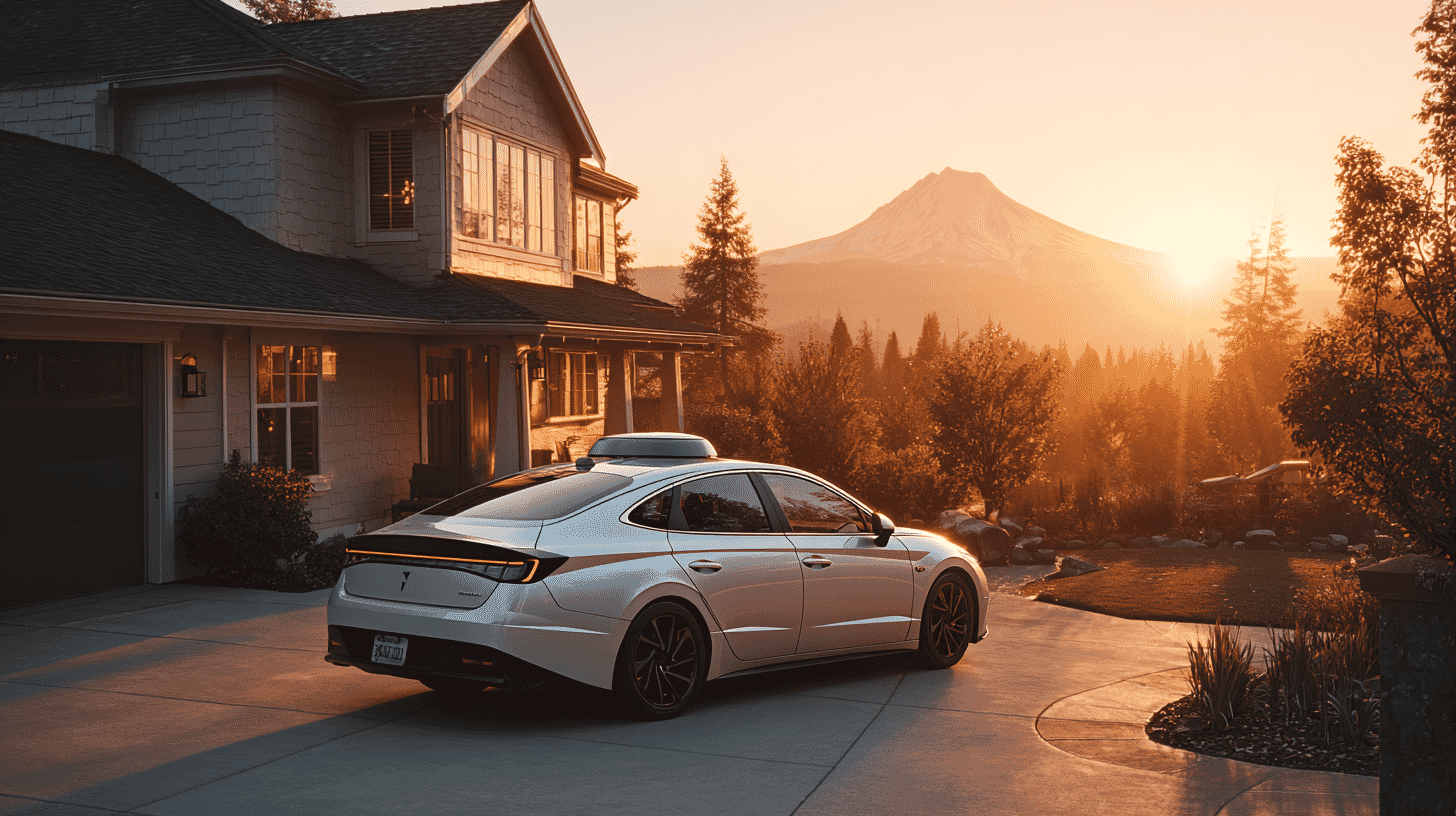
Imagine sipping coffee on your commute while your hands stay off the wheel, not in a taxi, but in a car you actually own.
On April 30, 2025, Toyota Motor Corporation and Alphabet-owned Waymo announced a preliminary strategic partnership to accelerate the development and deployment of autonomous driving technology. The twist? Waymo has so far been strictly a robotaxi operator, "hail a ride, get in, ride." This new deal opens the door to something radically different: Waymo's fully autonomous technology embedded in Toyota cars that ordinary people actually buy and park in their driveways. Here's what the deal means, how it compares with Tesla's FSD and China's Baidu Apollo, and whether the world's largest automaker is quietly pivoting its entire autonomy strategy.
What Actually Got Announced: Reading the "Preliminary Agreement"
The joint announcement from Toyota and Waymo used cautious language ("preliminary agreement," "explore collaboration"), but three pillars are clear.
First, co-development of a next-generation platform for personally owned vehicles built around Waymo's autonomous technology. Second, construction of a new autonomous vehicle platform that combines Toyota's vehicle-manufacturing expertise with Waymo's self-driving AI. Third, Woven by Toyota, Toyota's software innovation arm in Tokyo's Nihonbashi, joining as Toyota's strategic enabler.
Toyota Executive Vice President Hiroki Nakajima said the goal is to integrate Waymo's technology into Toyota vehicles to improve safety and mobility. Waymo co-CEO Tekedra Mawakana went a step further, suggesting "integration of Toyota vehicles into the Waymo One ride-hailing fleet is also in scope." That's the key nuance: this isn't a one-way street. Waymo tech flows into personally owned Toyotas, and those same Toyotas may also flow back into Waymo's robotaxi network.
Who Is Waymo, Again? The Quiet Winner of the Robotaxi Race
For readers outside the US, Waymo is worth a quick recap.
Waymo started in 2009 as Google's "Chauffeur" self-driving project, spun out of Alphabet as a separate company in 2016, and launched the world's first commercial robotaxi service in Phoenix, Arizona, in 2018. It now runs paid, driverless rides in San Francisco, Los Angeles, Phoenix, Austin, and Atlanta, with Miami becoming the sixth market in January 2026.
The scale numbers are striking: more than 250,000 paid trips per week at the time of the announcement (over 450,000 by the end of 2025) and tens of millions of fully autonomous miles. By Waymo's own published data, the company's vehicles are involved in 81% fewer injury-causing crashes than the human-driver benchmark in the areas where they operate. Achieving SAE Level 4 (full autonomy within defined areas, with no human in the driver's seat) at commercial scale is something only a handful of companies have pulled off, Waymo and Amazon-owned Zoox among them.
But Waymo has always had one glaring weakness: it can't build cars. Until now, it has been retrofitting production vehicles (Chrysler Pacificas, Jaguar I-Paces, and soon Hyundai IONIQ 5s), bolting its sensor arrays and computers onto cars designed by others. Mass production, quality control, a worldwide service network: these are exactly what Toyota has spent 60 years building.
Tesla vs Waymo vs Baidu: Three Philosophies of Autonomy
Self-driving technology has split into roughly three schools of thought. Understanding them is key to seeing what Toyota is actually buying into.
The Waymo Approach: Sensor Redundancy + Detailed Mapping
Waymo's sixth-generation vehicle carries 13 cameras, 4 LiDAR sensors, and 6 radar units (down from 29 cameras and 5 LiDAR on the fifth-generation system). LiDAR, which uses pulsed laser light to measure distance, gives extremely accurate 3D depth information but is expensive. It still works in darkness or bad weather where cameras struggle. Combining sensor types is designed to catch perception errors through redundancy: if one sensor misreads the scene, the others cross-check it. Waymo also pre-builds high-definition 3D maps of each operating area, giving the car a memorized "baseline" of the roads before it ever drives them.
The upside: safety and reliability. The downside: cost, and limited scalability: every new city means map-building and regulatory approval.
The Tesla Approach: Camera-Only, End-to-End AI
Tesla's Full Self-Driving (FSD) system goes in the opposite direction. Eight cameras, no LiDAR, no radar (earlier Teslas had radar, but Musk stripped it out). CEO Elon Musk's argument: humans drive using only eyes and brain, so a well-trained AI should be able to do the same. Since v12 launched in 2024, Tesla has moved to an end-to-end (E2E) architecture: a single giant neural network that takes camera pixels in and outputs steering and pedal commands directly, with no traditional modular perception/planning pipeline.
Tesla's edge is cost and scale. Cameras are cheap, and every Tesla on the road feeds back training data. The downside is safety margins: glare, heavy rain, obscured objects still challenge camera-only systems. Tesla's robotaxi service, launched in Austin in June 2025, still operates with safety monitors in the vehicle.
The Baidu Apollo Approach: Sensor-Heavy + Chinese Scale
China's Baidu runs Apollo Go (蘿蔔快跑), technically close to Waymo's multi-sensor approach but radically different in deployment speed and cost engineering. The 6th-generation Apollo RT6 is reportedly produced at around 200,000 yuan (roughly $28,000), a fraction of Waymo's estimated per-vehicle cost.
Deployment is aggressive: as of 2025, Apollo Go operates in more than 35 Chinese cities, including driverless operation in Wuhan with a fleet headed toward the hundreds. In March 2025, Baidu signed a strategic partnership with Dubai's Roads and Transport Authority to deploy 100 autonomous vehicles by end-2025 and expand to over 1,000 by 2028. Southeast Asia (Singapore and Malaysia) is next on the roadmap. Baidu also unveiled Apollo ADFM (Autonomous Driving Foundation Model), an L4-capable large language model for driving decisions.
Side by side
| Waymo | Tesla FSD | Baidu Apollo Go | |
|---|---|---|---|
| Sensors | 13 cameras, 6 radar, 4 LiDAR | 8 cameras only | Cameras + radar + LiDAR |
| AI architecture | Modular (moving toward E2E) | Pure E2E (since v12) | Modular + generative AI (ADFM) |
| Autonomy level | L4 commercial | L2 (supervised) + L4 trials | L4 commercial |
| Operating footprint | 6 US cities | Austin trials | 35+ Chinese cities + Dubai |
| Driverless miles | Tens of millions | Near-zero | 100M+ km |
Is Toyota Actually Changing Course?
For anyone who has watched Japan's auto industry, the first reaction to this news is: wait, is Toyota changing its strategy? The answer is: partly.
Toyota has long taken a distinctive line on autonomous and driver-assistance technology. Its Toyota Safety Sense driver-assist suite is built in-house together with keiretsu suppliers like Denso. Woven by Toyota is developing its own vehicle software platform, Arene, which debuted in the 2025 RAV4. Autonomy research has lived inside Toyota Research Institute (TRI) in Silicon Valley and inside Woven, with a clear bias toward L2-to-L3 "human-machine cooperative driving" rather than going straight for full autonomy.
Read the Waymo deal against that backdrop and the meaning sharpens.
What looks like a pivot: Toyota is effectively admitting that full L4 autonomy in personally owned vehicles is not something it can build alone on a competitive timeline. It is moving to embed Waymo's sensor-heavy architecture (a philosophy not especially native to Toyota's engineering DNA) into its own cars. More fundamentally, it is accepting a horizontal division of labor model: the automaker doesn't have to own the autonomy stack to win; it just has to integrate the best one.
What looks like continuity: Toyota has been quietly building autonomy partnerships for years, with Pony.ai, with Aurora (commercial trucks), with Lyft (via Woven Planet's acquisition of Lyft Level 5). The "become a mobility company, not a car company" vision predates this announcement by a decade. The founding CEO of Woven by Toyota, James Kuffner, came from Google and Waymo, so the personal network was already there.
So it's less "Toyota rewrote its strategy from scratch" and more "Toyota conceded the limits of pure in-house development, while fighting to keep the integration role for itself." Mawakana's comment about "integrating Toyota vehicles into Waymo One" makes clear that Waymo also wants Toyota inside its ecosystem. The tug-of-war over who leads is just beginning.
The "Hybrid Ownership" Model: The Most Disruptive Idea Here
The wildest implication of this deal is the fusion of private ownership with robotaxi fleets.
Picture this: you're at the office from 9 to 6. Your Toyota sits in the parking lot, earning nothing. Under a hybrid model, that same car drives itself into the Waymo One network during the day, picks up paid riders, and shows up to collect you at 6 PM. The owner earns income during idle hours. The city gains rides without adding cars. Parking demand falls. Purchase prices for expensive self-driving vehicles become more justifiable.
This, notably, is almost exactly the model Tesla has been pitching for years as part of its robotaxi vision. The difference: Tesla wants a closed ecosystem of Tesla-made cars running Tesla FSD. Waymo × Toyota would combine the world's largest automaker's production scale with the most proven L4 stack, potentially beating Tesla on both safety and reach.
The obstacles are real. Regulation (most countries don't yet allow a privately owned vehicle to run commercial autonomous rides). Insurance (who's liable when things go wrong: owner, Waymo, or Toyota?). Cybersecurity (a 24/7 networked vehicle is a big attack surface). And simple time: from "preliminary agreement" to commercial deployment usually takes years.
What This Means for Japan: Is "L4 Year One" Coming?
Waymo is already quietly moving inside Japan. From April 14, 2025, Waymo vehicles began test driving on public roads in central Tokyo (Minato and Shinjuku wards). For now, operations include a Nihon Kotsu driver in the vehicle, but this is Waymo's first overseas expansion. Japan's then-Digital Minister Masaaki Taira reportedly rode a Waymo in San Francisco in May 2025, signaling government openness to regulatory change.
Neither Toyota nor Waymo has stated when Waymo-powered Toyotas might hit the Japanese market. Factor in Woven City's real-world testbed in Shizuoka Prefecture, and the industry consensus is converging on late 2020s to around 2030 for geofenced deployment.
Does your country have autonomous taxis on the road already, or does this still feel like science fiction? If you had to ride one (Tesla, Waymo, or Apollo), which would you pick? Let us know in the comments!
References
- https://global.toyota/jp/newsroom/corporate/42703314.html
- https://global.toyota/en/newsroom/corporate/42703368.html
- https://waymo.com/blog/2025/04/waymo-and-toyota-outline-strategic-partnership
- https://www.cnbc.com/2025/04/29/waymo-toyota-partner-to-bring-self-driving-tech-to-personal-vehicles-.html
- https://www.pymnts.com/technology/2025/waymo-toyota-explore-partnership-bring-self-driving-tech-personal-vehicles/
- https://research.contrary.com/report/tesla-waymo-and-the-great-sensor-debate
- https://36kr.jp/289968/
- https://36kr.jp/353815/
- https://jidounten-lab.com/u_53594
- https://www.webcg.net/articles/-/52022




Global Discussion
14 comments