
🔘 The volume button on your phone has two states: pressed, or not pressed. Your finger, meanwhile, is constantly modulating how hard it pushes on things. A component maker in Fujiyoshida, Yamanashi has built a switch that splits the difference. Citizen Electronics' magnetic sensor switch reads press force across roughly 6,000 steps while still giving your fingertip a physical click. The company says no one has done both in one part before. It is now pitching it to robot hands.
Two Jobs, One Part
Citizen Electronics announced the product on February 27, 2026, under the not-especially-catchy name "high-precision 3-axis magnetic sensor switch." Two models, FS3020 and FS3030. Samples ship from March 2026, mass production sometime in fiscal 2026.
The idea is simple enough. Take a tactile switch, the kind with a domed metal spring that buckles with a click when you press it, which Citizen Electronics has been making for decades. Add a magnet inside. Read the magnet's movement as a change in the magnetic field, and you know in real time how far and how hard the button has been pushed. The spring is still there, so the click survives.
Conventional pressure sensors measure force but give your finger nothing back. Conventional tactile switches click but only report on or off. Nobody had put both in one package. A Citizen Electronics spokesperson told EE Times Japan that as a sensor capable of detecting press force and travel, this is the first product anywhere to come with a physical click.
Resolution scales with stroke. The FS3030 measures 8.0 x 8.0 x 2.5 mm and divides its 0.35 mm of travel into roughly 6,000 steps, with a light 0.6 N actuation force. The FS3020 is smaller at 3.0 x 2.0 x 1.85 mm, splits 0.12 mm into about 3,000 steps, and is actually stiffer at 2.4 N. Both run at 1.8 V and draw 21.1 microamps at 20 Hz. Output is digital over I2C, and the parts survive reflow soldering, meaning they drop straight into existing assembly lines.
Hysteresis, the Boring Hard Problem
Pressure sensors have a chronic ailment called hysteresis. Push down and let up, and the sensor reports different values for the same pressure depending on which direction you came from.
Citizen Electronics illustrates it with a stylus. If the output on the way down doesn't match the output on the way up, the pen records different pressure for what felt like the same stroke, and line weight goes wobbly. Trivial for a pen. Less trivial when a robot is holding an egg.
The fix here is mechanical. The tactile switch's metal spring pushes the magnet back the instant you release, so the sensor tracks the finger closely in both directions. Citizen says the combination of that spring-return structure and magnetic field detection solves the problem at the root.
From Game Pads to Robot Fingertips
The obvious application is a game controller. Buttons today are binary, so easing onto the accelerator in a racing game or feathering the brake means reaching for an analog stick or trigger. A button that reads continuous pressure does it in one place. You could also split a button into hard, medium and soft, or change the threshold at which it registers at all.
Citizen points to another use: mapping press depth to speed, or putting select and confirm on the same button. That matters on VR headsets and smartwatches, where you cannot simply add more buttons.
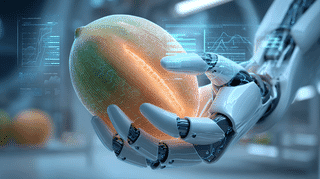
Then there are robot hands. The spokesperson told EE Times Japan that conventional robot arms grab an object first and adjust force afterward, and that when hysteresis is high, the arm can ease off too much and drop the thing. Low hysteresis, the argument goes, makes fine force adjustment possible.
Everyone Is Suddenly Chasing Touch
Giving robots a sense of touch went from niche to crowded in about two years. At CES in Las Vegas in January 2026, several companies made it their headline.
XELA Robotics, a Waseda University spin-out based in Tokyo, exhibited at CES for the first time and demonstrated uSkin, its 3-axis tactile sensor. The company says it detects down to 0.1 gram-force and can wrap not just fingertips but the phalanges and palm. Its booth demo had a robot hand picking up an origami crane, which Italy's La Repubblica filmed. China's ROBOTERA showed the XHAND 1, a five-fingered hand with dense fingertip sensors reading contact, slip and force direction.
So Citizen Electronics is not late to this. It just arrived through a different door.
A Switch Company Wandering Into Sensors
Citizen Electronics started in 1970 as Bulova Citizen, a joint venture between Citizen Watch and America's Bulova Watch Company. The venture dissolved in 1977, the name changed, and in 2005 Citizen Watch took full ownership and the company delisted. Its business is LEDs and switches.
Making very small things first is something of a habit here. In 1983 it produced CITILED, the world's first surface-mount chip LED. In 1989, the first miniature switch with an LED built inside. In 1999, the world's smallest side-push switch and the world's thinnest switch. This is a company that has been refining metal springs for a very long time.
The spokesperson's framing: ordinary magnetic sensors have no physical contacts, but as long as a human is doing the pressing, the reassurance of feedback at the fingertip matters. The structure is simple, but nobody had thought about a switch maker stepping into sensor territory, and combined with the metal spring expertise the company had built up, that made a world-first structure possible. Odd from the outside. Perfectly logical given the résumé.
Citizen Electronics calls the product the core of its business expansion, with industrial equipment, automotive, medical devices and IoT on the target list. An LED-and-switch company is trying to become a sensor company.
Whether a robot can hold an egg without cracking it comes down, in the end, to how finely you can slice 0.35 millimeters. How far along is robotic touch where you are? Are there machines in your local factories and warehouses that decide things by feel yet?
References
- https://ce.citizen.co.jp/news/detail/143
- https://eetimes.itmedia.co.jp/ee/articles/2602/27/news025.html
- https://monoist.itmedia.co.jp/mn/articles/2603/03/news045.html
- https://ce.citizen.co.jp/company/history
- https://www.robotics247.com/article/ces-2026-xela-robotics-demos-3d-tactile-sensor-to-give-robots-a-human-sense-of-touch
- https://xelarobotics.com/exhibition/ces-2026-wrap-up/
- https://www.geeky-gadgets.com/robotera-humanoid-robotics-at-ces-2026/






Global Discussion
15 comments