
🔬 Picture a film thinner than a thousandth of a human hair, stretched drum-tight over an area about the size of a postcard. If it tears, a chip factory can stop and a stencil worth as much as a sports car is scrapped. For years, no one could mass-produce it. Today, almost every one of them comes from a single plant on Japan's Seto Inland Sea. This is the story of the EUV pellicle, and why the world's most advanced chips lean on a membrane you will never see.
A dust cover for the priciest stencil ever made
To print a microchip, light is shone through a patterned plate called a photomask, or reticle. Think of it as the master stencil for a circuit. A single advanced mask runs around $300,000 (roughly ¥48 million), and a full set of masks for one chip can climb into the millions of dollars.
Now the problem: if one speck of dust lands on that stencil, the flaw doesn't print once. It prints on every wafer that passes underneath, ruining lot after lot and dragging the yield (the share of good chips) through the floor. So engineers cover the mask with a "pellicle," a transparent membrane held a few millimeters above the surface. Any dust settles on the pellicle instead of the mask, far enough from the focal plane that the scanner's optics never bring it into focus. The flaw simply doesn't appear.
Mitsui Chemicals has been making pellicles since 1984, back when chips were patterned with ordinary ultraviolet light. For three decades it was an unglamorous, low-profile business. Then the rules changed.
Why EUV broke the old playbook
As circuits shrank below 7 nanometers, the line widths in today's smartphone and AI chips, the industry switched to extreme ultraviolet light, or EUV, with a wavelength of just 13.5 nm. EUV is brutally hard to work with because almost everything absorbs it, including air, glass, and the very pellicle meant to let it through.
That turned the dust cover into one of the hardest objects in the factory to build. An EUV pellicle has to be only a few tens of nanometers thick (typically 20 to 50 nm) so the light can pass through without being soaked up. Yet that same wisp of a film has to span roughly 110 by 140 millimeters, free-standing, with nothing underneath to hold it up. It cannot sag, ripple, or tear. For a long time, the only company on Earth that had cracked it was ASML, the Dutch firm that builds the EUV machines themselves.
The film that catches fire
Making the membrane was only half the battle. EUV scanners keep getting more powerful (light sources have pushed from 250 watts toward 600 and beyond) because more power means more wafers per hour, which is exactly what chipmakers want. But all that energy lands on the pellicle as heat. The conventional silicon-based film couldn't take it; under the most intense beams it degraded and effectively burned away.
That boxed the industry in: more power burned the film, but keeping the film intact capped the line's speed. With existing materials, there was no clean way out.
A license from the Netherlands, a bet on carbon
The first move came in May 2019, when Mitsui signed a license agreement with ASML, until then the sole source of EUV pellicles, to take over their assembly and production. The company built a dedicated line at its Iwakuni-Ohtake Works in Waki, Yamaguchi Prefecture, and in 2021 became the first company in the world to put EUV pellicles into commercial production.
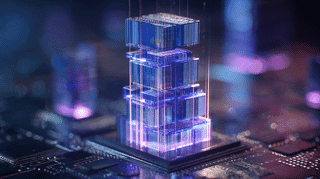
But the heat problem still loomed for the next generation. Mitsui's answer was to change the material itself. In December 2023 it partnered with imec, the Belgian nanoelectronics research center that had been developing carbon nanotube (CNT) films since 2015. Carbon nanotubes are tiny cylinders of carbon: strong, heat-conducting, and remarkably transparent to EUV. The idea was to weave the membrane out of them instead of silicon, so it could shrug off the heat that destroyed the old film.
Crossing the line
The bet paid off. Mitsui set up a CNT pellicle mass-production line at Iwakuni-Ohtake, completed at the end of 2025, with capacity for 5,000 units a year and supply due to start in fiscal 2026. The CNT film transmits at least 92% of the EUV light hitting it and withstands exposure power above 1 kilowatt, comfortably past the point where silicon film failed. A refined version, with transmittance of 94% or higher and a longer working life, is slated for 2027, timed to ASML's next scanner generation.

Source: Mitsui Chemicals
The wall that hasn't fallen yet
It would be tidy to end there, but the engineers themselves are blunt about what's left. At a 2025 industry forum, Akio Hirahara, the senior managing executive officer who runs Mitsui's ICT Solutions business, put a figure on it: today's CNT pellicle lasts somewhere between 5,000 and 10,000 wafers. Leading fabs, by most accounts, want a membrane that survives 30,000 or more. Stretching the lifespan without sacrificing transmittance is the next mountain, and it isn't climbed yet.
One invisible film, the whole map
Step back and the picture is striking. Europe's ASML makes the scanners. Taiwan's TSMC and South Korea's Samsung run the leading-edge lines that turn out the chips inside phones, data centers, and AI servers. And the membrane that keeps those production lines from choking on dust comes, for now, almost entirely from one plant in a small town on Japan's Seto Inland Sea. Mass production of 2nm-class chips and everything beyond is hard to imagine without it. Mitsui holds the top share of the pellicle market. Lintec is developing a CNT pellicle of its own, so the arrangement is not fixed forever, but for now Mitsui is the only company mass-producing one.
That raises an uncomfortable question worth sitting with: is it wise for so much of the world's most advanced manufacturing to hang on one nearly invisible component, made in one place? In Japan, the answer right now is a quiet factory on the coast of Yamaguchi. Where you live, do you know which "invisible" parts your country quietly depends on, and what happens if they break?
References
- https://jp.mitsuichemicals.com/jp/release/2024/2024_0528_1/index.htm
- https://jp.mitsuichemicals.com/en/release/2021/2021_0526/index.htm
- https://www.imec-int.com/en/press/imec-and-mitsui-chemicals-sign-strategic-partnership-agreement-commercialize-cnt-pellicle
- https://www.nikkei.com/article/DGXZQOUC173KQ0X11C25A2000000/






Global Discussion
4 comments