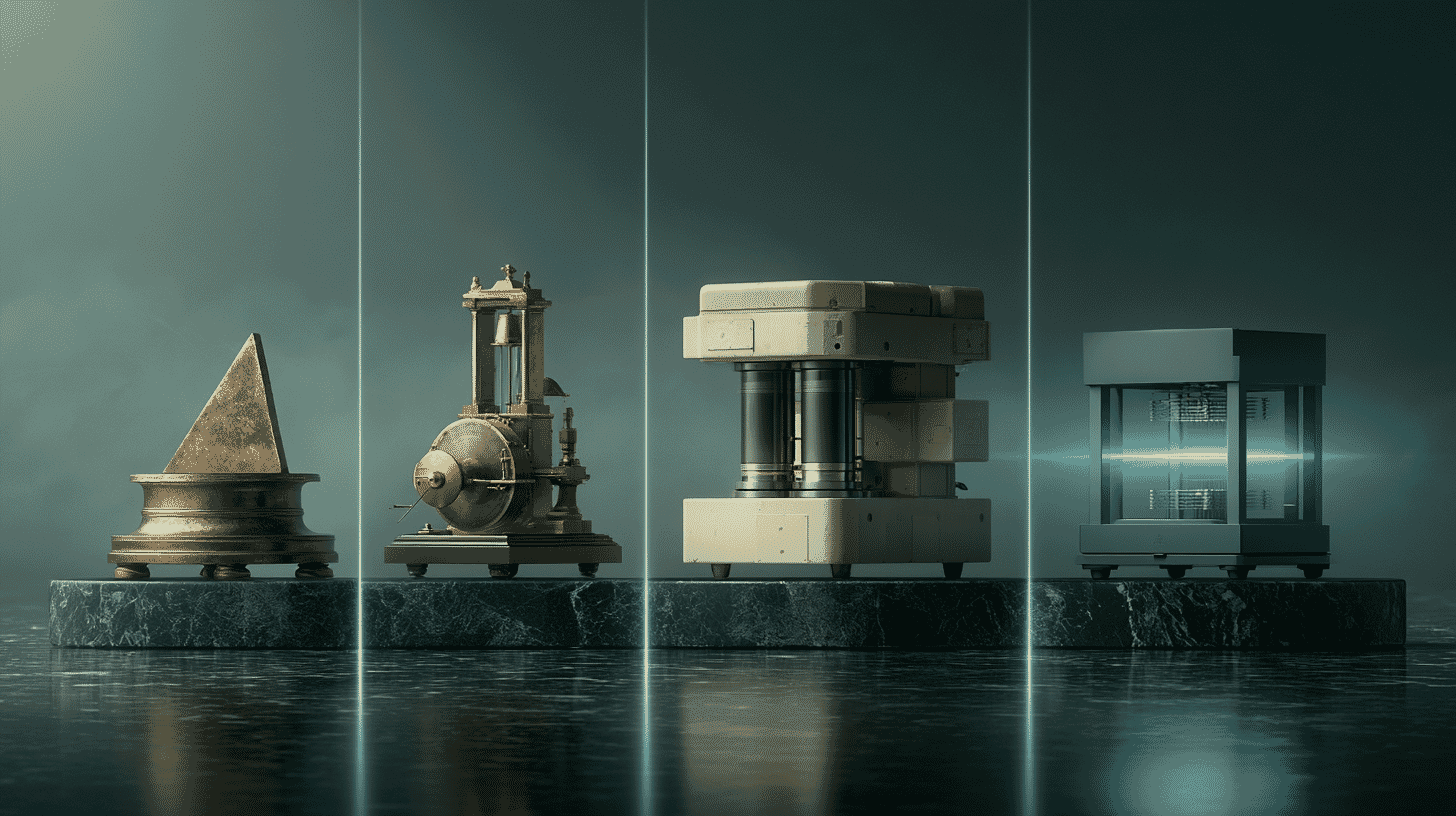
⏱️ Every four years or so, in a building outside Paris, delegates from more than sixty member states gather to argue about what a second is.
The next such meeting runs 13-15 October 2026. After that one, and the one after it in 2030, the length of one second will likely be something different from what it has been since 1967. Different by an amount you'll never feel, but built on a completely different physical object. The cesium atom, which has anchored timekeeping for two human generations, is being retired. The committee just hasn't yet decided what replaces it.
This is the story of that decision: how we got here, what the formal instruction looks like, and who's actually in the running.
A short history of the second
For most of human history a second wasn't really defined; it was inherited. A day was a day, divided into 24 hours by Babylonian convenience, hours into 60 minutes by sexagesimal habit, minutes into 60 seconds the same way. The second was a 1/86,400th slice of however long Earth took to rotate once.
That definition was good enough for sundials, pendulum clocks, and railroad schedules. It started to crack in the 20th century when astronomers noticed that Earth's rotation isn't constant. The planet wobbles, slows, and occasionally jumps. By the 1940s, quartz clocks were stable enough to detect that the Earth itself was the unsteady thing.
In 1956, the International Committee for Weights and Measures briefly redefined the second based on Earth's orbital motion: a specific fraction of the tropical year of 1900. This is called "ephemeris time." It lasted about eleven years and almost no one outside professional astronomy noticed.
Then came atomic clocks. In 1955, the National Physical Laboratory in Britain built the first practical cesium-beam clock. Within a decade it became clear that an atom, specifically the transition between the two hyperfine levels of the cesium-133 ground state, was a much more stable reference than any rotating planet. The 13th General Conference on Weights and Measures (CGPM) made it official in 1967: one second equals exactly 9,192,631,770 oscillations of cesium-133 microwave radiation.
That definition has now been in force for almost six decades. It survived the 1997 amendment that specified "at absolute zero" (to nail down a thermal correction). It survived the 2019 SI overhaul that rebuilt the kilogram, ampere, kelvin, and mole around fundamental constants. The second stayed with cesium because no rival was ready. Cesium fountain clocks today reach uncertainties around one part in 10^16, which means a deviation of less than a second over the entire span of recorded civilization.
The rival is now ready.
The 2030 order
The path to redefinition isn't a press release; it's a formal instruction issued by the CGPM and worked out in the technical trenches by the Consultative Committee for Time and Frequency (CCTF).
In 2016, the CCTF drafted a roadmap of mandatory criteria any new definition must satisfy. The criteria boil down to: optical clocks must demonstrably outperform cesium at a robustly verified level; multiple independent clocks based on the same transition, at different institutions, must show consistent results; clocks based on different transitions must show consistent frequency ratios; and the new clocks must contribute reliably to Coordinated Universal Time before redefinition is locked in.
In 2022, the 27th CGPM passed Resolution 5, which is the closest thing the metrology world has to a starter's pistol. The resolution explicitly instructs the CIPM:
- to bring proposals to the 28th meeting of the CGPM (13-15 October 2026) for the choice of the preferred species, or ensemble of species, for a new definition of the second;
- to take the further steps needed for a new definition to be adopted at the 29th meeting of the CGPM in 2030.
So the schedule is two-step: choose the atom in 2026, ratify the new definition in 2030. The 2024 review paper that updated the roadmap was explicit that a 2026 redefinition was always unrealistic, and that even a 2030 vote depends on consensus being reached at the species-selection stage. If consensus fails in 2026, the redefinition slides to 2034 or beyond, and cesium fountains keep ticking through the late 2030s.
The official redefinition criterion that matters most numerically: at least three independent optical clocks based on the same reference transition, each with a systematic uncertainty of 2×10^-18 or better. That bar is being approached fast but not uniformly across candidates.
The field
What follows is a guide to who is actually in the running, organized by candidate atom rather than by country, since most countries have stakes in multiple atoms. Star ratings reflect a rough sense of how strong each candidate's case looked going into 2026, based on number of independent labs operating at the required uncertainty level, accumulated frequency-ratio measurements, and political momentum inside the CCTF. They are not predictions; they're a way of grouping the contenders.
Strontium-87 (neutral atom, optical lattice) ★★★★★
The current heavyweight. Sr-87 is the most-studied optical transition in the world, with the largest number of independent clocks operating at the required uncertainty.
The architecture, called an "optical lattice clock," holds tens of thousands of laser-cooled strontium atoms in a stationary pattern of laser light, the lattice, and probes them with a clock laser tuned to a transition at 698 nm. Because thousands of atoms are interrogated simultaneously, the signal is statistically rich, which is the practical advantage Sr-87 has over single-ion clocks.
Active Sr-87 programs include SYRTE (Paris Observatory, France), NIST/JILA (Boulder, USA), PTB (Germany), INRIM (Italy), NPL (UK), NICT (Japan), KRISS (Korea), NIM (China), and the University of Science and Technology of China (USTC) in Hefei. The USTC group reported 9.2×10^-19 systematic uncertainty in September 2025. JILA has reported strontium clocks demonstrating differential precision below 10^-20 between separated atomic ensembles, though that is a precision figure, not a systematic-uncertainty figure.
Japanese involvement spans both the inventor side and the commercial side. The optical lattice clock was proposed in 2001 by Hidetoshi Katori, then at the University of Tokyo, now also a team director at RIKEN. NICT runs its own Sr-87 clock as a secondary representation of the second. And in March 2025, Shimadzu, the Kyoto-based instrument maker, became the first company in the world to sell an optical lattice clock as a commercial product, the Aether Clock OC 020. RIKEN, Shimadzu, and the BIPM signed a memorandum on May 12, 2026, to test whether the commercial unit can serve as a "traveling reference" carried physically between national labs for inter-comparison.
Sr-87's main weakness is not technical but political: it's so well-established that no single lab dominates it, which means consensus could fragment among the many strong Sr groups.
Aluminum-27 ion (trapped single ion, quantum logic) ★★★★★
The other current heavyweight, and as of mid-2025 the holder of the world record for systematic uncertainty.
NIST's quantum logic clock, which uses a single Al^+ ion paired with a magnesium "logic" ion for cooling and readout, reported 5.5×10^-19 systematic uncertainty in a paper published in Physical Review Letters in July 2025, the lowest of any optical clock to date and a 41% improvement on the previous record.
The Al^+ transition is exceptionally insensitive to background magnetic and electric fields and to temperature, which is why it pulls ahead on systematic uncertainty. The trade-off is that single ions produce a much weaker signal than thousands of lattice atoms, so stability has historically lagged behind Sr lattice clocks. The 2025 NIST improvements narrowed that gap considerably.
The architecture traces back to a 2005 demonstration of quantum-logic spectroscopy by David Wineland's group at NIST. Wineland later shared the 2012 Nobel Prize in Physics for related work on trapped ions. The original Al^+ clock was built by his group; the current generation is run by David Hume and David Leibrandt.
Beyond NIST, PTB in Germany is developing a transportable Al^+ clock, and additional Al^+ programs are advancing in several countries. The total number of operational Al^+ clocks worldwide remains small, only a handful with serious metrological pretensions, which is why this candidate's case rests less on breadth than on depth: each clock is exceptional.
If the CCTF leans toward a single-species redefinition, Al^+ has a strong case on accuracy alone.
Ytterbium-171 (neutral atom, optical lattice) ★★★★☆
The strongest secondary lattice candidate, often used as a cross-check against strontium.
Yb-171 has clocks at NIST (USA), AIST's NMIJ (Japan), KRISS (Korea), INRIM (Italy), and elsewhere. Its clock transition at 578 nm has been measured against Sr-87 in multiple frequency-ratio campaigns, and those ratios are converging tightly. Yb-171's appeal in a possible "ensemble of species" redefinition is precisely this: pairing it with Sr-87 gives you two independent lattice clocks that have been cross-validated against each other.
NMIJ's Yb-171 clock was recognized as a secondary representation of the second alongside the leading Sr clocks. NIST's Yb-171 work has been central to the global frequency-ratio matrix that the CCTF requires.
Ytterbium-171 ion (trapped single ion, E2 / E3 transitions) ★★★★☆
A unique candidate because it offers two usable optical transitions in the same ion species. The "E3" (electric octupole) transition at 467 nm is exceptionally narrow and has been pushed to extreme precision; the "E2" (electric quadrupole) transition at 436 nm has different systematic shifts and can serve as a cross-check.
PTB in Braunschweig, Germany has the leading Yb^+ E3 clock, demonstrated at the 10^-18 level. NPL in Teddington, UK has been competitive on both transitions for over a decade. The dual-transition feature makes Yb^+ unusually well-suited to certain ensemble definitions.
European labs have invested heavily in Yb^+, which gives it geographic weight even if its raw uncertainty doesn't yet match Al^+.
Mercury-199 (neutral atom, optical lattice) ★★☆☆☆
A dark horse with a real argument. Mercury's clock transition is far less sensitive to blackbody radiation (room-temperature thermal photons) than either strontium or ytterbium, which is one of the largest systematic shifts to evaluate. In principle, a Hg lattice clock can reach extreme accuracy without the elaborate thermal shielding that Sr and Yb require.
The principal Hg-199 program is at SYRTE in Paris. The practical problem is that mercury is harder to laser-cool than strontium or ytterbium, the wavelengths involved (around 266 nm in the deep ultraviolet) are technically demanding, and there are far fewer Hg clocks operating worldwide than Sr or Yb. Hg is a strong physics candidate but a thin field.
Lutetium-176 ion (trapped single ion) ★☆☆☆☆
The newest serious contender. Lutetium has theoretical advantages around low sensitivity to several systematic shifts, and the Centre for Quantum Technologies at the National University of Singapore has been building a case for it for the past decade.
The state of the art is competitive but the number of independent labs operating Lu^+ clocks is small: essentially CQT plus a handful of collaborators. Lu^+ won't anchor a 2030 redefinition, but it could enter the conversation as a secondary representation.
Strontium-88 ion, Calcium-40 ion, others ★☆☆☆☆
Sr^+ has an NPL program with a long track record. Ca^+ clocks exist at multiple labs and have been used for transportable demonstrations. Both are credible secondary representations of the second under the current framework but neither is currently positioned to anchor the new definition.
What's actually being decided in 2026
The 28th CGPM in October 2026 will not change the definition. It will instead choose between three structural options that the CCTF has been refining:
Option 1: single transition. Pick one atom (probably Sr-87 or Al^+), declare its clock frequency to be some exact value in hertz by definition, retire cesium. Clean, simple, but politically painful for the losing labs.
Option 2: weighted geometric mean of several transitions. Several optical transitions (some plausible packages have included Sr-87, Yb-171, Al^+, Yb^+, possibly Hg-199) jointly anchor the second through a defined combination of their frequencies. This is the "ensemble" option, and it's currently considered the politically most feasible because it spreads the prestige across more labs and accommodates the lack of a clear single winner.
Option 3: fundamental constant. A third approach considered fixing the value of a physical constant (e.g., the Rydberg) and deriving the second. The CCTF concluded this isn't yet feasible because no relevant constant is known to enough decimal places.
The CCTF adopted its recommendation on the redefinition (Recommendation 24-3) at its 24th meeting on 18-19 September 2025, so what the field is watching ahead of October is which option the CIPM carries forward as a proposal. If it lands on Option 1 and names a specific atom, that's a major announcement. If it lands on Option 2, the betting consensus, the next question becomes which species are in the ensemble and how they're weighted.
Ten optical clocks across six countries (Finland, France, Germany, Italy, the UK, and Japan) were linked by optical fiber and satellite for a 45-day joint measurement run from 20 February to 6 April 2022. The results appeared in Optica in June 2025: 38 frequency ratios, four of them measured directly for the first time. Some comparisons left unexplained offsets that still need investigating, but the run is widely read as evidence that the inter-comparison infrastructure the roadmap requires is starting to work.
That comparison, the May 2026 BIPM-RIKEN-Shimadzu memorandum on portable clocks, the NIST 5.5×10^-19 paper, the USTC 9.2×10^-19 strontium result, and the BIPM's recognition of NIM's Sr clock are all moves in the same run-up to October.
What changes if the second changes
For day-to-day life, almost nothing. GPS will keep working at the same accuracy you experience now. Your phone clock will keep syncing. UTC will be re-anchored under the hood, but the second that the world uses will shift by less than the noise floor of any commercial timing application.
What changes is the precision floor that every other measurement sits on. Geodesy that reads millimeter changes in elevation from precise time, searches for drift in the fundamental constants, tests of general relativity, and dark matter hunts that look for faint glitches in atomic transitions all gain resolution. Telecommunications synchronization, already pressing against optical clock limits at the network-equipment level, gains headroom.
There is also a slower, structural change. Once "the second" is something demonstrable in a transportable box rather than a stationary fountain at a national lab, the geography of timekeeping flattens. National metrology becomes less about who can build the biggest stationary instrument and more about who can verify against the same physical references. Whether countries that have historically been outside the timekeeping cartel will end up inside it depends on hardware availability, infrastructure, and politics.
October
By the end of October 2026, we'll know which atoms made the shortlist. By 2030, assuming consensus, the second you've used your entire life will be officially defined by something other than cesium. By the late 2030s, the last national-lab cesium fountain will probably be powered down for the last time.
These transitions tend to look small until you look back at them from a generation away. The kilogram was redefined in 2019; almost no one noticed, and yet every electrical measurement laboratory rebuilt its calibration chain. The second is the most consequential SI unit because the others depend on it. Its redefinition is the biggest unit-definition change in a hundred years, and most of the world will sleep through it.
In Japan, the redefinition is a Shimadzu story, a Katori story, and a quiet national pride about being on the short list of countries that can credibly build the new standard. What is it where you are: a sovereignty story, a science story, an industrial story, or one nobody's heard?
References
- https://www.bipm.org/en/cgpm-2022/resolution-5
- https://www.bipm.org/en/faq-redefinition-second
- https://iopscience.iop.org/article/10.1088/1681-7575/ad17d2
- https://www.nist.gov/news-events/news/2025/07/nist-ion-clock-sets-new-record-most-accurate-clock-world
- https://www.nist.gov/si-redefinition/second-future
- https://www.riken.jp/pr/news/2026/20260512_2/index.html
- https://www.nict.go.jp/press/2022/06/09-1.html
- https://en.wikipedia.org/wiki/Atomic_clock







Global Discussion
5 comments