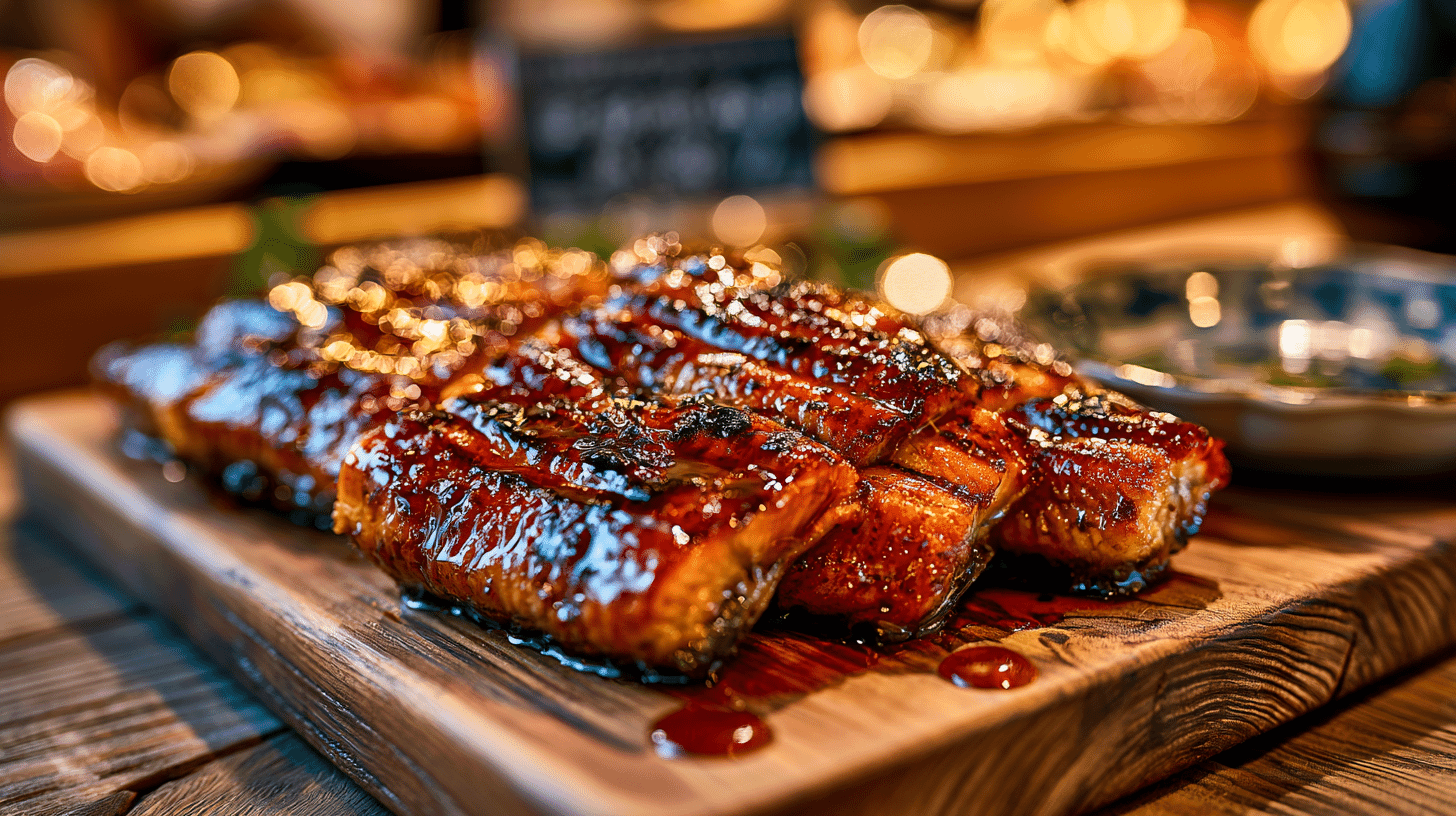
🥢 For the first time anywhere in the world, ordinary shoppers will be able to walk into a department store and buy an eel raised entirely from the egg. Yamada Suisan, an eel farmer and processor in Saiki, Oita prefecture, announced on May 20, together with the Japan Fisheries Research and Education Agency and Marino-Forum 21, that fully farmed Japanese eel kabayaki will go on sale to the public on May 29. The reference price is 9,720 yen for a two-fish gift box, about 4,860 yen (roughly $31) per fish. That is still expensive next to ordinary farmed eel, but in fiscal 2016 producing a single glass eel cost 40,000 yen. By fiscal 2023 it cost 1,800. A 22-fold reduction. With the country's summer eel-eating season just around the corner, the fragile future of an endangered species that Japan keeps eating is starting to take shape, one Tokyo counter at a time.
"Top three eels I've ever eaten in my life," says the minister
The eels go out through Yamada Suisan's own Yamada no Unagi outlets, one inside Mitsukoshi's flagship store in Nihombashi and one in Tsukiji, through the company's online shop, and through the AEON group's e-commerce channels. About 600 fish are set aside for the trial.
A day before the announcement, on May 19, Agriculture, Forestry and Fisheries Minister Norikazu Suzuki sampled a piece of the grilled product at his ministry and offered an unusually direct verdict: "It's definitely in the top three eels I've ever eaten in my life." Cabinet ministers in Japan rarely commit so openly to a flavor judgment, especially on a product their own ministry has been funding since the 1990s.
Full-cycle aquaculture means taking eggs from artificially raised parent fish, hatching them, and growing the next generation all the way back to spawning maturity, closing the entire life cycle in human hands. By contrast, almost every eel sold in Japan today comes from "half-farming": wild glass eels (juveniles) are caught in rivers and estuaries, then fattened in tanks. The trial sale is the first step in flipping that supply chain from wild capture to controlled production.
From 40,000 yen to 1,800 yen per glass eel
According to the Fisheries Agency, producing one artificial glass eel cost about 40,000 yen in fiscal 2016. Once mass-production methods, new feeds, redesigned tanks and automated feeding systems came together, that figure fell to about 1,800 yen by fiscal 2023. A 22-fold reduction.
It is still three to four times the cost of a wild-caught juvenile. The agency is now aiming for roughly 800 yen per glass eel (about $5), the level researchers say would make full-cycle aquaculture genuinely competitive with the wild fishery.
A whole grown eel works out to about 4,860 yen, or roughly $31 at the May exchange rate of 159 yen to the dollar; the Tsukiji restaurant sells it at 4,500 yen a fish, tax included. For context, a vacuum-packed Chinese-farmed kabayaki fillet at a Japanese supermarket typically sells for 2,000–3,000 yen, while a premium unaju lunch set at an established eel restaurant runs 4,000–5,000 yen. The "world's first" eel lands closer to the high end of normal than to a billionaire's curiosity item.
Why farm them at all? Glass eel arrivals have collapsed 90% since the 1970s
Behind the technology story sits a much harder one.
The Japanese eel, Anguilla japonica, was listed as Endangered on the International Union for Conservation of Nature's Red List in 2014. Japan's Ministry of the Environment had already given it equivalent national status the year before. The causes are overlapping: overfishing, dam construction, habitat loss, shifts in the Kuroshio current. The trend line is unambiguous. Arrivals of glass eels at Japanese coasts have fallen by roughly 90% since the 1970s.
A 2025 preprint that updated catch-per-unit-effort data across three eel generations (24 years) estimated that yellow and silver eel populations have declined by 79.2% to 99.9% depending on the dataset. Recruitment of glass eels is more volatile but is now at historic lows.
And Japan, by itself, consumes 50–70% of the world's eels. That mismatch is the entire problem in a single sentence.
The pressure is also diplomatic. In 2025, the European Union and Panama proposed listing every unlisted Anguilla species, Anguilla japonica among them, under CITES Appendix II at the CoP20 meeting in Samarkand, Uzbekistan. A secret ballot in committee on November 27 rejected it, 35 in favour to 100 against with eight abstentions, and the result stood when the meeting closed on December 5. Japan argued against alongside China, South Korea, the United States and Canada, backed by fisheries industry groups saying the listing failed the scientific criteria and would mostly fuel illegal trade. Parties did adopt a separate resolution covering all anguillid eels, so the demand for tighter trade monitoring has not gone away. The immediate trade threat has receded; the underlying conservation crisis has not, and similar proposals will almost certainly return. Commercial-scale full-cycle aquaculture functions, in that sense, as insurance: a way for Japan to keep eating eel even if the international trade picture turns against it next time.
The 2050 deadline: an entirely human-bred supply
The Ministry of Agriculture, Forestry and Fisheries has set a national target of replacing 100% of distributed eel with artificially raised juveniles by 2050.
That leaves 25 years on the clock. The May 29 sale is the official starting gun. A 5,000-yen eel is not the kind of price that makes the average household abandon imported kabayaki tomorrow, but it does mark the moment when full-cycle production stops being a laboratory result and becomes a product anyone can actually buy.
The research goes back further than most people realize. Hokkaido University achieved the world's first artificial hatching of eel eggs in 1973. The Japan Fisheries Research and Education Agency confirmed a complete closed cycle (parent → egg → juvenile → adult → spawning again) in 2010. From that milestone to a department store price tag took another sixteen years.
The production base is widening. Yamada Suisan joined the Fisheries Agency programme in fiscal 2022 and produced 13,006 fully farmed glass eels in 2024, then more than 10,000 again in 2025. It plans to expand from 12 juvenile tanks to 45 and raise 100,000 a year by 2028. President Shintaro Yamada has been careful to frame that as reproducibility rather than mass-market volume: this is not, he says, an era for making a lot and selling it cheap. Cell-cultured eel from Israeli startup Forsea is also targeting the Japanese market.
A summer tradition meets an endangered species
The cultural backdrop matters. The custom of eating eel during the hottest weeks of summer, Doyo no Ushi no Hi or "midsummer day of the ox," was popularized in the late 1700s by polymath Hiraga Gennai, partly as a marketing campaign for struggling eel restaurants. The 2026 summer doyo period runs July 20 to August 6, and it contains exactly one day of the ox: July 26. There is no second one this year. Convenience stores and supermarkets will roll out the same kabayaki campaigns they always do, mostly without dwelling on the fact that the species at the center of all this is endangered.
A future in which full-cycle aquaculture supplies the market affordably is one of the few realistic ways to resolve that contradiction. For now, 5,000 yen places this new eel firmly in the "special occasion" tier rather than the daily one. But the technology has crossed the line from possible to purchasable.
The trial sale is the first real handshake between decades of research and the consumer market. For readers outside Japan, it is also a chance to watch how one country tries to keep eating an endangered species without driving it to extinction, and whether that strategy can hold.
Is there a food in your country that has been pushed to the brink of extinction? What technologies or rules, if any, have actually worked to bring it back?
Update: July 2026
The trial sale opened on schedule on May 29. Yamada Suisan's online shop sold out its 42 gift sets within moments of launch, and a queue formed before opening at the Tsukiji restaurant, which had 45 portions at 4,500 yen each. At his post-cabinet press conference that morning, Minister Suzuki said he was humbled that decades of research had finally reached the point of sale. In July, Nikkei Business reported on Yamada Suisan as the first company in Japan to commercialise fully farmed eel.
References
- https://news.yahoo.co.jp/articles/9154ff4920f9dce9eba05531a52dd3680c04fd18 (Kyodo News via Yahoo Japan)
- https://www.kobe-np.co.jp/news/zenkoku/compact/202605/0020373748.shtml (Kobe Shimbun NEXT)
- https://kichijoji.keizai.biz/gpnews/1716067/ (Jiji Press: minister's tasting comment)
- https://www.fra.affrc.go.jp/ (Japan Fisheries Research and Education Agency)
- https://iucn.org/content/iucn-red-list-raises-more-red-flags-threatened-species (IUCN Red List)
- https://www.biorxiv.org/content/10.1101/2025.08.05.668826v1 (Japanese eel stock assessment, 2025)
- https://www.fra.go.jp/home/kenkyushokai/press/pr2026/20260520_press_unagi.html (Japan Fisheries Research and Education Agency press release, May 20, 2026)
- https://yamadasuisan.com/topics/kanzenyosyoku2026 (Yamada Suisan trial sale announcement)
- https://cites.org/sites/default/files/documents/E-CoP20-Com-I-Rec-05-R1_0.pdf (CITES CoP20 committee record and vote)
- https://www.itmedia.co.jp/news/articles/2605/29/news109.html (ITmedia: sale opens May 29)
- https://www.undercurrentnews.com/2024/11/21/japans-yamada-suisan-to-launch-antibiotic-free-eel-exports-to-europe/ (Yamada Suisan / Undercurrent News)




Global Discussion
5 comments