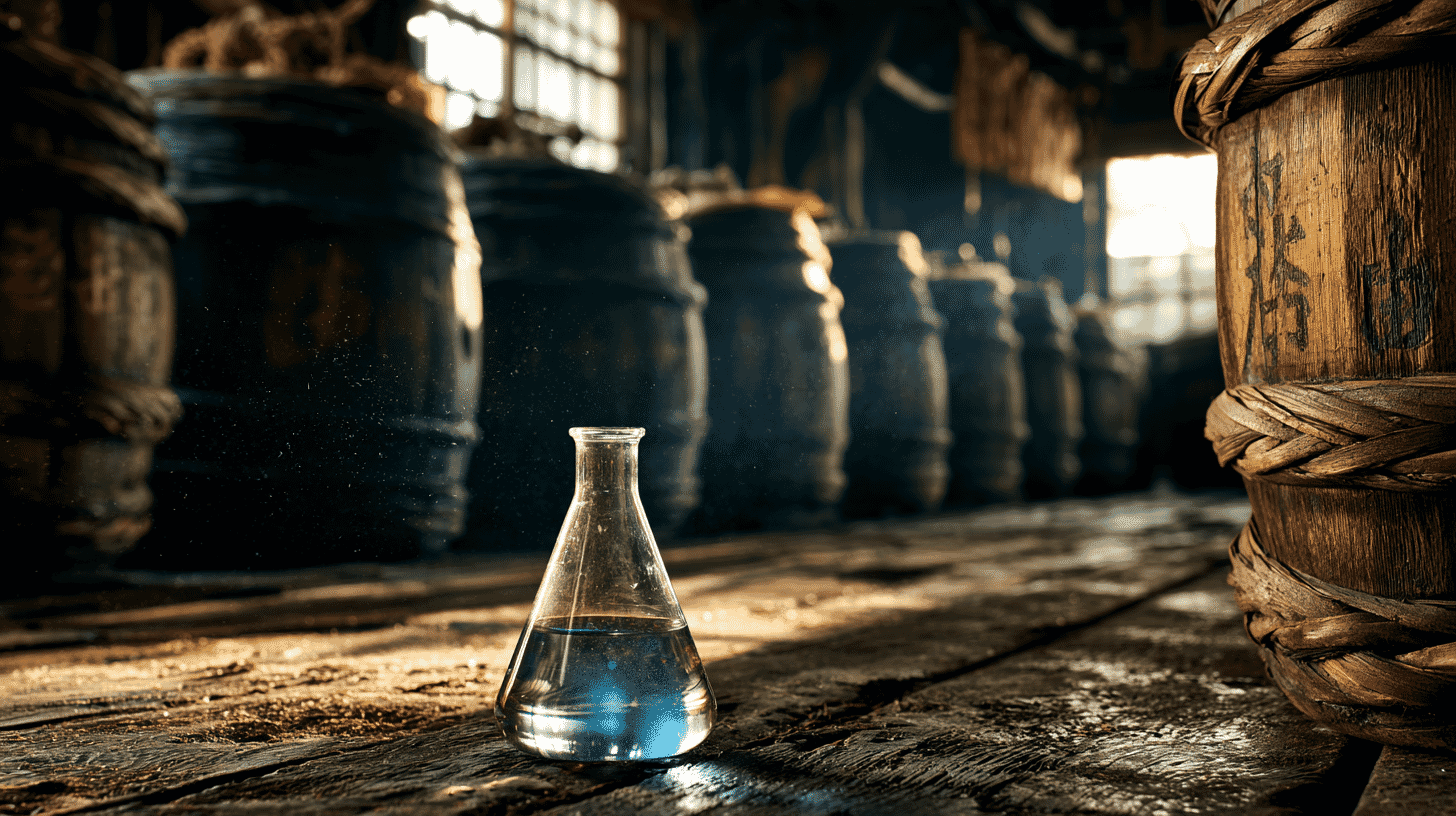
🧬 Pick up a bottle of Yamasa soy sauce in a supermarket, and you're holding a product from a company that has been brewing since 1645. What's harder to guess is that the same family-owned soy sauce maker is also one of a small handful of companies on Earth that can mass-produce a key ingredient in mRNA vaccines. This isn't a marketing gimmick or a recent pivot. It's the end point of a thread that runs, unbroken, from a wooden brewing barrel in a fishing town to the molecules inside a COVID-19 shot.
Here's how a soy sauce company ended up there.
It started with the science of "delicious"
Yamasa was founded in 1645 in Choshi, a windswept port on the Pacific edge of Chiba Prefecture, by Hamaguchi Gihei, who had moved east from the Kishu region. Choshi's humid, temperate climate, where the warm Kuroshio and cold Oyashio currents meet offshore, turned out to be ideal for the molds and yeasts that drive soy sauce fermentation. For most of its history, Yamasa did exactly what you'd expect: it made very good soy sauce, eventually becoming Japan's second-largest producer.
The turn toward chemistry began with a deceptively simple question: what, exactly, makes food taste good?
Japanese cooking leans heavily on dashi, the savory stock drawn from ingredients like dried bonito flakes and dried shiitake mushrooms. By the mid-20th century, researchers were pulling apart that savoriness, what the Japanese call umami, molecule by molecule. The umami in bonito flakes turned out to be inosinic acid; in 1957, a Yamasa researcher identified the umami in dried shiitake as guanylic acid. Both belong to a family of compounds called nucleotides, the same building blocks that make up DNA and RNA, the chemistry of life itself.
That discovery wasn't just trivia for a soy sauce maker. In 1961, Yamasa used an enzymatic method to break down RNA into nucleotides and launched a nucleotide-based umami seasoning. To do it, the company had to get good at something most condiment makers never touch: handling and synthesizing nucleic-acid compounds at industrial scale.
A pile of leftover molecules, and a bet
Making nucleotide seasoning left Yamasa with byproducts, other nucleotides like uridylic acid and cytidylic acid, and a practical question of what to do with them. Rather than treat them as waste, the company's researchers started probing whether these molecules had uses of their own.
They did. Many nucleic-acid compounds have real pharmacological activity, and modified versions of them can serve as the active ingredients in antiviral and anticancer drugs. By the 1970s, Yamasa had begun manufacturing pharmaceutical raw materials and active ingredients. The underlying logic was that fermentation, enzymes, and nucleic-acid synthesis, the toolkit honed making seasoning, could carry over into medicine.
It was a long, patient bet, and being privately held helped. Yamasa never listed its shares, which spared it the pressure to show quick returns. That mattered, because pharmaceuticals and biotech can take decades to pay off. In the 1980s, the company began selling a modified nucleotide called pseudouridine as a research reagent and even exporting it. Demand was tiny. There was no obvious reason a soy sauce maker would keep producing an obscure laboratory chemical year after year, except that it could, and the expertise was already in the building.
The road was not all triumph
It would be a clean story if every step worked out. It didn't.
In 1979, Yamasa synthesized an antiviral compound called sorivudine, effective against herpes and shingles viruses. Co-developed and marketed by another company, it went on sale in Japan in September 1993 under the brand name Usevir. Within weeks, a deadly problem emerged: in patients who were also taking certain 5-fluorouracil-based anticancer drugs, sorivudine interfered with how the body broke those drugs down, pushing them to toxic levels. At least 15 cancer patients died, and the drug was pulled from the market within about a month.
The sorivudine disaster became one of the most-studied drug-safety cases in Japan, taught to this day as a lesson in drug interactions and inadequate warnings, failures that lay largely with how the finished drug was tested and labeled for market. For Yamasa, whose name is attached to the compound's discovery, it's a sober reminder that moving from a brewing tradition into medicine carries risks that have nothing to do with how carefully you make soy sauce.
The discovery that changed everything, 25 years too early to notice
For most of those decades, pseudouridine remained a niche chemical with no blockbuster purpose. Then, in 2005, two researchers working in the United States, Katalin Karikó and Drew Weissman, published a finding that would eventually win them the 2023 Nobel Prize in Physiology or Medicine.
The problem they cracked was this: injecting messenger RNA (mRNA) into the body normally triggers an inflammatory immune reaction, which had made mRNA impractical as medicine. Karikó and Weissman showed that if you build the mRNA using pseudouridine in place of ordinary uridine, the immune system stops overreacting, clearing the path for mRNA to safely instruct cells to make a target protein.
In other words, pseudouridine turned out to be one of the keys that made mRNA vaccines possible. And a soy sauce maker in Choshi had been quietly producing it, by then, for roughly a quarter of a century.
When the world suddenly needed it
The payoff came with a speed that, in hindsight, looks almost like foresight.
In late 2020, with mRNA vaccines still awaiting their first regulatory approvals, Yamasa moved to scale up pseudouridine production at its Choshi plant, before it was certain the demand would materialize. When COVID-19 vaccines rolled out globally, demand for the ingredient exploded. Yamasa ran its plant at full capacity, and by some reports shipments climbed to dozens of times pre-pandemic levels.
Its customers reportedly include both Pfizer/BioNTech and Moderna. In 2021 the company also approved a new active-ingredient plant on its headquarters site, an investment of more than ¥3 billion, planned to make nucleic-acid drug substances alongside vaccine raw material, according to the Nikkei.
Very few companies anywhere can make high-purity pseudouridine at industrial scale and pharmaceutical quality. Yamasa, by virtue of having done it for forty years, found itself one of the world's major suppliers of an ingredient that billions of vaccine doses depended on. A condiment maker had become critical infrastructure for a global health emergency.
From a brewing barrel to the molecules of life
Yamasa hasn't stopped at vaccines. It's now working in newer frontiers of nucleic-acid medicine: oligonucleotide drugs built from chemically modified nucleotides, and materials for mRNA therapeutics. It has even extended its nucleotide research into cosmetics, proposing skin-care ingredients derived from the same chemistry. The company describes itself as one of the world's largest suppliers of nucleotides, with research, production technology, and quality rated among the global best in the field.
The thread is not soy sauce but the chemistry beneath it: fermentation, enzymes, and a century-spanning familiarity with the small molecules that carry both flavor and life. The leap from umami to mRNA looks absurd from the supermarket shelf. Up close, it's a single, stubborn line of expertise that a patient, privately held company refused to let drop.
It raises a question worth asking about the companies in your own country. Which of them are sitting on decades of niche knowledge that could turn out, one unexpected day, to matter to the whole world? And would anyone notice before it did?





Global Discussion
4 comments