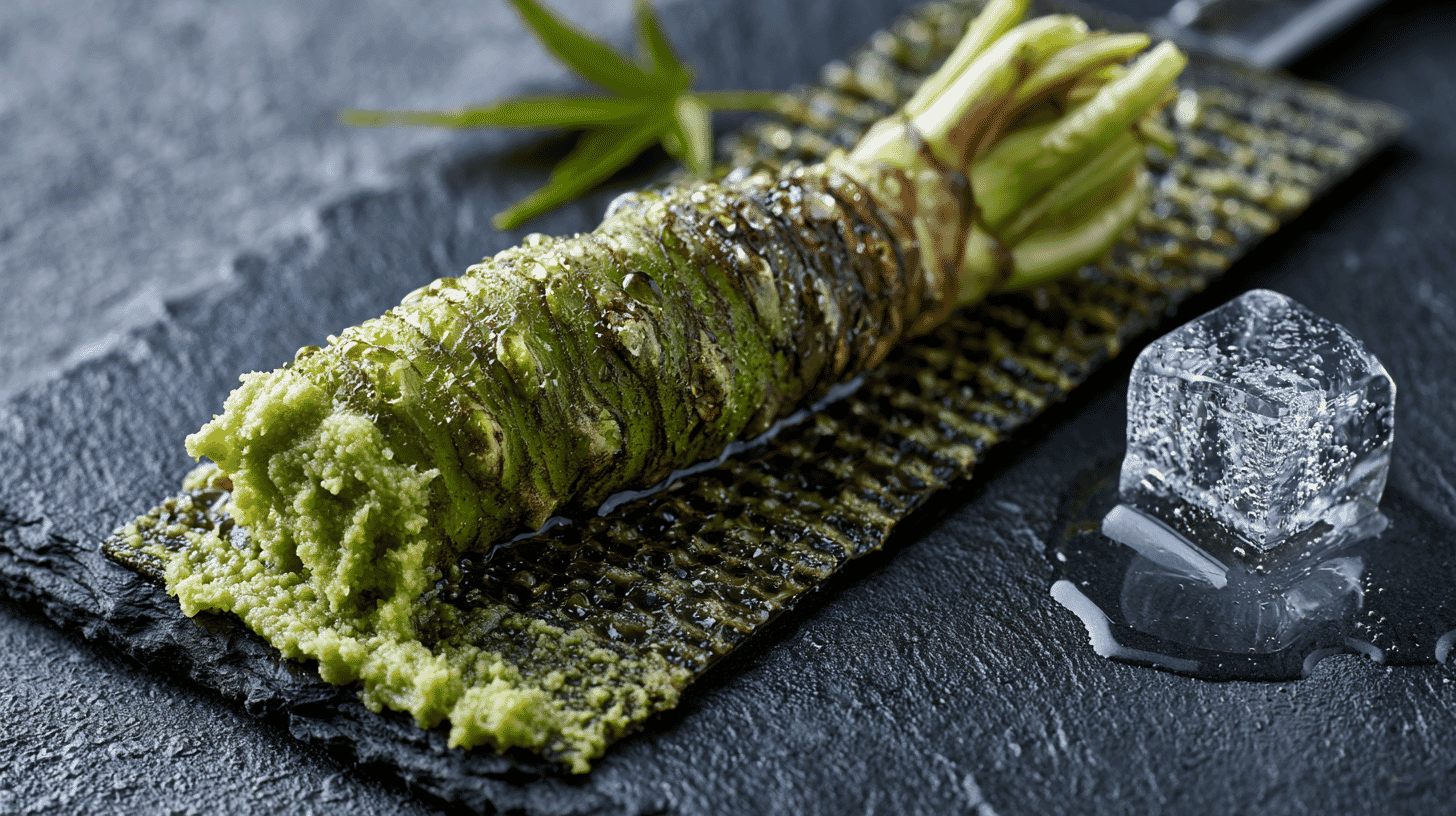
🦷 Ice cream on a scorching afternoon, a first mouthful of cold beer, and then that thin electric jolt through a tooth that has nothing wrong with it. A physiology lab in Tokyo thinks the fix might be sitting in the little green mound next to your sushi.
Researchers at Tokyo Dental College have shown that a compound found in Japanese wasabi drives the cells that build teeth to lay down fresh dentin. The findings appeared in The Journal of Physiology on February 24, 2026, and the university announced them on May 21. A small clinical study is now running at the university hospital, and the delivery method is chewing gum.
The pain that is not a cavity

Source: KDS4444 / Wikimedia Commons (CC BY-SA 4.0)
A tooth is built in layers. Enamel forms the hard outer shell. Under it sits dentin, noticeably softer. Below that is the pulp, packed with nerves and blood vessels.
Acidic things you drink often, including wine, soft drinks and lactic acid bacteria drinks, dissolve a little of the enamel surface. Add a heavy hand with a toothbrush and the surface wears through, exposing dentin. That is where the trouble starts, because dentin is threaded with microscopic tubules full of fluid. Something cold or sweet makes that fluid shift inside the tubules. Odontoblasts, the cells that manufacture dentin, register the movement and release ATP and glutamate onto the tooth's nerve endings. The signal arrives as a fast, bright stab and then vanishes, which is exactly why most people put up with it rather than book an appointment.
Estimates of how many people live with this vary enormously. A 2019 meta-analysis of 65 papers found reported rates anywhere from 1.3 percent to 92.1 percent, settling on 11.5 percent as its best estimate and 33.5 percent as the average across the studies it pooled.
Sealing it up versus building it back
The standard treatment is physical. A dentist packs the spot with resin or paints a desensitizing agent over the exposed dentin. It works, but it is a lid, and lids come off, especially on a tooth where the bite is landing wrong.
There is a bigger reason to get this right. Once decay progresses far enough that the nerve has to come out, the tooth loses its blood supply and the tissue that maintains it, and its remaining lifespan drops sharply. Molars, which absorb the most chewing force, often give out before the person who owns them does. Dentists work hard to keep the nerve alive because nothing performs like your own tooth.
So Yoshiyuki Shibukawa, a professor of physiology at Tokyo Dental College, asked a different question. Rather than blocking the signal, could you get the tooth to rebuild the layer that has worn away?
It started at a sushi counter
His lab had already established that odontoblasts carry TRPA1, a sensor protein involved in forming dentin. TRPA1 is also the receptor that registers the sinus-clearing burn of wasabi. The broader TRP family sits behind the 2021 Nobel Prize in Physiology or Medicine, awarded to David Julius and Ardem Patapoutian for their discoveries of receptors for temperature and touch.
Which raised an unusually appetizing hypothesis. If the cells that build dentin carry the wasabi sensor, would wasabi make them build dentin?
According to Science Portal, the science news site run by the Japan Science and Technology Agency, what happened next was pure Tokyo. Shibukawa went out for dinner at a sushi restaurant in Kanda and asked the chef whether he happened to know anyone in the wasabi business. The chef headed to Toyosu market the following morning and explained the situation to a long-established produce wholesaler, who phoned a wasabi manufacturer directly. At 7:30 that morning Shibukawa picked up a call from Isao Okunishi at Kinjirushi, a wasabi company in Nagoya, who told him about a compound called 6-MSITC. The industry-academia collaboration started on that call.

Source: Wikimedia Commons (public domain)
6-MSITC, or 6-methylsulfinylhexyl isothiocyanate, occurs in the rhizome of Japanese wasabi. Kinjirushi has trademarked it under the name hexaraphane and has spent years studying it with university partners for effects that have nothing to do with teeth.
What the compound actually does inside the cell
The team put 6-MSITC up against seven chemically altered versions of itself on cultured human odontoblasts and measured how much mineral the cells laid down. Two came out ahead: 6-MSITC itself and one variant, 6-MSFITC.
The mechanism turned out to be a relay of ion transporters. 6-MSITC switches on carbonic anhydrase inside the cell, which generates bicarbonate and hydrogen ions. Bicarbonate transporters of the SLC4A family move bicarbonate out. The sodium-hydrogen exchanger pushes hydrogen out and pulls sodium in. That loaded sodium flips the sodium-calcium exchanger into reverse, so calcium floods in, and the calcium pump in the cell membrane then throws it back out, right at the mineralizing front. The space outside the cell turns alkaline and calcium-rich, and tertiary dentin forms. Block any link in the chain with a drug and the mineralization drops off.
In live animals, cavities prepared in rat teeth and treated for two weeks with a gel carrying 500 micromolar 6-MSITC produced more new collagen, more dentin and more calcium deposition than saline-treated controls. Science Portal reports that this effect did not run through TRPA1, so the sensor that pointed the team toward wasabi is not the route the compound actually takes. Tokyo Dental College says patents have been filed in Japan and abroad.
Gum, not a needle
At the university's Suidobashi Hospital in central Tokyo, Shibukawa is running a clinical study in people who report avoiding cold food. They chew gum containing 6-MSITC. It does not carry the nose-hitting sting of wasabi.
Some participants have said they came to enjoy cold things again, and Science Portal describes a degree of effect being seen. As of July 2026 the team says it plans to test a larger group and measure the results properly, with approval as a drug the eventual goal. No trial numbers have been published, no control arm has been described, and people reporting that cold food no longer bothers them is a soft endpoint. Shibukawa says he wants to develop safer and more powerful regenerative agents to replace what dentistry uses now.
Before any of that
Asked about prevention, Shibukawa's advice was refreshingly unglamorous. Do not drink wine, beer, black vinegar, lactic acid bacteria drinks or sports drinks right before bed, because a little acid lingers in the gum pockets and works on your teeth all night. Rinse and brush after meals. Ease up on the brush, since the right pressure is 150 to 200 grams, which you can check by pressing your toothbrush onto a kitchen scale as if you were brushing. And if a filling feels off or your bite has shifted, get it looked at rather than waiting for the jolt to arrive.
In Japan the pharmacy aisle is full of desensitizing toothpaste, and the standard advice is to go see a dentist about it. When a cold drink sets off one of your teeth, what do people reach for where you live?
References
- https://scienceportal.jst.go.jp/stories/20260731_s01/
- https://www.tdc.ac.jp/college/wp/wp-content/uploads/2026/05/7fd3ec79e0ddc9f782d7bffb365df60c.pdf
- https://physoc.onlinelibrary.wiley.com/doi/10.1113/JP287809
- https://www.nobelprize.org/prizes/medicine/2021/press-release/
- https://www.kinjirushi.co.jp/kenkyu/function/
- https://pubmed.ncbi.nlm.nih.gov/30639724/






Global Discussion
3 comments