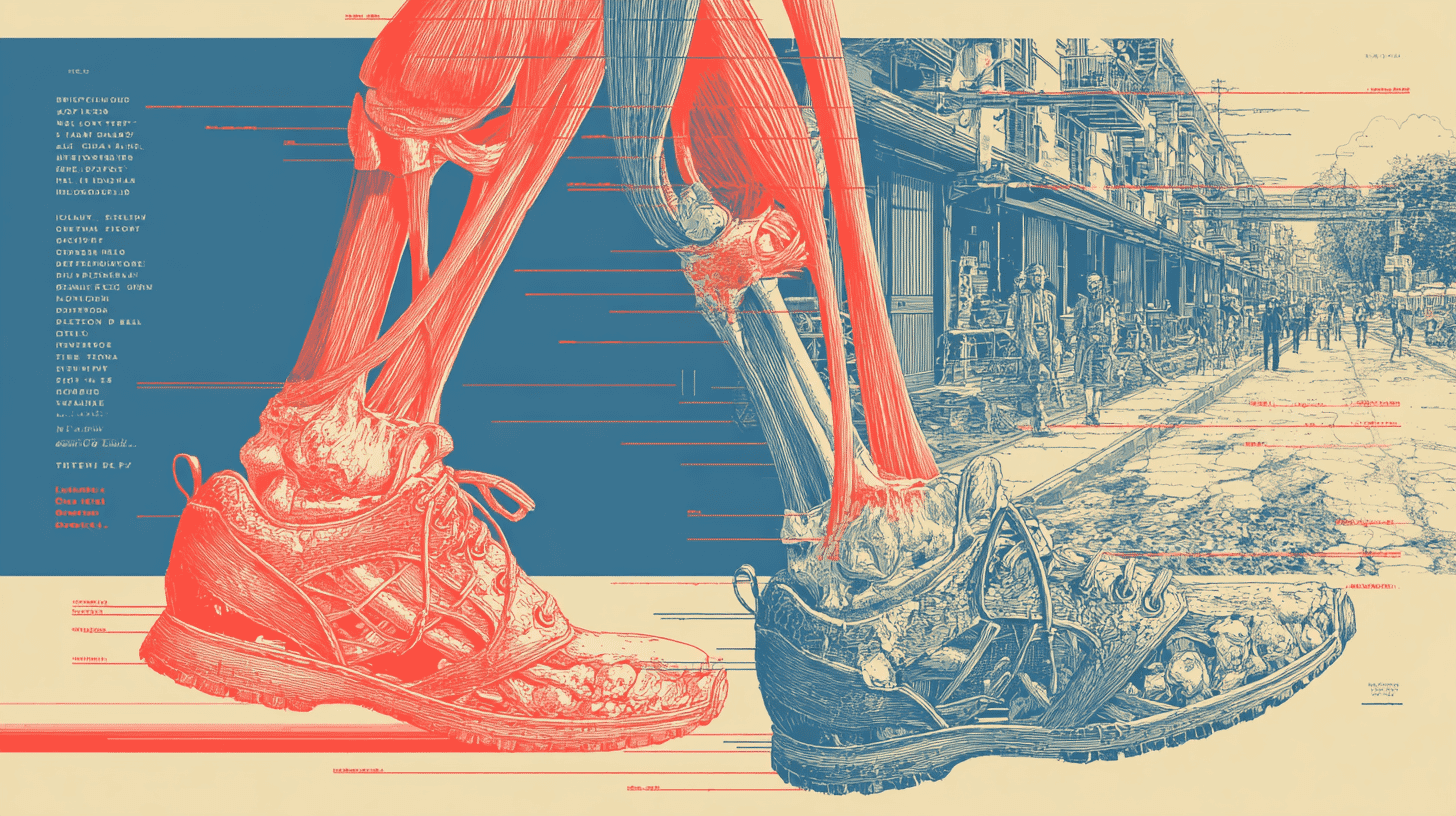
No batteries. No motors. Just 280 grams of rubber. A Japanese bone-setter built a walking support device from hardware store materials in just one week, and it helped someone walk without a cane for the first time in seven years. The company behind it? Three family members and $20,000 in capital. This is the story of "futto," Japan's rubber muscle revolution.
The "Rubber Muscle" Concept That Flips Assistive Tech on Its Head
Ask anyone to picture a walking assistance device and they will describe a robotic exoskeleton: motors, batteries, a price in the thousands or tens of thousands of dollars, heavy, and often needing a professional to operate. A small company in Hamamatsu City, Shizuoka Prefecture, went the other way entirely.
Its product, "futto", is a walking muscle support gear that consists of nothing more than a waist corset and rubber tubes running down each leg. No power source needed. Weight: just 280 grams (about 10 ounces). Price: ¥33,000, roughly $220, a small fraction of what even the cheapest powered walking robots cost.
The breakthrough concept is deceptively simple: rubber contracts when stretched, just like muscles do. By routing rubber tubes along the skeletal muscles used for walking, futto provides external support that supplements weakened muscle power. It's essentially a set of "artificial muscles" made from rubber, working alongside the body rather than replacing it.
Born From a Patient's Tears and Hardware Store Supplies
The inventor is Yoshihiro Yamada, a "judo seifukushi", a traditional Japanese bone-setter and manual therapist. He opened his clinic in Hamamatsu in 1993 and went on to run a rehabilitation day service and a sports gym alongside it, accumulating decades of close observation of how bodies move.
The spark for futto came from a heartbreaking moment. One of Yamada's patients, who had been eagerly anticipating a walking experience using a high-tech robotic device made by a major corporation, was devastated when the robot couldn't help them walk at all. Watching their disappointment, Yamada thought: "I have to find a way to help this person walk."
Using training tubes and belts he had on hand, Yamada improvised an assistive device on the spot. Within a week, he had a working prototype. Every material came from a nearby home center (Japan's equivalent of a hardware store). That crude prototype would eventually evolve into e-foot (for hospitals and care facilities) and futto (for general consumers).
What made this possible was Yamada's decades of clinical experience, he understood intimately which muscles control which movements. He knew the exact pathways of the quadriceps, tibialis anterior, iliopsoas, and other muscles involved in walking. This knowledge of kinesiology and functional anatomy allowed him to map rubber tubes precisely along the body's natural muscle lines. The design is patented in Japan, with applications pending abroad.
How 3 Steps of Walking Get Rubber-Powered Assistance
Putting on futto is remarkably easy. Wrap the corset around your waist, hook the rubber tubes around the toes and heels of both feet, and clip the front and back tubes together at each knee. With practice, the whole process takes 30 seconds to a minute.
The walking support works in three phases:
In the first, as you try to raise your leg, the rubber assists the iliopsoas, the deep muscle connecting hip and lower spine, and the thigh comes up on its own. Knee and heel follow, which heads off the shuffling gait that causes trips.
In the second, as the heel reaches for the ground, rubber assisting the tibialis anterior along the shin lifts the toes, so they catch less on uneven surfaces. The gluteal muscles are supported at the same time, steadying posture on landing.
The third is continuous walking. The tubes front and back contract alternately in rhythm with the stride, so one step leads into the next. Stride length increases, the centre of gravity settles, and walking speed improves.
Interestingly, Yamada says the actual force provided by the rubber is minimal when measured by electromyography. But even this small assist triggers a neurological response, the brain "remembers" which muscles to activate, drawing out strength the person already possessed. In this sense, futto isn't just a support device, it's a walking coach that retrains the body's movement patterns.
The "Do It Yourself" Design Philosophy
Yamada was adamant about one design requirement: users must be able to put on futto entirely by themselves. If you need someone else's help, you'll find excuses not to use it, and eventually stop walking altogether. That defeats the whole purpose.
His 85-year-old mother puts on futto by herself and walks with it. The consumer version comes in waist corset sizes A (70–105 cm) and X (100–120 cm), rubber tubes in S, M and L, and a separate junior range.
Durability is rated at about one year of regular use, and replacing the rubber tubes, which are consumables, keeps it going.
Scientific Validation: Published in an International Medical Journal
The innovation caught the eye of Dr. Yuyu Ishimoto, a lecturer at Wakayama Medical University. Encountering e-foot at an academic conference exhibition, Dr. Ishimoto was struck by its novelty. Traditional orthotic devices, she noted, work by immobilizing and restricting movement, like casts. The idea of using rubber to add power to muscles was something entirely different.
With approval from the university's ethics committee, Dr. Ishimoto conducted a scientific study. The results, published in 2025 in the Journal of Orthopaedic Science (vol. 30, no. 5) (the official English-language journal of the Japanese Orthopaedic Association), confirmed that futto improved walking speed and produced more dynamic movement in the knees, heels, and toes of healthy adult subjects.
Dr. Ishimoto described futto as unique in that it provides "dynamic support", assisting the muscular activity of the lower limbs directly, rather than using the upper body (arms on a walker or cane) as a substitute.
Additional research has been conducted at Maebashi Institute of Technology (motion capture analysis) and Hamamatsu University School of Medicine (gait analysis for spinal degeneration patients), building a growing body of scientific evidence.
Real-World Impact: Walking Again After 7 Years
User testimonials shared by the company and its distributor include the following.
A woman whose knee and hip had been replaced with artificial joints after a traffic accident and degenerative hip disease walked without a cane for the first time in seven years after putting on futto. A man with muscular dystrophy said it made him feel like he could run or even jump. A patient with ALS (amyotrophic lateral sclerosis), who had been shuffling dangerously even with a walking frame, was able to walk under his own power with just light assistance while wearing futto.
According to Re-Life.net, an Asahi Shimbun outlet, about 1,500 units had been sold in Japan in the roughly two and a half years since the June 2023 consumer launch, a meaningful number for a product made by a company with just $20,000 in capital and three family members on staff.
A Prescription for Aging Societies
Japan is one of the world's most aged societies. Government population estimates put the share of people aged 65 and over at 29.4% as of October 2025, a record. Healthy life expectancy, the years lived without limits on daily activity, stood at 72.57 for men and 75.45 for women in 2022, essentially flat since 2019. The gap against average lifespan is about 8.5 years for men and 11.6 years for women, and closing it depends heavily on keeping people walking.
Age-related muscle decline leads to "frailty" (a state of physical and mental vulnerability) and "sarcopenia" (progressive loss of muscle mass), creating a vicious cycle: difficulty walking leads to less time outdoors, which accelerates muscle loss, and can ultimately result in becoming bedridden or developing dementia. In Japanese, the phrase "ashi-koshi ga yowaru" (legs and lower back weaken) captures this health crisis in everyday language.
An affordable, easy-to-use walking support device like futto offers a potential answer. If a $220 investment can maintain or improve walking ability, the downstream savings in medical and caregiving costs could be substantial.
Going Global: From Hamamatsu to the World
Distribution has widened on both fronts. At home, the company signed a distribution agreement in November 2025 with France Bed, a major bedding and home-care supplier, which now carries futto as a rehabilitation product through welfare equipment channels nationwide. Abroad, sales have begun through Amazon. Overseas tech media have also covered it as a passive walking-assist wearable that runs without power.
Aging isn't just Japan's challenge. South Korea, China, and many European nations face rapidly rising elderly population ratios. Plenty of people outside Japan want affordable walking assistance too.
Yamada's vision is clear: "We want to deliver the joy of walking to people around the world, transcending borders and cultural differences." How far a tiny company from Hamamatsu can carry that is still an open question.
As Japan ages, interest in simple, affordable walking aids like this is growing. How does your country help older people keep walking?
References
- https://prtimes.jp/main/html/rd/p/000000001.000123197.html
- https://futto.jp/
- https://medical.francebed.co.jp/home_medical_care/rehabilitation/futto_e-foot.html
- https://tarzanweb.jp/post-294219
- https://doi.org/10.1016/j.jos.2024.12.006
- https://www.stat.go.jp/info/guide/asu/pdf/2026asu_3-5.pdf
- https://www.notebookcheck.net/Yamada-Orthopedic-Clinic-introduces-Futto-leg-wearable-to-boost-walking-ability-of-hikers-elderly-and-partially-disabled.809468.0.html









Global Discussion
16 comments