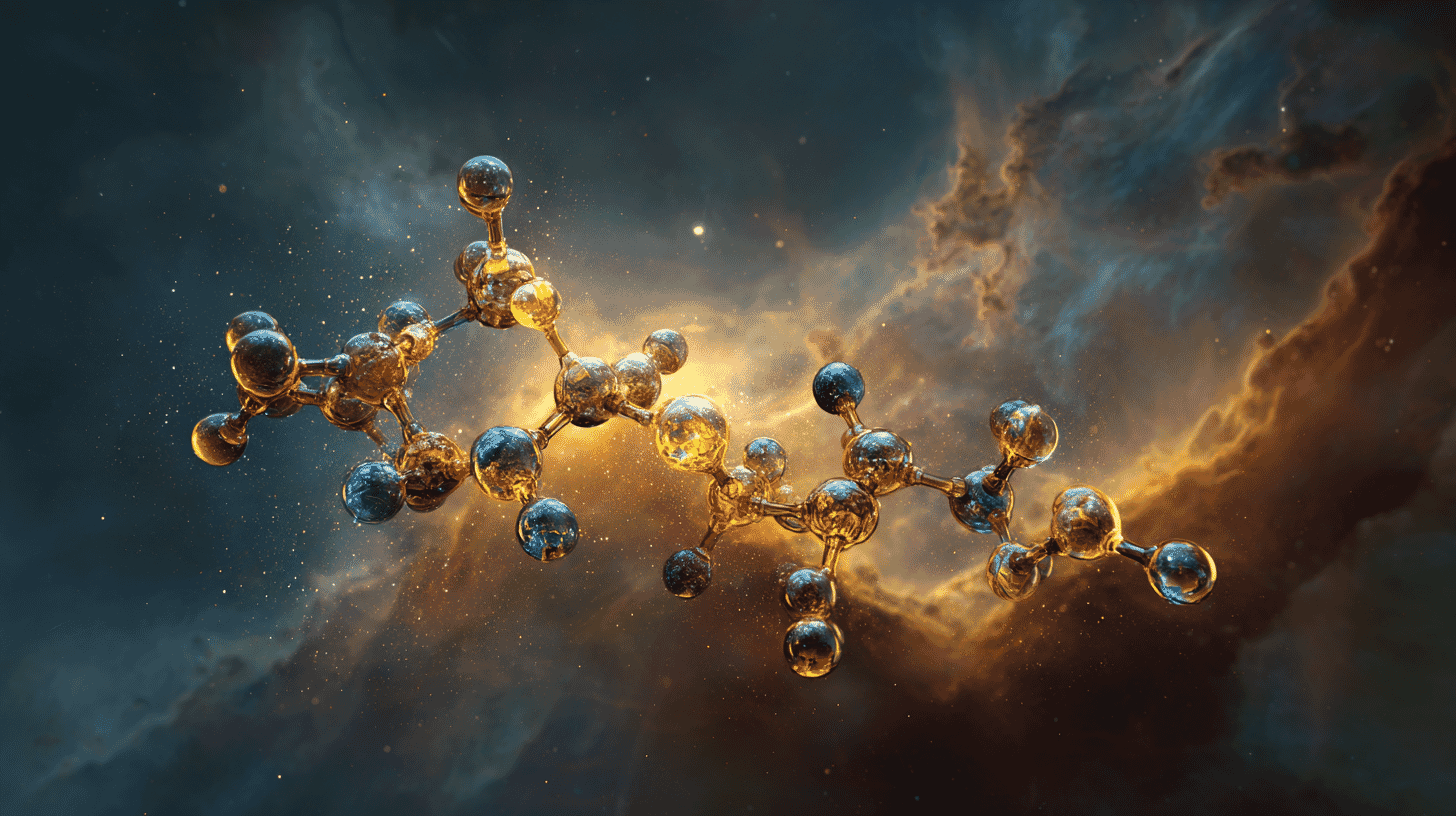
Another ingredient of life has been found in space, and this time it is a large organic molecule containing sulfur, something that had rarely been found in space. Made of 13 atoms in a ring, it closely resembles substances found in comets and meteorites. The research was led by Mitsunori Araki, a Japanese scientist working in Germany. A "missing link" between space and life may now be falling into place.
The Largest Organic Sulfur Molecule Ever Found in Interstellar Space
In January 2026, a landmark paper appeared in Nature Astronomy. An international team led by Mitsunori Araki of the Max Planck Institute for Extraterrestrial Physics (MPE) in Germany detected, in the molecular cloud G+0.693-0.027 near the center of the Milky Way, the largest organic sulfur compound ever found in interstellar space.
It is 2,5-cyclohexadiene-1-thione (C₆H₆S), a stable six-membered ring of 13 atoms including carbon, hydrogen and sulfur. Most sulfur-bearing molecules found in interstellar space so far have had three to five atoms, with nine the previous maximum. Jumping to 13 atoms pushes the frontier of astrochemistry considerably further.
Why Sulfur Matters So Much
Sulfur is the tenth most abundant element in the universe and, on Earth, an essential part of amino acids, proteins and enzymes. Sulfur-containing amino acids such as methionine and cysteine form disulfide bonds that set the three-dimensional structure of proteins, making the complex functions of life possible.
Curiously, though, only a handful of sulfur-bearing molecules had been found in space. Sulfur should be plentiful, yet it could not be observed. This "missing sulfur problem" has been one of the big puzzles of astrochemistry. One idea was that it is locked away in ice; the new discovery adds an important piece to the puzzle.
A Precise "Fingerprint Match" Linking Lab and Telescope
The team's method is distinctive. First, in the laboratory, they synthesized the target molecule by applying an electrical discharge of about 1,000 volts to thiophenol, a foul-smelling liquid. Using a spectrometer they built themselves, they measured the radio frequencies emitted by the molecule to better than seven-digit precision, obtaining its radio "fingerprint."
They then compared that fingerprint with observations of the molecular cloud from the IRAM 30-meter radio telescope and the Yebes 40-meter radio telescope in Spain. The match was clear, proving for the first time that this complex ring-shaped sulfur molecule actually exists in space.
A "Missing Link" to the Origin of Life
Why does this discovery bear on the origin of life? The key is that the molecule is structurally close to sulfur compounds detected in comets and meteorites.
Life on Earth is thought to have begun about four billion years ago, but where its ingredients came from has long been a mystery. One leading hypothesis holds that comets and meteorites delivered complex organic molecules to Earth from space. Large sulfur-bearing ring molecules such as benzothiophene and dibenzothiophene have been found in meteorites, but there had been no evidence that such molecules form in interstellar space.
Co-author Valerio Lattanzi says: "Comets and meteorites may have brought complex molecules to Earth as one source of the origins of life. What we are aiming for is to connect the missing links in the process leading to the birth of life." The discovery builds, for the first time, a direct "chemical bridge" between the chemistry of interstellar space and the organic matter of the solar system.
Connections to Japanese Space Science
Mitsunori Araki, who led the study, is a Japanese-born scientist working as a postdoctoral researcher at MPE's Centre for Astrochemical Studies (CAS). The result is a good example of Japanese scientists tackling the mysteries of space at the global frontier.
Japan has built up distinctive contributions in this field. Samples returned from asteroid Ryugu by JAXA's Hayabusa2 contained more than 20 amino acids and uracil, a building block of RNA, directly showing that the ingredients of life form in space. Research in organic cosmochemistry by Yoshinori Takano of JAMSTEC and colleagues traces a path from molecular evolution in space to the origin of life.
In addition, the Tanpopo mission by Japanese scientists has attempted to capture organic matter drifting in space from the International Space Station.
The discovery of this interstellar organic sulfur molecule is highly significant in the context of Japanese space science. In the grand story in which material born in molecular clouds is incorporated into small bodies and eventually delivered to planets, the analysis of Hayabusa2's samples and this discovery tackle the same puzzle from different angles.
Life's Chemistry Nurtured in a "Cradle of Stars"
G+0.693-0.027, where the molecule was detected, is a molecular cloud near the center of the Milky Way about 27,000 light-years from Earth. Molecular clouds are cold, dense concentrations of dust and gas that eventually collapse under gravity to form stars, which is why they are called "stellar nurseries."
What matters is that the molecule was found in a young molecular cloud where stars have not yet formed. As Lattanzi stresses, "a 13-atom molecule structurally similar to those in comets already exists in a young, starless molecular cloud. This proves that the chemical groundwork for life begins long before stars form."
In other words, the origins of the molecules that make up our bodies may have been prepared deep in the galaxy before the solar system was born.
Looking Ahead: Toward Amino Acids in Space
Associate Professor Ryan Fortenberry of the University of Mississippi says: "Fifty-some years ago, finding molecules in space at all was a miracle. The conventional wisdom was that large molecules would be destroyed in the harsh environment of space. Now we are finding molecules of 13 atoms, or even dozens." He adds that he is "confident that amino acids will eventually be found in space beyond the solar system."
Professor Sara Russell of the Natural History Museum in London notes that "the presence of complex organic molecules at the center of the Milky Way suggests biologically important substances may exist everywhere in space," and says "the chance of life existing on another planet has gone up a little."
The universe has turned out to be far more chemically rich than once thought. The ingredients of our lives may not be unique to Earth but the product of universal chemical processes spread across the galaxy. This discovery takes a new step toward humanity's oldest question: where did we come from?
In Japan, interest in the link between space and life runs high, not least through the analysis of Hayabusa2's Ryugu samples. What research and debate on the origin of life is there in your country?
References
- https://www.nature.com/articles/s41550-025-02749-7 - Nature Astronomy 原論文
- https://www.mpe.mpg.de/8130016/news20260129 - マックスプランク地球外物理学研究所プレスリリース
- https://phys.org/news/2026-01-astrophysicists-largest-sulfur-molecular-compound.html - Phys.org報道
- https://www.cnn.co.jp/fringe/35243473.html - CNN日本語版報道
- https://www.isas.jaxa.jp/feature/interview/154.html - JAXA宇宙科学研究所「生命の起源の答えを宇宙に見つける」
- https://www.jamstec.go.jp/j/pr/topics/explore-20230927/ - JAMSTEC「有機宇宙化学で迫る生命の起源」







Global Discussion
15 comments