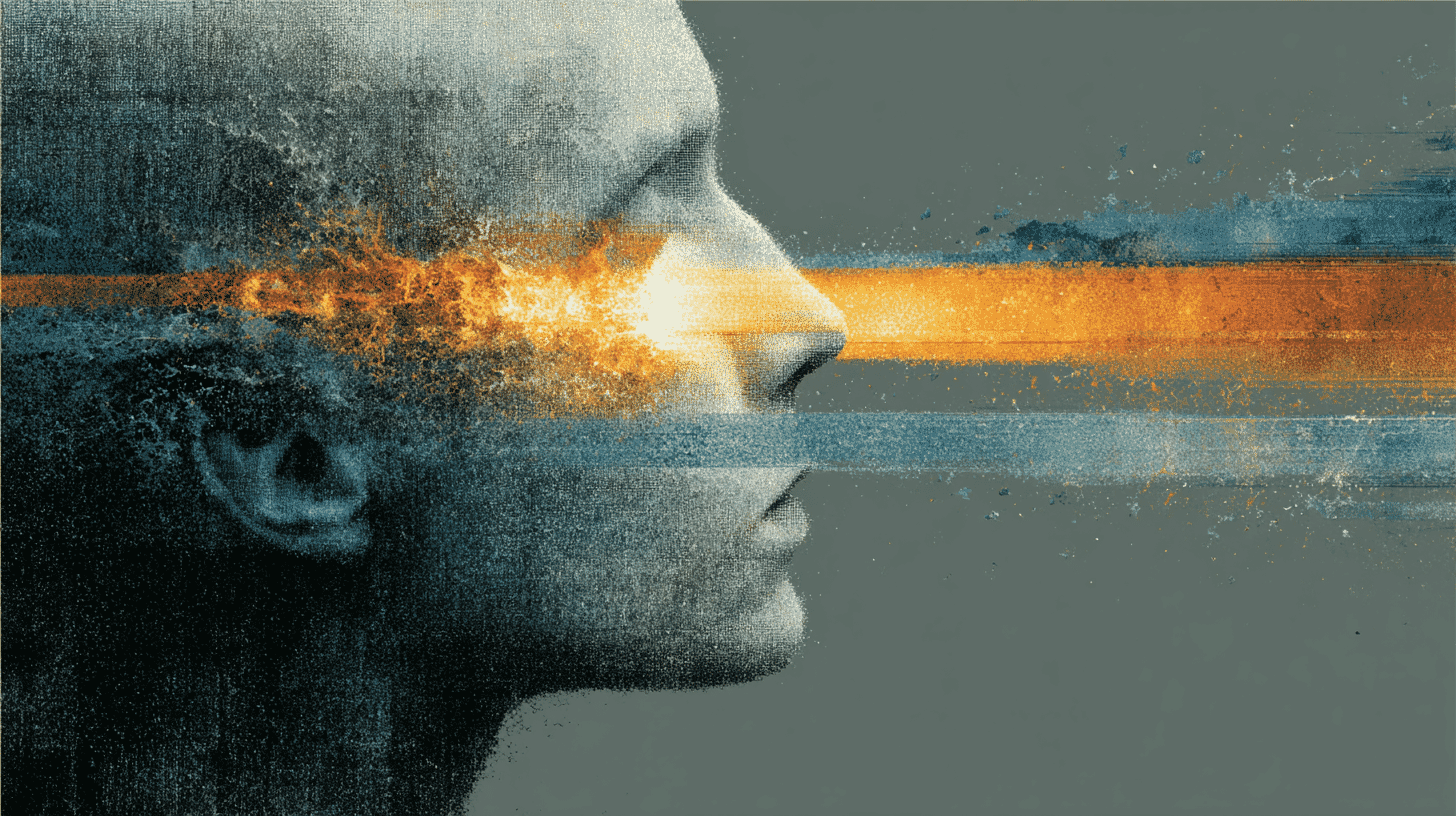
🧠 You're in the shower and you swear you hear the doorbell. You step out, dripping, and… nobody's there.
Your brain didn't malfunction. It was doing something it does every waking second: betting on what's out there based on what just happened. That bet is what we call intuition, and a team at Japan's RIKEN has now found where the brain keeps it, and the surprising trick it uses to know when the bet has gone stale.

Source: RIKEN
The bet your brain never stops making
When the information reaching your senses is too thin to be sure, you don't freeze. You guess: fast, and usually without noticing. That guess leans on the recent past: the sounds, sights, and patterns of the last few moments, quietly stacked up into an expectation of what's likely to happen next.
Most of the time this is a gift. It lets you finish a half-heard sentence, catch a ball, or sense that a meeting is about to go sideways. But the same machinery has a dark side. Lean on the stored expectation too hard and you start hearing doorbells in the hiss of the water. Or, in the extreme, you tip into the territory of delusion and the voices of schizophrenia, where the brain's internal picture overrides what's actually coming in.
So the brain faces a balancing act. It has to use its running expectation, but also throw it out and refresh it the moment the world changes. Two questions had stumped neuroscientists: where is this short-term "sensory experience" physically held, and how does the brain decide when to wipe it and start taking in fresh information? Catching the precise instant of an update happening inside a living brain had proven almost impossible.
The study, led by Lukas Ian Schmitt's Distributed Cognitive Processing team at the RIKEN Center for Brain Science, was published in the journal Neuron on May 29 (May 30 in Japan).
Two tones, one mouse, and a hidden tally
To catch the brain in the act, the team built a deceptively simple listening game for mice. The animals heard a stream of two kinds of beeps, high and low, and had to judge which was more common, turning right for "mostly high" and left for "mostly low."
The clever part was the mix of trials. In some, the answer was obvious from the sounds alone. In others, the two tones came in equal numbers, leaving no clue in the moment, so the only way to score was to fall back on the recent trend, the tones that had dominated the previous few rounds. To do well overall, a mouse had to listen carefully and keep a quiet tally of recent experience.
The team recorded single neurons across several brain areas at once, and also reached into the brain with light. Using optogenetics, a technique that fits neurons with light-sensitive switches so they can be turned on or off in milliseconds, they briefly silenced a region called the posterior parietal cortex, an integration hub near the top of the cortex, in the pause between trials.
The result split in two. On the "experience" trials, the mice got worse: the stored memory of recent tones had vanished, so they had nothing to lean on. But on the clear-cut trials, they actually got better. That second finding is the tell. It means that in normal conditions the stored expectation was quietly biasing the animals' read of what was right in front of them, the same way a stored memory of doorbells can make you mishear the shower. Take the expectation away, and the mouse sees the present more clearly.
Silencing the pulvinar, the largest lump of the thalamus, a deep brain structure whose name is Latin for a cushioned chair piled with pillows, produced the same effect. The conclusion: the brain's recent "sensory experience" isn't parked in one spot. It's held in a loop running between the cortex and the pulvinar, refreshed in a constant back-and-forth.
The brain's mismatch detector
That left the harder question. If a stored expectation can quietly distort what you perceive, the brain needs a way to notice when it has gone wrong and wipe it. What plays the role of editor?
The team's suspect was an unglamorous sliver of tissue called the thalamic reticular nucleus, a thin shell wrapped around the thalamus, made entirely of cells whose job is to inhibit, to turn other regions down. Back in 1984, Francis Crick (yes, the co-discoverer of DNA's structure) proposed that this shell acts as the brain's "searchlight," steering attention. The RIKEN team suspected it might also be the switch that updates intuition.
When they used light to crank up the reticular nucleus, the stored expectation in the cortex-pulvinar loop got overwritten, and the mice's grip on the present sharpened. So the nucleus could trigger an update. But did it do so naturally, at the right moment?
So the team singled out the trials where an update was most needed: recent trend pointing one way, current sounds the other, and the mouse getting it wrong. That is a sign the old expectation was too strong. Using a fluorescent sensor that tracks inhibition, they measured the signal reaching the pulvinar in real time. On exactly those mismatch-and-wrong trials, the inhibitory signal rose. When expectation and reality agreed, being wrong produced no such rise, so the brain wasn't simply reacting to mistakes. It was detecting the clash between a too-confident memory and fresh evidence, and using it to refresh.
Tracing the wiring, they found why. Each reticular-nucleus cell pulls together inputs from two different pulvinar neurons, one carrying the current information, one carrying the stored experience, and responds when the two disagree. In plain terms, it's a comparator: a circuit whose job is to flag a mismatch, and when it does, to flip the brain into "take in something new" mode.
A circuit that evolution and AI both stumbled onto
The last result didn't involve a mouse at all.
The team built a stripped-down computer model of just the basic wiring between cortex, pulvinar, and reticular nucleus, then trained it on the very same tone game. After learning, model "neurons" with the same comparator pattern, two clashing inputs feeding one cell, appeared on their own. Switch those artificial neurons on, and the model started failing the experience trials the way the mice did.
So a circuit motif that evolution shaped to keep our intuition honest also self-assembled inside an AI handed the same problem, a hint that it isn't a quirk of mammals but something close to a general solution for updating beliefs under uncertainty.
What could this switch do for the rest of us?
There's a reason this lands now. We all live inside more information than any brain evolved to handle, and the same nucleus has long been tied to schizophrenia, where the handoff between "what the world shows me" and "the picture in my head" breaks down into hallucination or fixed false belief. Schmitt, who keeps a compass on his desk because "it conveys meaning but you have to interpret it", calls intuition a detective's gift, the brain pulling patterns from noise without formal logic. Powerful, but easily jammed by today's overload. Knowing the switch that keeps it calibrated is a first step toward sharpening it on purpose.
Now for a leap into pure imagination. None of what follows is possible today, but picture this circuit being read and gently nudged in humans, fifty years from now. You might wear a kind of fitness tracker for an open mind: one that notices when your update switch has stalled, when you've been trusting the same sources without letting anything new in, and quietly flags it. Someone trapped in a hallucination or a fixed false belief might be eased back toward "take in fresh evidence" mode, instead of letting the picture in their head override the world. And experience itself could be turned down on purpose, letting a pilot or a surgeon facing something with no precedent see it with fresh eyes, on the rare occasions when hard-won habit would only mislead. The team itself floats one far-off version of this: "next-generation mental control," watching your own brain switch modes and learning to steer it, like meditation with instruments.
Keep the brakes on, though. This is work in mice, and treating human minds is a hope, not a result. What the study actually delivers is more fundamental: the first clear look at the moment a belief gets rewritten, and the sliver of brain that calls the play.
So the next time your gut speaks up, it's worth a thought: that hunch is your brain tallying the last few minutes and betting they'll keep being true. Sometimes they won't. In Japan, "reading the air" and trusting a quiet sense of the room is practically a national skill, but where you live, do people lean on gut feeling, or stop to double-check it?
References
- RIKEN press release (May 30, 2026): https://www.riken.jp/press/2026/20260530_1/index.html
- Hosford PS, Mei H, Tagomori Hosana, Hayde CP, Abdelaal MS, Tagomori Hanna, Nakajima M, Schmitt LI. "Control of representation updating by higher-order thalamus enables history-based decision-making." Neuron (2026). https://doi.org/10.1016/j.neuron.2026.04.045
- RIKEN CBS researcher profile, L. Ian Schmitt: https://cbs.riken.jp/en/faculty/l.schmitt/







Global Discussion
0 comments