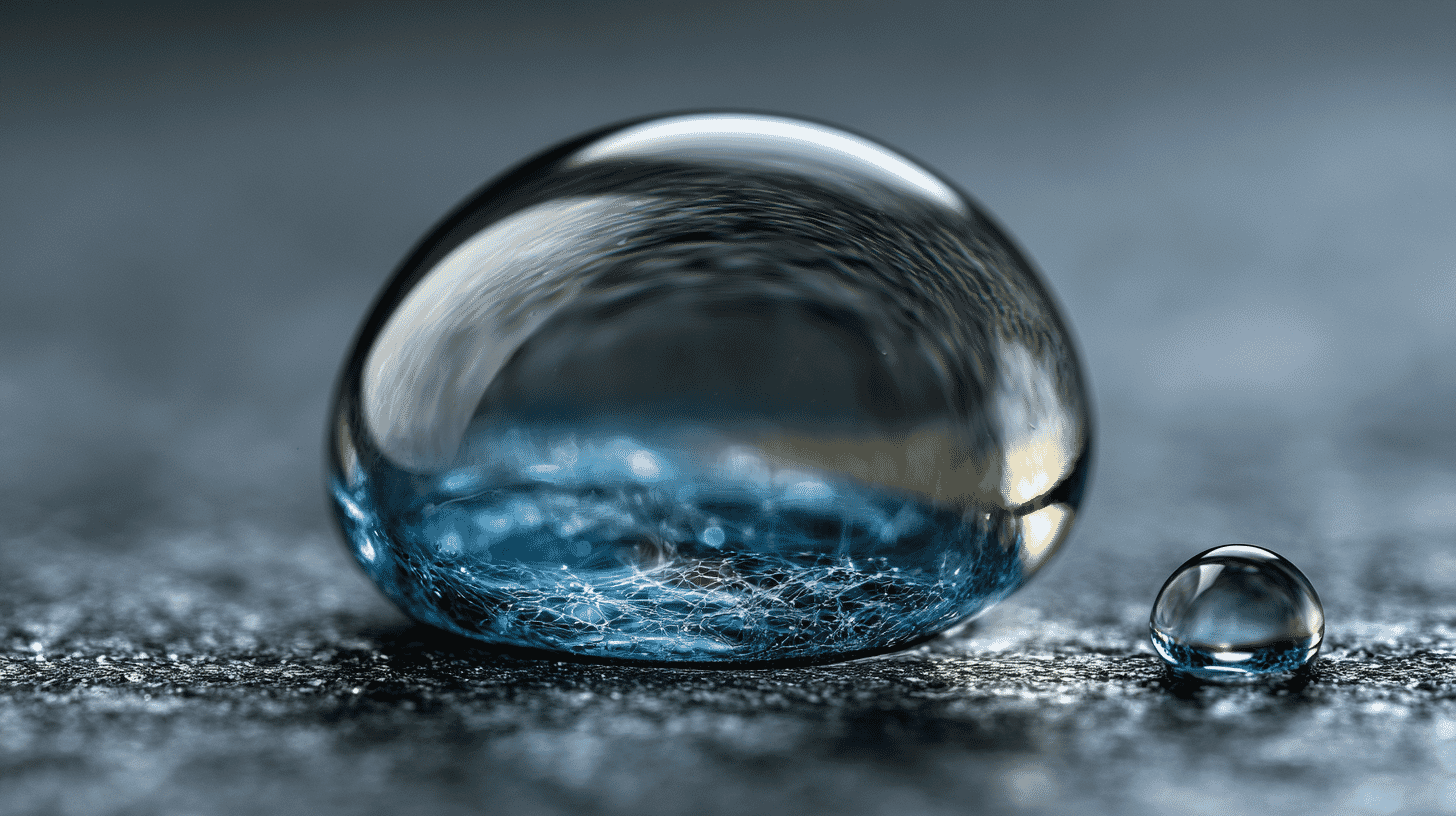
🟢 Squeeze a block of jelly and it smears. Drop it and it splats. A gel that is mostly water is not supposed to bounce. Yet a team at Hirosaki University in northern Japan has made one that does: a soft material that is about 70% water by volume and still springs back like a rubber superball. The trick was not a new polymer or a clever additive. It was swapping a single chemical group on the tip of a side chain.
Why wet usually means weak
Most gels you have met are pushovers. Gelatin dessert, agar, a soft contact lens, the squishy core of a stress ball: all are polymer networks swollen with water, and all are easy to tear or crush. There is a reason for that. The water that makes a gel soft and slippery also keeps the load-bearing polymer strands far apart and lubricated, so the material has little to fight back with when something hits it hard. Push the water content up, and you usually trade away strength.
The obvious fix is to lock the network down with more permanent chemical bonds, called covalent crosslinks. But that backfires. A densely crosslinked gel does get stiff, and it also gets brittle. Instead of bouncing, it cracks. For a long time, "wet and stiff and springy, all at once" has been a frustrating combination to pin down.
A one-group swap
The Hirosaki group, led by assistant professor Takuma Kureha with associate professor Takahiro Okabe, went a different way. Their polymer carries short side chains that branch off the main backbone, like tiny flexible arms. In the standard recipe, each arm ends in a methoxy group (–OCH3), which is mildly water-repelling. The team changed only that endpoint to a hydroxyl group (–OH), the same –OH found in water and alcohol, which readily forms hydrogen bonds.
That one change, made in a simple one-pot, water-based reaction, rewired how the material holds itself together. The hydroxyl tips reach out and grab one another through hydrogen bonds, weak and reversible links that constantly break and reform. The payoff was big. The gel's stiffness climbed from roughly 0.1 megapascals to as much as 2, about a twentyfold jump, landing it in genuinely firm, MPa-class territory while still sitting at around 70% water. And it bounced. Even under repeated loading, it kept absorbing and returning energy without wearing out.
The reason it springs rather than shatters comes down to those reversible bonds. A permanent crosslink, once stretched too far, snaps for good. A hydrogen bond simply lets go, slides, and re-grabs somewhere new, soaking up the energy of an impact and then knitting the network back together. The team's measurements traced the extra strength to this reversible bonding rather than to packing in more permanent links, which is exactly why the gel stayed tough and elastic instead of turning glassy and fragile.
Cartilage, cushions, and the fine print
Why care about a bouncy blob of water? Because a fair amount of the soft machinery in your own body is, in effect, a stiff wet gel. Cartilage, the slick cap on your joints, is roughly 70 to 80% water and still absorbs the load of every step you take. Engineers have wanted synthetic materials that behave like that for years: firm under weight, springy on impact, and content to stay soaking wet. The Hirosaki gel points that way. The team names artificial cartilage and underwater shock absorbers as targets, along with a broader role as a smart material that could feed into soft robotics, where flexible, water-based parts are increasingly in demand.
A reality check belongs here. This is early-stage work, published as a short communication in the Royal Society of Chemistry journal Chemical Communications on June 12, 2026. It proves a principle in the lab, not a product on a shelf. Turning a benchtop gel into a load-bearing knee implant or a marine bumper would mean years of durability testing, biocompatibility studies, and scale-up. What makes it worth watching is not a finished application but how little it took: a result this counterintuitive, from editing one group at the end of a molecular arm, is the kind that sends other labs back to recipes they thought they had figured out.
From wobbly desserts to the cushioning gel in a pair of running shoes, soft wet materials are everywhere once you start looking for them. Where do you run into them in daily life, and is materials science something your country tends to take pride in?







Global Discussion
3 comments