
Bend it, wear it down, and watch it heal itself. Metals succumb to "fatigue" when bent repeatedly, but a graphite material discovered by Mitsubishi Electric and Kyoto University can restore its own strength after deformation. Hardness that dropped to 41% recovered to 97% in just seven days. This breakthrough could dramatically extend the lifespan of MEMS sensors, the tiny devices powering everything from your smartphone to autonomous vehicles.
A World-First Discovery: Self-Healing Graphite
On January 27, 2026, a joint research team from Mitsubishi Electric Corporation and Kyoto University's Graduate School of Engineering announced a groundbreaking discovery in materials science. They became the first in the world to demonstrate that a special carbon material called HOPG (Highly Oriented Pyrolytic Graphite) possesses "self-recovery properties," the ability to regain its original hardness after softening from repeated stress.
The research findings have been accepted by "Diamond and Related Materials," an international academic journal covering diamond and related materials.
What is HOPG? A Special Layered Structure of Graphene
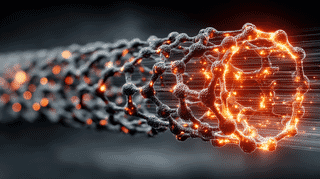
HOPG stands for Highly Oriented Pyrolytic Graphite, a high-purity synthetic graphite where individual graphite microcrystals are extremely well-aligned. Its structure consists of multiple stacked layers of "graphene," ultra-thin sheets of carbon atoms arranged in a honeycomb pattern.
The key lies in what holds these graphene layers together. Unlike the strong atomic bonds in metals, these layers are stacked using extremely weak intermolecular forces called "van der Waals forces (vdW forces)." This special structure allows HOPG to absorb large deformations flexibly through inter-layer slippage when bent, without cracking like metal would.
Remarkable Recovery: From 41% to 97%
The research team conducted repeated bending tests on extremely small HOPG specimens inside an electron microscope. They used two testing methods: "pulsating tests" (deformation in one direction only) and "alternating tests" (deformation in both directions).
The alternating test results were particularly striking. After 1,000 load cycles, the specimen's deformation resistance (an indicator of hardness) dropped to just 41% of its initial value, less than half its original hardness. However, after being left alone for 7 days, the deformation resistance recovered to 97%, essentially restoring its original hardness completely.
Pulsating tests showed similar trends. Deformation resistance that dropped to 66% after 10,000 load cycles recovered to 91% after 38 days of rest. Even more intriguing, when left for just 30 minutes between the 13,000th and 13,001st cycles, recovery from 70% to 82% was observed, demonstrating that even brief rest periods allow some recovery.
Why Does "Self-Recovery" Occur?
This remarkable property stems from HOPG's layered structure.
The van der Waals interactions that bind graphene layers together can reform over time even after being disrupted by inter-layer slippage. Imagine an adhesive that naturally re-bonds after being separated. The combination of graphene's inherent high strength and flexibility, along with this "reconnection property" of vdW interactions, gives HOPG self-recovery capabilities that metals simply don't possess.
This stands in stark contrast to metals, which develop cracks through "metal fatigue" under repeated loading, eventually leading to failure.
MEMS Applications: The Ultra-Small Sensors Powering Our Lives
The primary reason this discovery attracts attention is its potential application to MEMS (Micro Electro Mechanical Systems).
MEMS are micron-level ultra-small devices that integrate mechanical elements, sensors, actuators, and electronic circuits on a single substrate. Countless MEMS devices already surround us in daily life.
Everyday MEMS examples:
- Smartphone accelerometers (automatic screen rotation, step counting)
- Automotive airbag deployment sensors
- Autonomous driving and safety control sensors in vehicles
- Health monitoring sensors in wearable devices
- Motion sensors in game controllers
- Inkjet printer nozzles
- Digital mirror devices in projectors
The MEMS market is expanding rapidly, projected to reach approximately $18.23 billion in 2025 and $27.32 billion by 2030. This growth is driven by increasingly sophisticated smartphones, advancing autonomous driving technology, and the proliferation of IoT devices.
The Path to "Unbreakable Devices"
HOPG's self-recovery property shows potential for use as a "vibration absorption mechanism" in MEMS.
Current MEMS devices gradually degrade when exposed to prolonged vibration and shock. However, by applying materials with self-recovery properties to vibration absorption mechanisms, it becomes possible for devices to continue operating while recovering from vibration-induced fatigue on their own. This means achieving devices that are resistant to failure and highly reliable even in continuous vibration environments.
Mitsubishi Electric plans to apply this self-recovery property to MEMS vibration absorption mechanisms, aiming to develop long-lasting, highly reliable devices. They will also investigate whether other vdW layered materials (materials bonded by van der Waals forces besides graphite) possess similar properties, and are considering applications to vdW layered materials that generate electrical potential when deformed. This opens the possibility of MEMS that efficiently and continuously convert deformation energy into electrical energy: sensors with self-generating power capabilities.
A Breakthrough Born from Industry-Academia Collaboration
This research achievement emerged from organizational collaboration activities between Mitsubishi Electric and Kyoto University that began in 2019. Mitsubishi Electric handled HOPG fatigue property evaluation and result analysis, while Kyoto University's Graduate School of Engineering Solid Mechanics Laboratory (Hirakata Laboratory) conducted fundamental research on nanostructure properties.
This represents an excellent example of Japanese industry-academia collaboration bearing fruit in the form of a world-first materials science discovery.
Japan's Materials Technology Opens the Future
Japan has traditionally been known as a country with strength in materials technology. This discovery demonstrates that Japan can lead the world in both fundamental science and applied technology.
The Mitsubishi Electric Group, which holds global market share in semiconductor manufacturing equipment and electronic components, posted consolidated sales of ¥5.5217 trillion in fiscal 2024, with over 200 group companies worldwide and approximately 150,000 employees. The fusion of their technological prowess with the knowledge of Kyoto University, one of Japan's leading research institutions, made this groundbreaking discovery possible.
In Japan, this discovery of "self-healing material" is attracting attention for its potential to significantly improve the reliability of next-generation devices like smartphones and autonomous vehicles. What kind of initiatives are being undertaken in your country regarding new materials research and development or MEMS technology?







Global Discussion
16 comments