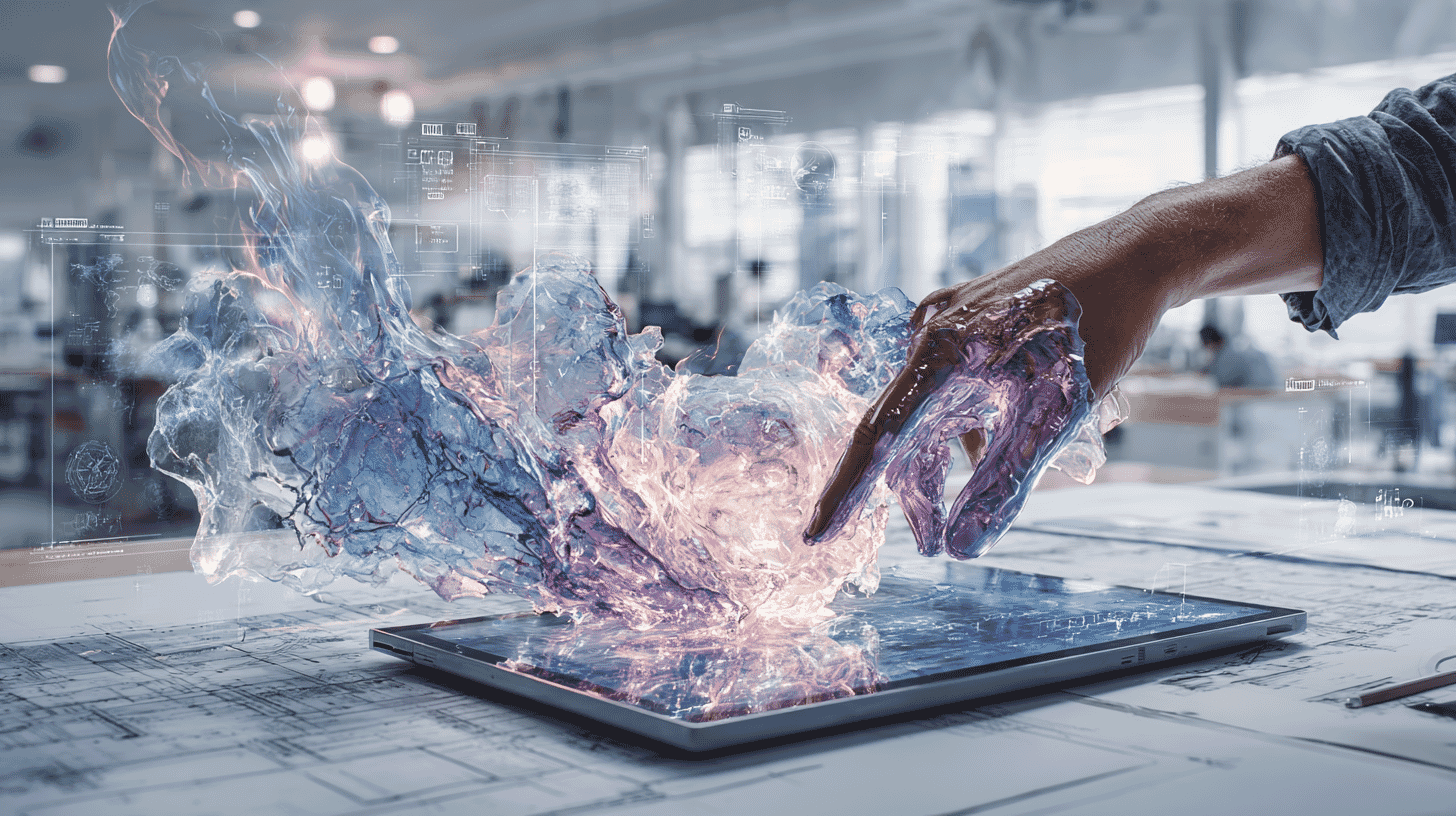
🖐 Pinch an object on your screen and feel its stickiness or softness, without wearing a glove, holding a controller, or touching anything at all. It works with nothing more than a smartphone camera.
NTT's "world-first" illusion method, announced on May 12, 2026, starts from a different premise than the haptics we know, which has long relied on vibration motors, exoskeleton gloves, and other physical devices.
What Makes This a "World First"
On May 12, 2026, Nippon Telegraph and Telephone Corporation (NTT) announced that it has developed the world's first technique to convey the textures of "softness" and "stickiness" in an augmented reality (AR) environment without any physical contact. The softness findings were published in IEEE Transactions on Visualization and Computer Graphics, a peer-reviewed journal in visualization and computer graphics. The announcement came at a press preview in Tokyo the same day, and working demos were shown at NTT Communication Science Laboratories' "Open House 2026," held May 20 to 22 at PRISM inside QUINTBRIDGE in Miyakojima, Osaka.
The key feature: users wear nothing, touch nothing, and yet experience material qualities just by moving their fingers in front of a PC or smartphone screen.
The mechanism is elegantly simple. A camera tracks the user's hand movements in real time, and a virtual object displayed on the screen deforms in sync: squishing when the user pinches, stretching when the user pulls apart. In the demo, a sphere sat near the centre of the screen with a black dot overlaid on the tracked fingertip. The brain processes the match between how the dot follows the finger and how the sphere deforms, and generates the illusion of touch from visual information alone.
Two Parameters That Create the Illusion
What NTT's researchers established experimentally is the precise relationship between what kind of visual deformation produces what kind of texture sensation.
Softness is determined by "spatial deformation range"
When pressing a virtual object, how widely the deformation spreads across its surface determines the perceived softness. With 130 experimental participants evaluating videos with varied push depths and deformation ranges, the team found that the object feels softest when the deformation spread is around 16–32 pixels.
Stickiness is determined by "stretch distance until break"
Separate the thumb and index finger on screen and the virtual object between them stretches, then breaks at a certain point. The longer it stretches, the stickier it feels: like mochi at the extreme, like oil at the short end. The same pattern held in both a 31-person laboratory study and a 57-person online study conducted via smartphones.
In other words, by controlling pixel-level deformation parameters, the system can plant in the viewer's brain the impression "this is a soft gel" or "this is a sticky candy."
What "Mainstream Haptics" Looks Like Today
Why this approach is unusual becomes clear next to the mainstream, which splits into two broad families.
① Tactile feedback stimulates the skin surface. Vibrotactile is the dominant method: phone notification vibrations, game controller rumble, the nuanced feedback of the PS5 DualSense, all built on eccentric rotating mass (ERM) motors, linear resonant actuators (LRA), or piezoelectric elements. Cheap and easy to implement, but limited to variations of vibration. Ultrasonic mid-air haptics also needs nothing worn, focusing acoustic pressure from a transducer array onto a bare hand, but the array itself runs to hundreds of elements. Electrotactile methods use weak currents to stimulate tactile nerves directly, as in braille displays.
② Kinesthetic or force feedback applies force to muscles and tendons. Exoskeleton gloves such as HaptX use motors in a worn frame to resist finger movement and can reproduce genuine resistance, but the hardware is heavy, expensive, and impractical for daily home use. The most sophisticated consumer-grade example is the PS5 DualSense adaptive trigger, which simulates the tension of drawing a bowstring or compressing a spring.
What these approaches share: some physical device either touches the user's body or generates a physical stimulus. Touch reaches the brain through a physical intermediary.
NTT's Work Sits in the "Pseudo-Haptics" Lineage
NTT's new technology belongs academically to a field called pseudo-haptics, a concept systematized around the year 2000 by French researcher Anatole Lécuyer and colleagues. The core idea: exploit the mismatch between visual feedback and the user's motor actions to create tactile illusions without any physical stimulus.
A familiar example: slow down a mouse cursor and users perceive heaviness that isn't there.
NTT has been accumulating research in this area for years. In 2021 it applied the velvet hand illusion in a method where rotating a thin sheet between the hand and an object makes rough surfaces feel softer and smoother. In May 2025 it showed that rotating an ultrasonic focal point at 5 Hz amplifies perceived force roughly twentyfold, which still uses a physical stimulus even though nothing is worn.
This latest announcement marks the far end of that line. Not "make the device lighter" or "make the device smaller," but eliminate the device entirely. A smartphone's front camera and display are sufficient.
What Problems Could This Solve?
NTT lists four application domains: e-commerce, remote communication, education/training, and entertainment. Each addresses a concrete real-world problem.
① The "can't touch online" problem in e-commerce
The biggest source of anxiety in online shopping for clothes and food is that you can't gauge the texture of the actual item. Is the T-shirt scratchy or soft? Is the bread fluffy or dense? Photos and descriptions can't fully resolve this, and the resulting return rates cut directly into e-commerce margins. In apparel specifically, return rates are said to reach 20–30%.
Past research has explored vibration gloves that simulate fabric texture, but requiring consumers to wear hardware is impractical. NTT's method needs only a camera-equipped phone: the user pinches the sweater on the screen and gets an intuitive sense of its softness. The bar for retailer adoption is correspondingly low.
② Sharing textures at a distance
Saying "this is really chewy" over a video call doesn't convey much. Letting the listener feel the same texture through their own phone screen is a different proposition. Cooking instructors conveying dough firmness to remote students, teachers showing how clay should behave, training on human tissue or hazardous materials nobody can hand around: all of these start from the premise that touching is off the table.
③ The cost barrier
A point easy to overlook: this approach is fundamentally cheap. Exoskeleton gloves sit in professional price brackets, and even consumer haptic vests run into the hundreds of dollars. Pseudo-haptics requires only a smartphone, which is a completely different reach in emerging markets and among individual consumers.
The Limits That Remain
That said, pseudo-haptics doesn't replace mainstream technology in every domain.
Because no actual physical stimulus is delivered, the strength of the "touching" sensation can't match the real thing. For applications that need strong, real-time force feedback, such as the heft of a sword swing in a VR game or the tissue resistance felt by a surgeon manipulating a scalpel, force feedback hardware remains necessary.
The illusion also depends on tight synchronization between screen and finger motion, which makes it vulnerable to communication latency. Share textures remotely with enough lag and the illusion collapses. NTT itself lists usage environment, device variation and communication latency as verification topics going forward, and says effectiveness in actual purchasing behaviour has yet to be evaluated.
The right framing isn't "haptics has a new king." It's that this opens a new layer, bringing texture experiences cheaply to an enormous market of ordinary smartphone users who previously had no access to haptic feedback at all.
What "Touchless Touch" Could Change About Consumption
Online shopping has pushed Japan's e-commerce market past 20 trillion yen (roughly $130 billion) annually. Consumers are now used to buying by "looking and reading." But in categories where you really want to touch first, clothing and food above all, physical stores still hold strong advantages.
If NTT's illusion technology reaches practical deployment, actions like "pinching a sweater on screen to check its softness" or "stretching a virtual mochi to test its stickiness" could become routine. That's not just a convenient feature; it's an attempt to extend the human sense of touch itself into digital space.
Takahiro Kawabe, Senior Distinguished Researcher at NTT Communication Science Laboratories, put it plainly: the point is to convey a product's texture at home or in a store using only a PC or smartphone, without touching the real thing. NTT says it will investigate applying the framework to other texture qualities like weight and temperature. If a systematic, vision-based texture presentation technology takes shape, it could address the e-commerce return problem, sensory sharing in remote medicine and education, and immersion in the metaverse from a single foundation.
How Is It in Your Country?
In Japan, instead of strapping on a vibration glove to solve the "can't touch online" problem, researchers came up with the idea of "tricking the brain via screen and finger movement." In your country, do you feel frustrated by not being able to gauge texture when shopping online? When you buy clothes or food online, what do you rely on to make decisions? And how do you feel about the spread of these "illusion technologies," exciting or unsettling? Let us know in the comments.
References
- https://news.yahoo.co.jp/articles/724b208ba039504128d2dd8c50f117ba6d257e5d
- https://group.ntt/jp/newsrelease/2026/05/12/260512a.html
- https://group.ntt/jp/newsrelease/2025/05/13/250513b.html
- https://www.rd.ntt/research/JN202107_14487.html
- https://www.frontiersin.org/journals/virtual-reality/articles/10.3389/frvir.2024.1442829/full






Global Discussion
14 comments