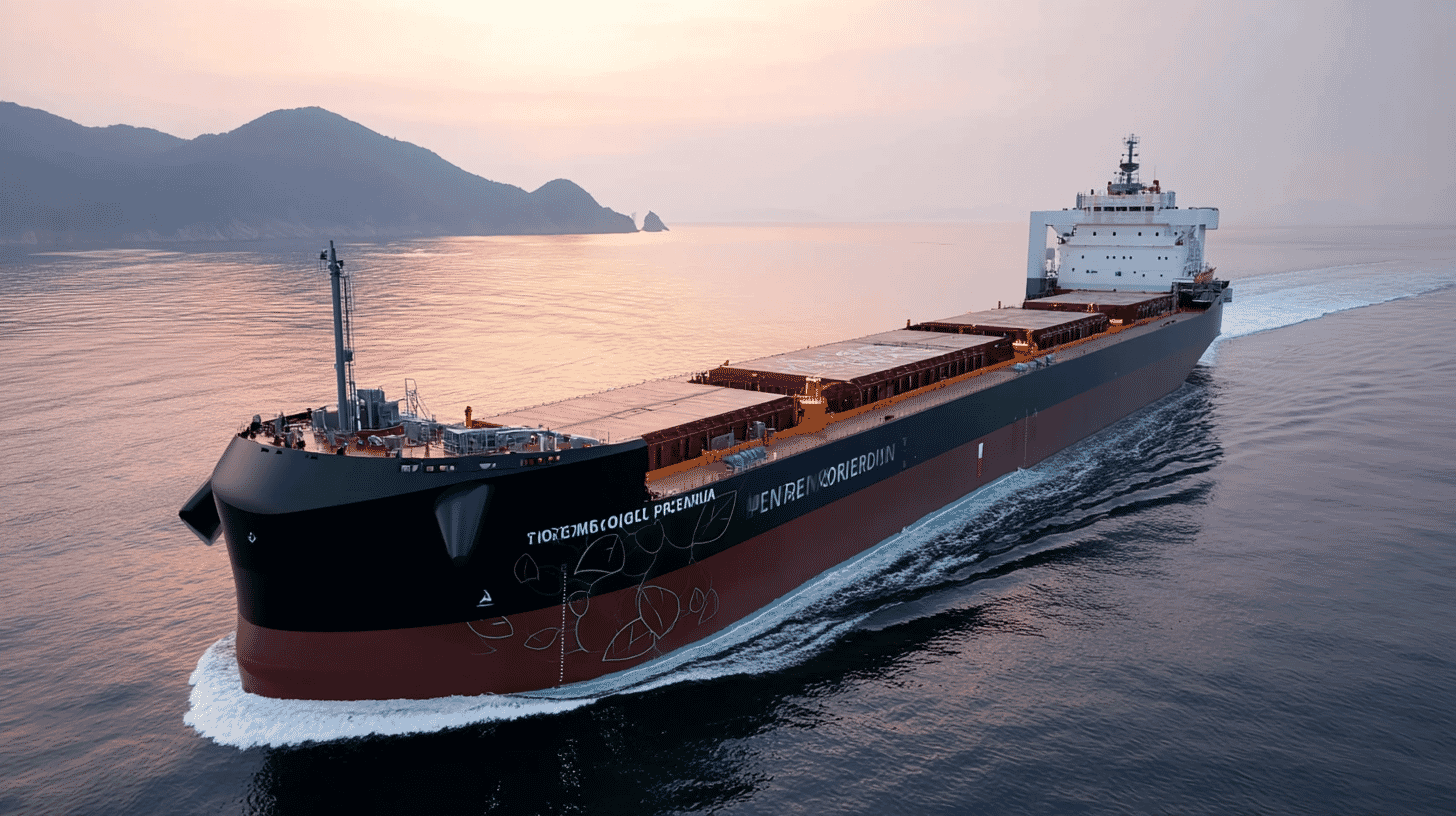
Methanol has been available at over 130 ports worldwide for years, while Japan's own bunkering network lagged behind. Now Japanese shipbuilders are putting out one world-first and domestic-first hull after another. Here is why methanol, and what is happening in 2026.
Why Methanol Fuel Ships Are Gaining Momentum
The Urgent Need for Maritime Decarbonization
In July 2023, the International Maritime Organization (IMO) made a landmark decision: achieve net-zero greenhouse gas emissions from international shipping by around 2050. With global shipping responsible for approximately 2-3% of worldwide CO2 emissions, reducing this footprint has become an environmental imperative.
The European Union introduced the FuelEU Maritime regulation in 2025, making GHG emissions from ships a direct cost factor. The era of carbon-cost shipping has arrived.
The IMO's own machinery, meanwhile, has stalled. The Net-Zero Framework (NZF), pairing a GHG fuel intensity standard with a price on emissions, was agreed in principle at MEPC 83 in April 2025. But at an extraordinary session in October 2025, adoption was adjourned for a year: Saudi Arabia's motion to delay carried 57 votes to 49, with Japan and South Korea abstaining after backing approval in April. The session reconvenes in autumn 2026, and the earliest entry into force has slipped from March 2027 to March 2028. Shipowners and fuel suppliers are being asked to invest while the rules stay unsettled.
What Methanol Has Going For It
Methanol offers several compelling advantages as a next-generation marine fuel.
First, environmental performance. Compared to conventional heavy fuel oil, methanol can reduce sulfur oxide (SOx) emissions by up to 99%, nitrogen oxide (NOx) by up to 80%, and particulate matter (PM) by up to 95%. CO2 emissions can be cut by 10-15%. When using green methanol, synthesized from renewable hydrogen and captured CO2, reductions of 60-90% are possible.
Second, practicality. Methanol remains liquid at ambient temperature, unlike LNG which requires cryogenic storage. It's already available at over 130 ports globally, and existing infrastructure can be leveraged. Compared to ammonia, methanol is less toxic and easier to handle.
Third, retrofit compatibility. Existing ships can be converted to methanol fuel with relatively minor modifications, reducing capital investment requirements. Dual-fuel engines that can run on both methanol and conventional fuel oil ensure operational flexibility, even in ports without methanol bunkering facilities.
Challenges and Limitations
Methanol does have its drawbacks. Its energy density is less than half that of heavy fuel oil, meaning larger fuel tanks are needed for equivalent range, potentially reducing cargo capacity.
With a flash point of just 12°C and corrosive properties, additional safety measures are essential. In Japan specifically, the methanol bunkering infrastructure remains underdeveloped, with limited supply points available.
Notable Methanol Ships Launching in 2026
World First: Tsuneishi's Methanol Dual-Fuel Kamsarmax Bulker "BRAVE PIONEER"
On January 15, 2026, a historic vessel was delivered at the Tsuneishi Group's Philippine shipyard (TSUNEISHI HEAVY INDUSTRIES in Cebu): the world's first methanol dual-fuel Kamsarmax bulker, named "BRAVE PIONEER."
Philippine President Ferdinand Marcos attended the naming ceremony. The ship is 229 metres long with a cargo capacity of 98,000 cubic metres, and can carry the three major bulk commodities: iron ore, grain and coal.
Tsuneishi Shipbuilding has received orders for over 27 methanol fuel ships and aims to make all vessels built by 2035 compatible with next-generation fuels.
February 2026: 5,900-TEU Methanol Container Ship
At Tsuneishi Group's Zhoushan shipyard in China, the group's largest methanol-fueled 5,900-TEU container ship is scheduled for completion in February 2026. The main engine is a 38,400-horsepower unit from Mitsui E&S, a first for domestic adoption.
Japan's First: Mitsubishi Shipbuilding's Methanol RORO Vessels (2027 Delivery)
Mitsubishi Shipbuilding has received orders from Toyofuji Shipping and Fukuju Shipping for Japan's first methanol-fueled RORO (roll-on/roll-off) vessels. Two ships are scheduled for delivery during fiscal 2027.
These car carriers, designed for trucks and trailers to drive on and off, will be the first methanol-fueled vessels for Japanese domestic routes. Mitsubishi Gas Chemical will supply the fuel methanol, with group company Kokuka Sangyo handling bunkering operations using existing methanol tankers.
NYK Group's First Methanol Dual-Fuel Bulker "Green Future"
In May 2025, the NYK Group's first methanol dual-fuel bulk carrier "Green Future" was delivered at Tsuneishi's Hiroshima factory. At 199.99 meters long with a deadweight of approximately 65,700 tons, the vessel will be operated by NYK Bulk & Projects under time charter from Kambara Kisen.
Industry Leaders Driving Maritime Decarbonization
Tsuneishi Shipbuilding: The Methanol Pioneer
Based in Fukuyama City, Hiroshima Prefecture, Tsuneishi Shipbuilding leads the world in methanol fuel ship development. With facilities in Japan, the Philippines (Cebu), and China (Zhoushan, Zhejiang), the company has built a global production network. The Kamsarmax bulker is their flagship vessel type, with over 400 delivered to date.
In October 2025, they also delivered Japan's first hydrogen-blended engine tugboat "Tenou," demonstrating their commitment to exploring all next-generation fuel options.
A.P. Moller-Maersk: Champion of Methanol Adoption
Danish shipping giant A.P. Moller-Maersk has been aggressively promoting methanol fuel ships. Since 2021, they've ordered over 25 methanol-capable container ships, targeting net-zero GHG emissions across all operations by 2040.
In April 2024, Maersk held a naming ceremony in Yokohama for their new methanol container ship "Astrid Maersk." The company is collaborating with shippers like Nissan Motor to use green methanol fuel for parts transportation.
Japanese Government Initiatives
Japan's Ministry of Land, Infrastructure, Transport and Tourism established a working group in September 2024 to develop methanol bunkering hubs. The concern: without the ability to fuel methanol ships, Japanese ports risk losing international competitiveness. Starting with Yokohama Port, green methanol supply infrastructure development is underway.
The Promise of Green Methanol
The Path to Carbon Neutrality
Currently, most methanol is produced from natural gas or coal. But the future lies in green methanol, synthesized from renewable hydrogen and CO2 captured from the atmosphere or industrial emissions, achieving lifecycle carbon neutrality.
Maersk has partnered with Chinese wind power giant Goldwind to secure 500,000 tons of green methanol annually starting in 2026. Mitsubishi Gas Chemical is also considering green methanol production at their Niigata plant.
Methanol by Color
Methanol is classified by "color" based on its production method: brown methanol from coal gasification, gray methanol from natural gas, blue methanol using CCS-captured CO2, and green methanol from biomass or renewable energy sources. The maritime industry's decarbonization ultimately depends on transitioning to green methanol.
Looking Beyond 2026
2026 won't just see methanol ships, ammonia fuel ships will also begin demonstration voyages. NYK Line plans to complete the world's first ammonia-fueled ammonia carrier with domestic engines by November 2026, with plans for 3 vessels by 2030 and 12 more between 2031-2033.
Ships typically operate for over 20 years, meaning zero-emission vessels must be introduced now to achieve 2050 carbon neutrality. Japanese shipbuilders are developing technologies across multiple next-generation fuels: methanol, ammonia, hydrogen, and LNG.
Japan is seeing methanol fuel ships emerge in earnest from 2026. What about your country? We'd love to hear about maritime decarbonization efforts in your region and your thoughts on alternative fuels. Share your perspective!
References
- https://trafficnews.jp/post/622611
- https://www.tsuneishi.co.jp/news/
- https://www.mhi.com/jp/news/240618.html
- https://www.nyk.com/news/2025/20250514_02.html
- https://www.mgc.co.jp/corporate/news/2024/240618.html
- https://www.decarbonation-tech.com/ship_22/
- https://www.mlit.go.jp/maritime/content/001740220.pdf









Global Discussion
15 comments