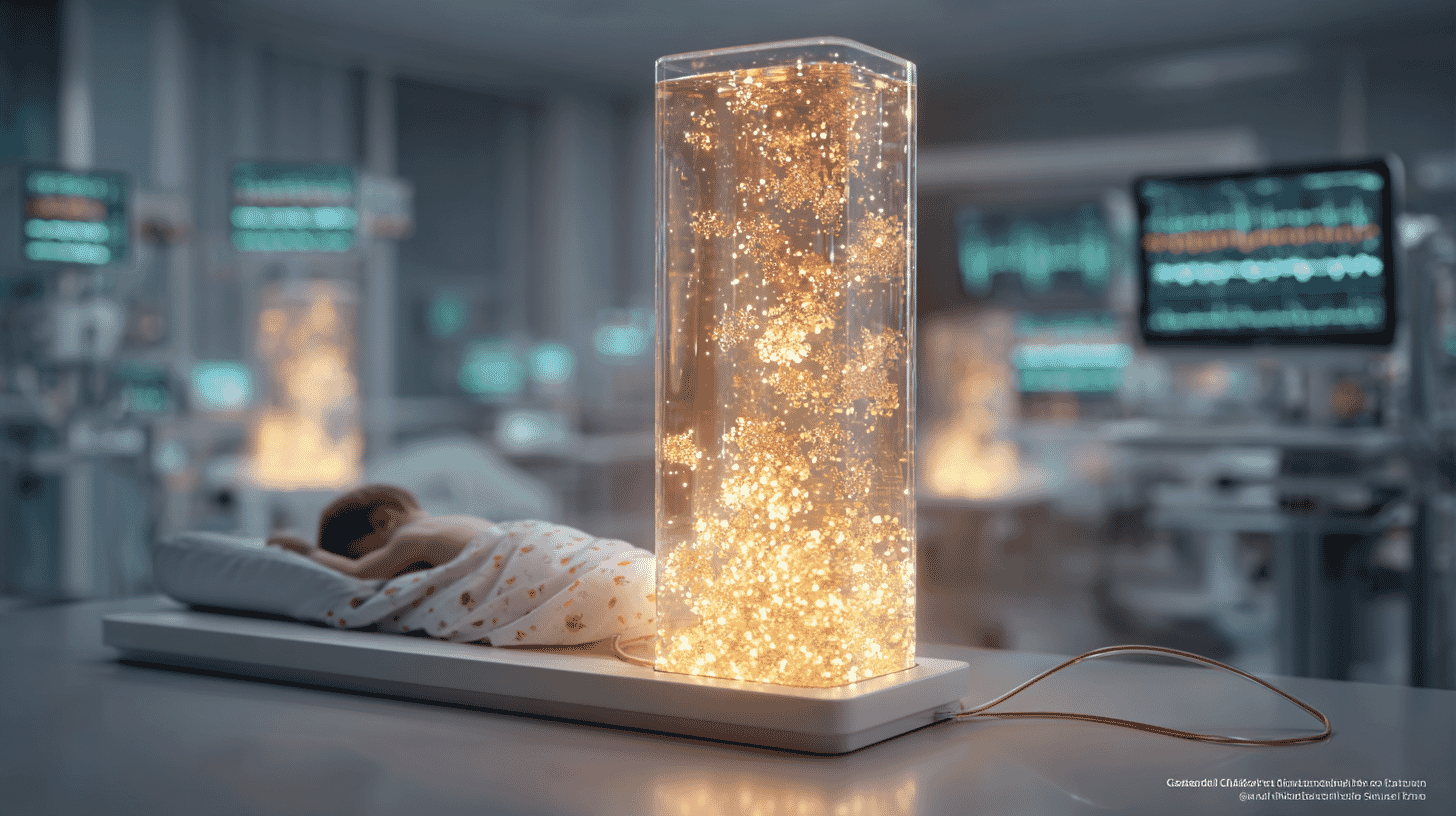
What if a child's failing liver could be rescued without a transplant? A Japanese research team has built an extracorporeal device that pumps a patient's blood through tiny "mini-livers" grown from iPS cells and encapsulated in seaweed gel, using the same technology behind artificial salmon roe. The Yomiuri Shimbun reports that clinical trials in children, the world's first of their kind, are planned within three years.
Pediatric acute liver failure, and why it is so hard to treat
Acute liver failure in children is one of the cruelest emergencies in medicine. Until a few weeks earlier the child was healthy. Then a viral infection, an autoimmune flare, or an unidentifiable trigger sets off a cascade of cell death in the liver, and within days the organ stops detoxifying the blood. Ammonia builds up. The brain swells. Without a transplant, most of these children die within a week or two.
The problem is that there are not enough livers to go around. In the United States, around 400 children sit on the pediatric liver waiting list at any given time, and roughly three dozen die or become too sick to transplant every year. Pretransplant mortality remains highest among children younger than one year. In Japan, where deceased-donor organs are scarce, with only zero to four pediatric brain-dead donors a year, families have leaned heavily on living donor transplants from parents or relatives. But not every child has a viable donor in the family, and not every parent's liver fragment is the right size or compatible.
On May 1, 2026, the Yomiuri Shimbun broke a story that could redraw the rescue map for these children. A team led by Professor Takanori Takebe (a joint appointment at the University of Osaka, Institute of Science Tokyo, and Cincinnati Children's Hospital in the United States) and the National Center for Child Health and Development in Tokyo has finalized plans for what would be the world's first pediatric clinical trial of an iPS-cell-derived bioartificial liver. The first patient could be treated within three years.
A dialysis machine, but with living mini-livers inside
The device the team is bringing to the clinic is called UTOpiA, and the underlying paper was published in October 2025 in the Journal of Hepatology. The principle is deceptively simple: take a patient whose liver has stopped working, route their blood through a column packed with hundreds of microscopic "mini-livers" grown from human iPS cells, and let those mini-livers do the dirty work of breaking down ammonia, processing bilirubin, and secreting the proteins that promote liver regeneration, until the patient's own liver either recovers or a transplant becomes available.
In other words, it works almost exactly like a kidney dialysis machine, but instead of filtering waste through a synthetic membrane, it filters it through living human tissue.
The mini-livers themselves are not metaphorical. They are real organoids: three-dimensional clusters of liver cells about 0.1 to 0.2 millimeters across, grown in the lab from induced pluripotent stem cells. Each tiny organoid is then dropped into a gel capsule about 2 to 3 millimeters in diameter, made from alginate, a polysaccharide derived from seaweed. The technique is borrowed, of all places, from the food industry: it's the same encapsulation method used to make the gel-skinned "artificial salmon roe" that appears on supermarket sushi platters in Japan.
Hundreds of these capsules are packed into a cylindrical column. The column connects to the patient's bloodstream, typically through a vein in the neck, the same access route used for emergency dialysis. A second column performs granulocyte-monocyte apheresis (GMA), which strips out the inflammatory immune cells that would otherwise destroy both the patient's own liver and the foreign organoids. The two columns work in tandem: GMA cools the inflammation, the mini-livers do the metabolic work, and the patient's blood circulates back into the body, cleaner than it left.
To prevent the patient's immune system from rejecting the foreign cells, the iPS cells used to grow the organoids have had three immune-related genes (HLA-A, HLA-B, and CIITA) knocked out using genome editing. The result is a low-immunogenicity "off-the-shelf" cell product: the same batch of organoids can serve many different patients, without the weeks of custom cell preparation that personalized iPS therapies usually require.
The animal data
In rats with severe liver failure, both acute and acute-on-chronic, about two hours of UTOpiA treatment lifted survival rates dramatically. The 48-hour survival rate with the UTOpiA system was approximately 90%, compared with near-total mortality in untreated controls. The treated rats showed lower blood ammonia, lower bilirubin, less liver tissue damage, and less brain dysfunction.
Mechanistically, the team found that the iPS-derived hepatocytes secrete alpha-fetoprotein, a fetal protein that signals the patient's own liver to start regenerating. UTOpiA, in other words, is not just a temporary blood filter. It appears to actively wake the dying liver and tell it to grow back.
The rodent results were strong enough that, per the Yomiuri Shimbun, the team is now finalizing plans for a first-in-human trial. According to the newspaper, the National Center for Child Health and Development plans to enroll three to five children with severe acute liver failure (fulminant hepatitis), with the first treatment targeted within three years.
Why children, and why this hospital?
The choice of pediatric patients, and of this particular hospital, is not arbitrary. The National Center for Child Health and Development, in Setagaya in western Tokyo, performs more pediatric liver transplants than any other hospital in Japan. Its director, Dr. Mureo Kasahara, is one of the most experienced pediatric transplant surgeons in the world: his team performs about 60 liver transplants a year, against a national pediatric total of roughly 140, with survival rates above 90 percent that rank near the global top. According to the article, the center has treated over 100 cases of pediatric fulminant hepatitis. "If it succeeds," Kasahara told the Yomiuri Shimbun, "we will be able to save lives without having to transplant a liver."
There are practical reasons children are the right patients to start with. Pediatric livers tend to have stronger regenerative capacity than adult ones, so buying time with UTOpiA may be all that is needed for the child's own liver to come back. Pediatric acute liver failure also progresses faster than adult liver failure, so the window for finding a donor is brutally short. And in Japan specifically, where deceased pediatric organ donation is structurally limited, the moral case for a non-transplant rescue option is unusually strong.
The collaboration also makes sense scientifically. Takebe is the rare biomedical researcher with a foot in three institutions on two continents, Osaka, Science Tokyo, and Cincinnati, and is widely considered one of the founders of liver organoid research. He produced the first iPS-derived liver organoids back in 2013, when he was 26, in a Nature paper that drew global attention. In February 2026, TIME magazine named him to its TIME100 Health list of the world's most influential leaders in health.
How it compares with work abroad
Japan is not the only country trying to rescue children from acute liver failure with cell-based therapies. The most direct comparison is the HELP trial at King's College Hospital in London, which is preparing to test alginate microbeads containing donor hepatocytes co-encapsulated with mesenchymal stromal cells, infused into the abdominal cavity of children with acute liver failure. The British approach uses cells from deceased adult donors, not iPS cells, and delivers them inside the body rather than in an external circuit. The Japanese device differs on three counts: the cell source is renewable (iPS, not cadaveric), the cells are immune-engineered (HLA-knockout), and the delivery is extracorporeal, so the cells never enter the patient.
China has been moving fast in parallel. Beijing Friendship Hospital is recruiting for a Phase 1/2 trial of a chemically induced pluripotent stem cell-based bioartificial liver (CiPS-BAL) in adult liver failure patients. Sun Yat-sen University is running a Phase 1 trial of a hybrid BAL combining mesenchymal stem cells with extracorporeal blood purification. South Korea's HLB Cell has run a Phase 2b trial of a bioartificial liver called LifeLiver. The United States, ironically, has the longest history with bioartificial livers. Vital Therapies' ELAD device went through Phase 2 trials over a decade ago but did not meet its primary endpoints, partly because the cells used (C3A, a clone derived from the liver cancer line HepG2) had limited liver function. The Japanese team's bet is that iPS-derived organoids, which more closely resemble real liver tissue, will succeed where ELAD failed.
Takebe's group has also founded a U.S. biotechnology venture, Kanzo Biomedicines, to bring the platform to the American market eventually. But the team has decided to run the first human trial in Japan, where the regulatory pathway for regenerative medicine, including time-limited conditional approvals and the Sakigake designation system, is more permissive than in the United States or Europe. Japan's two iPS-cell-derived products, Cuorips' cardiac muscle sheet ReHeart and Sumitomo Pharma's Parkinson's therapy Amshepri, received time-limited conditional approval in March 2026. Both are world firsts, and both emerged from this same regulatory environment.
How much of this is actually settled
A few important caveats. As of this writing, no formal press release has been issued by the University of Osaka, Institute of Science Tokyo, or the National Center for Child Health and Development announcing the clinical trial. The information published in the May 1 Yomiuri Shimbun article is sourced through the newspaper's own reporting, and the trial design of three to five patients with a first treatment within three years should be read as a planning target rather than a confirmed protocol. The animal data, by contrast, is fully published and peer-reviewed.
It also bears repeating that UTOpiA is a bridge therapy, not a permanent replacement liver. The device is meant to keep a child alive long enough for their own liver to recover, or for a suitable transplant to be found. The vision of a fully implantable, permanent iPS-grown liver remains years, possibly decades, away. Cost is another open question, though there is now a benchmark. ReHeart enters Japan's public insurance system on September 1, 2026 at ¥53.2 million per case, roughly $326,000 at ¥163 to the dollar; Amshepri was covered from May. Regenerative medicine products tend to land in that range. The off-the-shelf, immune-edited approach used in UTOpiA is designed specifically to pull that number down.
There are also legitimate scientific concerns about long-term safety. iPS-derived cells carry a small but real risk of forming tumors if any undifferentiated cells slip through quality control. Encapsulating the organoids in alginate and keeping them outside the body addresses much of this risk, since a column can simply be unhooked. But the long-term consequences of repeated extracorporeal exposure to iPS-derived secreted factors are not yet known.
The distance left to the bedside
Step back from the technical details and the picture is striking. A decade ago, "growing a human liver in a dish" was the kind of phrase that belonged in science fiction. Today there are at least five active or planned clinical programs around the world trying to put cell-based liver therapies into actual patients with actual liver failure. Japan's UTOpiA, if and when it reaches a child in a hospital bed in Setagaya in 2027 or 2028, will not be the only such device. It will, however, be one of the first built specifically for children, and the first to combine genome-edited iPS organoids with apheresis in a single circuit.
Takebe has spent much of his career between Cincinnati and Yokohama, assembling organoid technology across two countries. What began in 2013 as a five-millimeter cluster of cells in a petri dish is now close to being handed a child's life in a Setagaya hospital.
How do children with acute liver failure get treated in your country, and what do you think about using lab-grown mini-organs as a bridge to transplant, or instead of one?
References
- https://news.yahoo.co.jp/articles/055ed7fea5a415713c35c13bdb4b4755776f6490
- https://www.journal-of-hepatology.eu/article/S0168-8278(25)02477-8/fulltext
- https://sj.jst.go.jp/news/202512/n1202-01k.html
- https://scienceblog.cincinnatichildrens.org/novel-bioartificial-liver-extends-survival-in-preclinical-models-of-advanced-liver-failure/
- https://www.med.osaka-u.ac.jp/eng/introduction/research/genome/organoid_medicine
- https://clinicaltrials.gov/study/NCT05491135









Global Discussion
14 comments