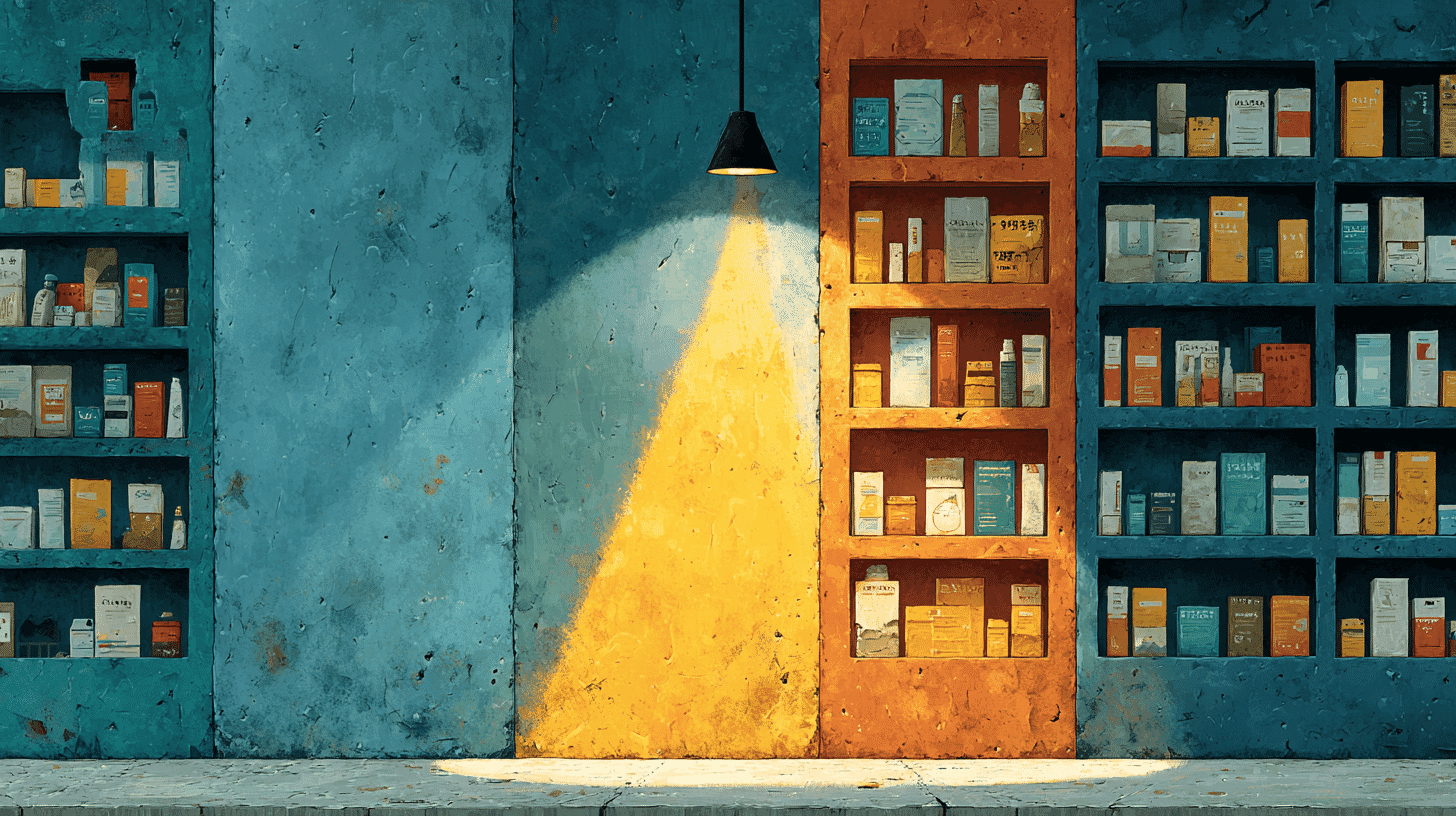
🩺 There's a list, kept by Japan's health ministry, of medicines a doctor in New York or Berlin can prescribe today, but that a patient in Tokyo simply cannot get. Not because they're banned. Because no company has even started the paperwork to bring them in. That list is finally shrinking. But a single executive order signed in Washington could push it the other way.
The medicines that never arrive
Japan has two related problems hiding behind deceptively dry names. "Drug lag" is when an approved overseas medicine eventually reaches Japan, just years late. "Drug loss" is worse: the drug never comes at all, because no company has begun developing it for the Japanese market.
As of March 2023, of 143 medicines approved in the US or Europe but not in Japan, 86, about 60%, had no domestic development underway. They were not scattered at random. They skewed toward drugs from small overseas biotech startups, treatments for rare diseases, and medicines for children: exactly the areas where patients have the fewest alternatives.
By the end of March 2025, a health-ministry research group reported that 8 of those 86 had been resolved, leaving 78 still in limbo. The remaining drugs have been sorted into four groups by how urgently each is needed. It's progress, but the people on the list are often kids and rare-disease patients with no Plan B.
Why Japan keeps getting skipped
Two forces drive it. The first is price. Japan keeps drug prices low and trims them on a regular schedule. The cancer immunotherapy Opdivo launched in 2014 at roughly ¥729,000 per 100mg; by 2025 its official price had fallen to ¥132,000, an 82% cut. Lower prices help patients afford treatment, but they make it hard for a company to predict whether a Japanese launch will ever earn back what it costs to develop. Japan's slice of the global drug market has slid from over 25% in the early 1980s to about 4.4% in 2023, roughly level with Germany.
The second force is who invents drugs now. Increasingly it's tiny biotech firms, often 30 to 50 employees, that license or sell their compound to a larger company. Around 65% of drugs approved in the US between 2015 and 2021 originated at such ventures. Japan barely takes part: only about 4% of new clinical trials start from a Japanese biotech. A 40-person American startup with a promising rare-disease drug doesn't have the staff or the cash to run trials in the US, Europe and Japan at the same time, so the smaller and more complicated market gets postponed or dropped. Layer on Japan-specific rules, such as requirements for data on Japanese trial subjects, plus a venture scene that does under 100 biotech deals a year against 2,200 in the US, and the country slips off the priority list.
How the number started to fall
The turn came at the end of 2023. Japan dropped a longstanding requirement that companies first generate early-stage data on Japanese subjects before adding domestic sites to a late-stage global trial. In plain terms, a worldwide study can now include Japan from the outset, which in theory lets a drug win approval in Japan at the same time as in the US and Europe, instead of years behind.
Around the same time, the government convened a council on raising Japan's drug-discovery capacity, and in mid-2024 set concrete targets: begin development by fiscal 2026 on drugs for conditions that have no existing treatment, draw up 50 pediatric-drug development plans, and approve 150 orphan (rare-disease) drugs across fiscal 2024 to 2028.
The early numbers moved. New-drug approvals in Japan jumped from 35 in 2023 to 66 in 2024, and 43 more are expected to gain insurance listing in 2025.
From plan to open call
This is no longer a line in a budget document. The program now has a name, GRiT (the Global Research and Development Support Project for Intractable and Rare Diseases), and money behind it: ¥12 billion (about $75 million) set aside in a dedicated fund through the fiscal 2025 supplementary budget, plus a ¥500 million (about $3.1 million) line in the fiscal 2026 budget, which itself cleared only on April 7, 2026, after a January dissolution and a February election pushed the debate back and forced the government onto its first stopgap budget in eleven years.
Run by AMED, the government's medical-research agency, the scheme does the obvious thing: it pays. For an eligible rare-disease or pediatric drug, AMED funds the upfront feasibility study in full and then covers up to half of the international joint trial that follows, as much as ¥1.5 billion (about $9 million) per project. Applications opened on March 30, 2026 and closed on May 29; AMED expects to back up to about ten projects, with selection hearings set for late August.
The wildcard from Washington
On May 12, 2025, US President Trump signed an executive order pushing "most favored nation" drug pricing: the idea that Americans shouldn't pay more for a medicine than the lowest price it fetches in other developed countries. Here was a variable nobody in Tokyo had planned for.
It has not stayed a declaration. By April 2026 the US administration had struck individual agreements with 17 drugmakers headquartered in the US or Europe.
Here is the trap for Japan. Japanese prices already sit among the lowest in the developed world. If the US starts pegging its prices to the cheapest foreign one and uses Japan as a reference point, drugmakers gain a fresh reason to be wary of launching in Japan at all, because a low Japanese price could now drag down their far larger US revenue. The US pharmaceutical lobby PhRMA flagged precisely this in its July 2025 submission to Japan's 2026 drug-pricing review, warning the risk could widen drug lag and loss rather than shrink it.
Access versus affordability
Strip away the acronyms and this is a question every health system faces, just in different forms. The US pays the world's highest prices and gets new drugs first, while millions struggle to afford them. Europe's regulator approves drugs centrally across the bloc, and countries like the UK ration by cost-effectiveness. Japan made a different bargain: near-universal access at low, controlled prices. It is now finding that the same bargain can leave its patients without certain drugs entirely.
Tokyo is betting that regulatory reform and targeted money can close the gap before Washington's pricing politics pry it open again. For the families on that list of 78, the arithmetic is simpler: they are waiting for a medicine that already exists, somewhere else.
How does your country handle the trade-off, paying more to get new drugs sooner, or holding prices down and risking the wait?
Note: In a June 2026 interview, AstraZeneca chief executive Pascal Soriot said the company could hold back new launches in Japan if prices there stay low. (As of July 2026)
References
- https://www.tkfd.or.jp/research/detail.php?id=4523
- https://www.mhlw.go.jp/content/10808000/001462594.pdf
- https://www.mhlw.go.jp/content/10808000/001514784.pdf
- https://www.cas.go.jp/jp/seisaku/souyakuryoku/pdf/chuukantorimatome_mokuhyou.pdf
- https://bio.nikkeibp.co.jp/atcl/news/p1/25/12/03/14035/
- https://www.amed.go.jp/koubo/03008/01/B_00005.html








Global Discussion
4 comments