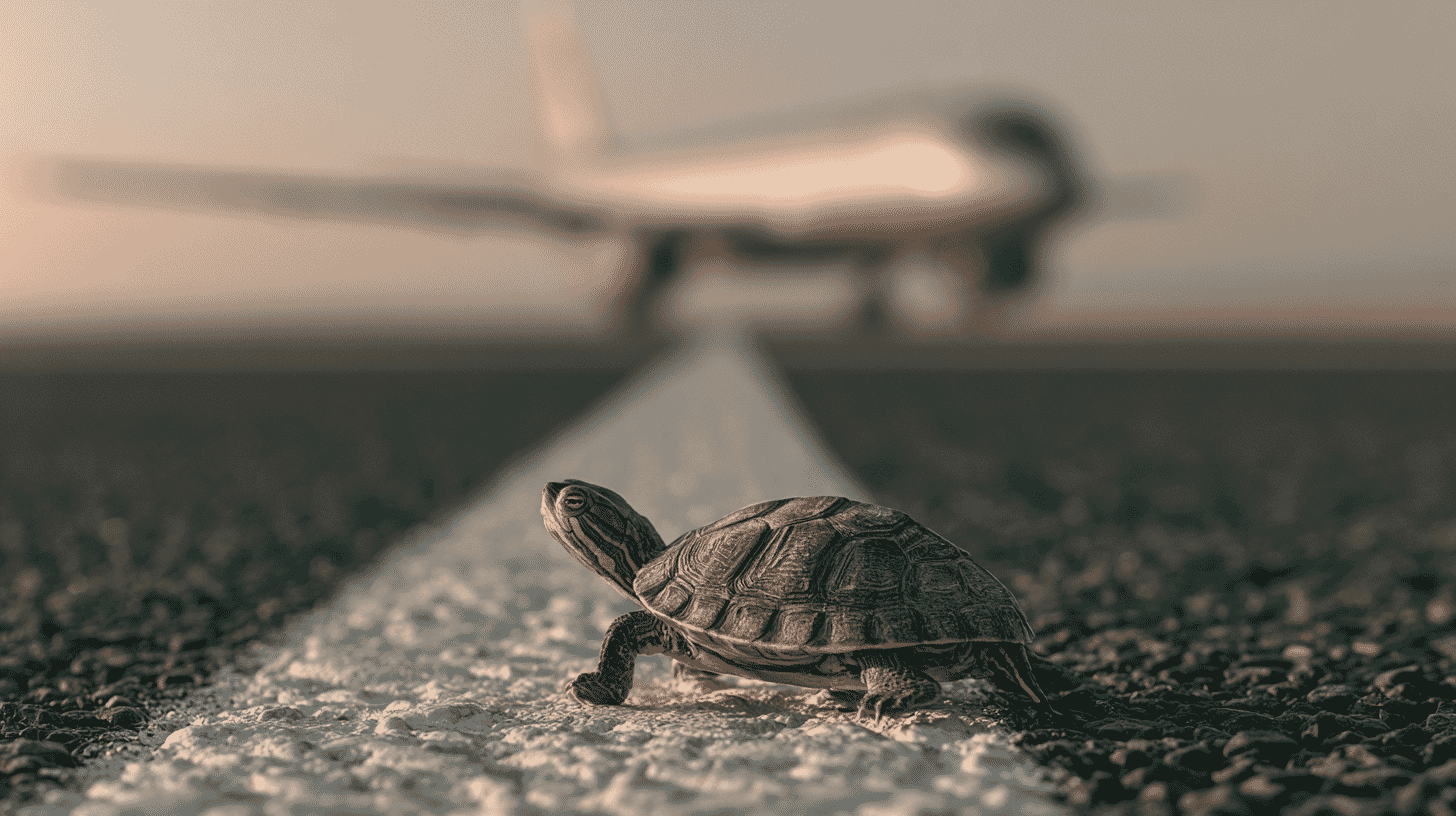
🐢 A turtle once stopped an airplane painted with turtles. In September 2021, a single red-eared slider crawled onto a runway at Tokyo's Narita Airport and brought a giant ANA Airbus A380 to a halt. It was funny. It was also a warning. Behind the viral headline lies a four-year campaign that airport staff quietly call the "turtle war", and a much bigger story about an American reptile that has slowly colonized ponds all across Japan.
When a turtle stopped a turtle plane
It was Friday, September 24, 2021, around 11:30 in the morning. A Japan Airlines co-pilot taxiing toward takeoff at Narita spotted something small moving across the A runway. He radioed air traffic control. The reply, later shared far and wide, was a flustered question: "A... a turtle?"
Controllers paused departures. Staff went out, picked up the wanderer, and swept the full 4,000-meter runway to be sure nothing else was out there. The runway reopened after about 12 minutes, according to contemporaneous reports, but several flights were delayed in the meantime.
One of them was almost too perfect for the internet. It was NH2023, an All Nippon Airways charter to Naha in Okinawa, flown by the first of the airline's A380s (JA381A) in the "Flying Honu" livery: a giant blue sea turtle. It pushed back at 11:03 and did not lift off until 11:52, a 49-minute crawl where 25 minutes is normal. A turtle had stopped a turtle plane. The story flew around the world.
The reptile itself was unremarkable: a red-eared slider about 30 centimeters long, weighing roughly two kilograms. Officials suspected it had crawled out of a stormwater retention pond about 100 meters from the runway.
Why it isn't just a cute story
For NAA (Narita International Airport Corporation), the operator, the incident was less "aww" and more "uh-oh."
Picture an aircraft rolling for takeoff at speed and running over a turtle. The shell doesn't simply disappear. It shatters into hard fragments scattered across the runway, and the next plane to take off could suck those fragments into an engine.
Aviation has a name for this kind of hazard: a bird strike. A turtle shell works the same way. Debris ingested by a jet engine can damage it badly enough to force an aborted takeoff, or worse. In safety terms, a slow-moving turtle is a fast-moving problem.
And turtles at Narita are not a one-off. According to NAA, between fiscal 2013 and fiscal 2021, turtles or turtle carcasses were found on or near the runway twelve separate times.
The culprits were almost all born in America
Here is the twist that surprised even Japanese readers: the turtles besieging one of Japan's busiest airports are not Japanese.
Between 2022 and 2025, NAA captured 267 red-eared sliders around the runway area, by far the most of any species. A distant second was the Chinese pond turtle, known in Japan as kusagame, with 26 caught. It, too, is non-native. Japan's native turtles barely featured at all. In other words, the "turtle war" is overwhelmingly a war against a foreign invader.
The red-eared slider is native to the Mississippi River basin in the southern United States. It became one of the most widely traded pets on Earth. In Japan, hatchlings were sold cheaply at summer festivals as midori-game, "green turtles." The problem is what comes next. A cute, coin-sized hatchling grows into a 25-centimeter adult that can live more than 30 years. Owners who can't keep up dump them in the nearest pond or river.
Multiply that by decades and you get today's Japan, where the slider has pushed the native Japanese pond turtle out of most urban waterways. In June 2023, Japan finally designated the red-eared slider, together with the American crayfish, as a "conditionally invasive species." Selling and importing them is now banned, and releasing them into the wild is illegal, though households may keep the pets they already own.
The turtles wandering toward Narita's runways, then, are the descendants of abandoned pets, generations removed from anyone's living room.
You can't just drain the pond
So why doesn't NAA simply get rid of the pond the turtles come from?
Because the pond has a job. It is a retention basin that holds rainwater and releases it gradually to prevent flooding. Fill it in, and you trade a turtle problem for a drainage problem.
Instead, NAA went to war methodically. In April 2022 it began setting traps in the retention pond near the runway. From 2022 to 2025, during the warm April-to-October stretch when turtles are most active, staff ran trapping operations one to four times a month.
In May 2023 they added a physical barrier, U-shaped concrete gutters along the route turtles were thought to use, creating what NAA calls a layered defense. On top of that, the daily inspections that already check the runway, taxiways and apron for debris now also keep an eye out for slow-moving reptiles.
It appears to be working. No turtle has met a plane since 2021. Captures in the pond north of the A runway fell year after year, and in 2025 the pond yielded zero turtles.
The war is not quite over, though. In 2025, even as the pond came up empty, 17 red-eared sliders were caught in a drainage channel leading out of the airport. The front line had simply moved, and NAA says it is still running focused trapping through 2026 at the spots turtles are most likely to use.
Narita isn't alone: airports vs. wildlife
If a turtle on a runway sounds absurd, look at the rest of the world.
Airports everywhere fight a constant, low-profile battle with wildlife. The biggest threat by far is birds: in U.S. Federal Aviation Administration data, they account for around 94% of all reported wildlife strikes. But the ground belongs to everyone else.
In Florida, where airports sit in subtropical wetlands, runways have been crossed by alligators and iguanas. FAA records show that between 1990 and 2019, U.S. civil aircraft struck 27 alligators and 24 green iguanas. Strikes involving non-bird animals have been climbing as cities expand and squeeze wildlife onto the last green space around, which is often the airport itself.
The responses look a lot like Narita's: fences, vegetation control, and, increasingly, wildlife biologists on staff. Some U.S. airports even send animal remains to the Smithsonian Institution so the exact species can be identified.
Seen that way, Narita's turtle war is not a quirky Japanese oddity. It is one country's version of a problem every major airport shares: the awkward, unavoidable overlap between the busiest human infrastructure and the animals that were there first, or that humans carelessly brought along.
The lesson the turtle left behind
In Japan, a turtle on the runway became a viral joke before it became a four-year operation. But the punchline is a serious one: a small American reptile, sold as a festival pet and then abandoned, ended up reshaping safety procedures at an international airport.
Does wildlife stray onto runways, roads or railways where you live? And has a foreign pet species quietly taken over the ponds and rivers of your country the way the red-eared slider has in Japan? We'd love to hear about it.
References
- https://trafficnews.jp/post/665627
- https://news.yahoo.co.jp/articles/0189b3f719dabefac9119a26050a915324ae916a
- https://japantoday.com/category/national/Flight-out-of-Narita-Airport-delayed-because-of-a-turtle-on-the-runway
- https://www.foxnews.com/travel/turtle-runway-halts-multiple-flights-japan
- https://www.env.go.jp/nature/intro/2outline/attention/akamimi.html
- https://www.wlrn.org/environment/2024-12-16/planes-turtles-death



Global Discussion
4 comments