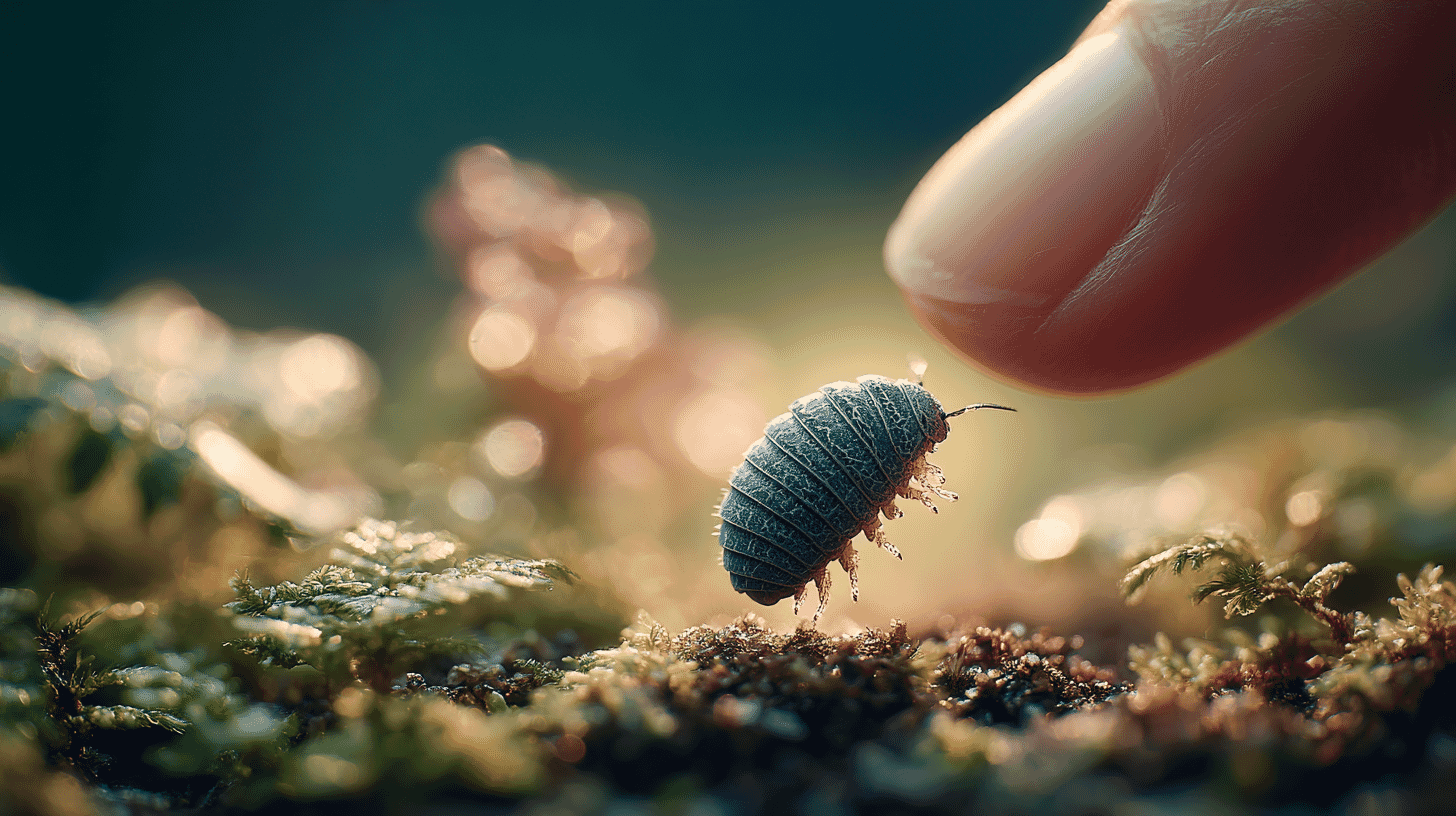
Flip a stone in any Japanese park and you'll meet them: tiny grey creatures that curl into a ball at the slightest touch. The fact that they nibble on stones is well known among bug enthusiasts. But researchers at the University of Tsukuba have revealed something stranger. Pill bugs don't wear the stones they eat. They dismantle the rocks atom by atom inside their tiny bodies and rebuild them into a different crystal before laying them down as armour.
First, the surprise: pill bugs aren't insects
Before getting to the discovery, here's the foundational fact that often catches people off guard. The little roly-poly creature known in Japan as dangomushi, what English speakers call a "pill bug" or "woodlouse", is not an insect. It's a crustacean, more closely related to shrimp and crabs than to beetles or ants. The species in this study is Armadillidium vulgare, the common pill bug found in gardens around the world.
This 1–2 cm crustacean lives quietly under damp leaves, beneath stones, and in the cracks of urban concrete. In Japan, prodding one and watching it curl up is a rite of passage for children, practically a national pastime in spring. Yet that "ball-up" defense is held together by a surprisingly sophisticated armor made of calcium carbonate (CaCO₃), chemically the same stuff as chalk and stalactites.
In the small world of pill bug husbandry, it has long been folk wisdom that "putting a stone in the cage helps the shell grow strong." Until now, though, no one had carefully traced what actually happens to those stones once they're swallowed.
A 60-day mineral diet experiment
A team led by Associate Professor Atsushi Kyono (a mineralogist) and graduate student Shumpei Tatsunami at the University of Tsukuba's Institute of Life and Environmental Sciences ran what amounts to a "rock diet experiment", feeding pill bugs three different minerals for roughly 60 days each.
The menu:
- Calcite, the most familiar polymorph of calcium carbonate. It's the main ingredient of limestone and marble. Atoms arranged in a rhombohedral pattern.
- Aragonite, the same chemistry (CaCO₃), but with a columnar crystal structure. It's what you find in seashells, pearls, and coral skeletons.
- Quartz, a totally different beast: silicon dioxide (SiO₂). Common in sand and rocks, but contains zero calcium.
Calcite and aragonite are what mineralogists call polymorphs: same composition, different crystal architecture, like diamond and graphite, both pure carbon yet wildly different materials.
After 60 days, the researchers used scanning electron microscopy, Raman spectroscopy, and high-energy synchrotron X-ray diffraction to look at the pill bugs' dorsal cuticle (the tergite cuticle) at the molecular level.
Result 1: Diet doubles shell thickness
The first finding was straightforward but striking:
| Diet | Tergite thickness |
|---|---|
| Native soil only (control) | 30–50 micrometers |
| Calcite or aragonite | 70–120 micrometers |
| Quartz | Under 30 micrometers |
Pill bugs given calcium carbonate minerals built shells more than twice as thick as those fed only quartz. The quartz-only group, denied any usable calcium, ended up with thin, weak armor.
So far, so expected. Without raw material, no armor.
Result 2: Aragonite-fed bugs make calcite anyway
This is where things got weird.
The team's working hypothesis was the obvious one. If you feed a pill bug aragonite, you should get aragonite armor. The chemistry is identical; the easy assumption is that the eaten mineral is broken down, transported, and laid back down in roughly the same form.
The data flatly refused to cooperate.
When the researchers ran X-ray diffraction on the shells of aragonite-fed pill bugs, almost every crystal they detected was calcite. The aragonite structure was simply gone. Whatever molecular pathway the pill bugs were using had erased the original crystal architecture entirely.
Inside the shell, the team also found an amorphous (non-crystalline) intermediate called calcite-type amorphous calcium carbonate (ACC). So the actual sequence appears to be: pill bug eats aragonite → bug breaks it down to ions and amorphous precursor → bug deposits ACC under the cuticle → ACC crystallizes into calcite. The eaten rock is dissolved and reassembled into something architecturally different.
In an interview with the Tokyo Shimbun, Professor Kyono said he had assumed the bugs would just reuse the minerals as-is. The result genuinely surprised him: living things, he said, are remarkable.
Why does the bug bother?
Here's the puzzle: this is not the cheap path. Reusing the eaten mineral directly would save energy. Why would evolution favor an animal that dismantles its food rocks down to ions, parks them as an amorphous precursor, then reassembles them as a different polymorph?
One clue lies in stability. At Earth's surface temperature and pressure, calcite is more thermodynamically stable than aragonite. Aragonite tends to convert to calcite over geological time. So the pill bug is, in effect, choosing the longer-lasting form for its armor.
Another clue comes from comparing marine biomineralizers. Coral skeletons and most mollusk shells are built from aragonite. Sea urchins, starfish, and barnacles use calcite. Each species has a "preferred" polymorph that fits its lifestyle.
For pill bugs, lifestyle matters. Armadillidium vulgare defends itself by rolling into a sealed ball, it needs a thick, rigid shell. Its close relative Porcellio scaber runs away instead and gets by with a thinner, more flexible cuticle. That behavioral split has long been correlated with how heavily mineralized each species' shell is. The new finding suggests A. vulgare has gone further than anyone realized: it has evolved an active mineral-processing chemistry to make sure the rolled-up rampart is built from the right crystal.
What this means for materials science
Professor Kyono told the Asahi Shimbun that the discovery may eventually feed into the development of new bio-inspired materials. Atsushi Niigaki, a bioengineering professor at Tokyo University of Agriculture and Technology, similarly noted to the Yomiuri Shimbun that understanding how the bugs metabolize minerals could allow researchers to control shell strength and properties for materials applications.
Biomimetics, engineering inspired by biology, has become a hot frontier. Spider silk, the nacre layer in seashells, shark skin, lotus leaves: again and again, structures evolved over millions of years outperform what humans can make in factories. The pill bug's armor is light, hard, and assembled at room temperature inside a 1 cm body. Manufacturing the equivalent industrially requires high-temperature kilns and complex chemistry.
If we can copy the pill bug's trick, depositing an amorphous precursor and then steering it toward a target crystal structure, we might unlock low-energy fabrication routes for high-performance ceramics, building materials, medical implants, and lightweight composites.
Where the work was published
The paper, "Effects of Mineral Nutrition on the Cuticle Structure of Armadillidium vulgare," appeared in the Journal of Structural Biology (DOI: 10.1016/j.jsb.2026.108312). The University of Tsukuba issued its press release on March 19, 2026, and Japanese media began covering the story in earnest in early May.
Next time you flip a stone in a Japanese garden and see one of these tiny crustaceans curl up, it's worth pausing for a second. Inside that 1 cm body is a molecular workshop quietly disassembling rocks and reassembling them into armor, a process human chemists are still trying to understand.
What's it like in your country?
In Japan, pill bugs are a fixture of spring. Schoolchildren collect them, watch them curl up, and use them as the easy first subject of their science fair projects. Their compact shape has made them mascots and emoji-style characters.
How do people in your country see pill bugs? A backyard friend? A pest? A creature you barely register? And what's your reaction to learning that this 1 cm garden visitor is quietly running a molecular-scale mineral factory? Let us know in the comments.
References
- https://news.yahoo.co.jp/articles/8aad12e443f6596ade5542ef4cdb9d800aeffc29 (Asahi Shimbun)
- https://www.tsukuba.ac.jp/journal/biology-environment/20260319140000.html (University of Tsukuba press release)
- https://www.tsukuba-sci.com/?p=18762 (Tsukuba Science News)
- https://www.eurekalert.org/news-releases/1125054 (EurekAlert!)
- https://phys.org/news/2026-04-pill-bugs-dont-minerals-rebuild.html (Phys.org)
- https://www.tokyo-np.co.jp/article/484706 (Tokyo Shimbun)
- https://news.yahoo.co.jp/articles/b997192f3e2f7ca3ec5d2c3b6a44fa322f2e9efd (Yomiuri Shimbun)







Global Discussion
14 comments