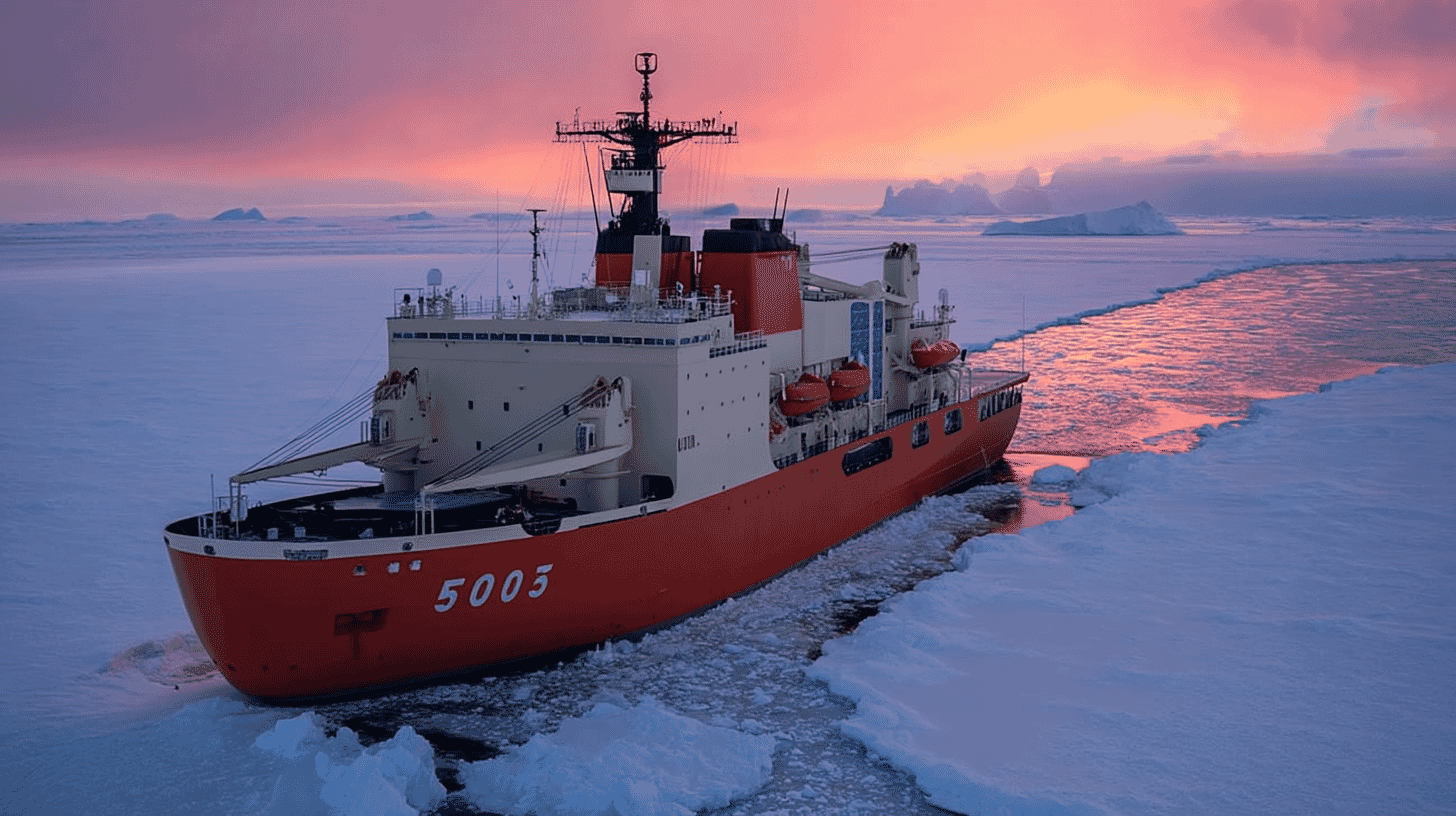
For over six decades, Japan's Maritime Self-Defense Force has been breaking ice and delivering cargo to Showa Station. That era is quietly ending. When the icebreaker Shirase retires around 2034, its successor will be operated not by the Navy, but by Japan's premier ocean research agency, JAMSTEC. From discovering the ozone hole to building the world's second-largest meteorite collection, Japan's Antarctic legacy is significant, and a major institutional shift is now underway.
A historic handover: from military to science
In April 2026, Japan's Ministry of Education (MEXT) and Ministry of Defense presented a proposal to expert advisors: the successor to the current Antarctic icebreaker Shirase should be operated by the Japan Agency for Marine-Earth Science and Technology (JAMSTEC), not the Maritime Self-Defense Force (JMSDF).
The current Shirase (hull number AGB-5003), commissioned in 2009, is expected to be retired around 2034 due to aging, and its onboard CH-101 heavy-lift helicopters are slated for retirement around 2033.
According to the Ministry of Defense, the JMSDF withdrawal stems from manpower shortages, the force is currently below its authorized strength, and the growing demands of surveillance missions in waters around Japan. Assigning personnel to an Antarctic research vessel has become increasingly difficult.
That said, the Self-Defense Force isn't fully stepping away from Antarctica. JMSDF officers will still be dispatched as needed to support ice navigation and on-ice transport in a logistics role. Education Minister Yohei Matsumoto emphasized at a press conference that "even as the operator changes, the transfer of technology and know-how will be carried out thoroughly."
The overall direction is to be finalized by June 2026, with operational details worked out from July onward.
70 years of Japanese Antarctic research
Japan's Antarctic observation program started in 1957, spurred by the International Geophysical Year (IGY). The first expedition ship was Soya, a converted icebreaker famously known as the "Miracle Ship" for having survived World War II. Carrying 53 members of the 1st Japanese Antarctic Research Expedition, Soya landed at East Ongul Island, where Showa Station was established on January 29, 1957.
Successive ships followed: Fuji (commissioned 1965), the first Shirase (1982), and the second Shirase (2009). The JMSDF took over transport duties starting with the 7th expedition in 1965. Since then, Japan's Antarctic program has been divided between MEXT (science) and Defense (logistics).
Scientific contributions that caught the world's attention
Over nearly seven decades, Japanese Antarctic research has produced remarkable science.
1982: Discovery of the ozone hole Shigeru Chubachi, a meteorologist on the 23rd expedition, observed unusually low ozone levels above Showa Station, readings so extreme he initially suspected instrument malfunction. His measurements became foundational evidence for the global recognition of the "ozone hole" and the subsequent Montreal Protocol that phased out CFCs.
World's second-largest meteorite collection Japanese teams have recovered over 17,000 meteorites from the Antarctic ice sheet, the second-largest national collection after the United States. The ice sheet acts as a natural meteorite concentrator, and Japan pioneered much of the technique for finding and retrieving them.
Ice cores reaching back 720,000 years At Dome Fuji Station, built in 1995 at 3,810 meters above sea level, Japanese researchers have drilled deep ice cores and successfully analyzed air bubbles dating back 720,000 years, some of the oldest climate records on Earth.
Add to these achievements work on auroral physics, the founding of Antarctic meteoritics, and recent investigations of the melting Totten Glacier in East Antarctica. Japanese data underpins global climate-change research.
Inside Shirase: 1.5 meters of ice at 3 knots
The current second-generation Shirase is a serious piece of hardware:
- Standard displacement: 12,650 tons
- Length: 138 meters
- Icebreaking capability: continuous breaking through 1.5-meter-thick ice at 3 knots
- Cargo capacity: approximately 1,100 tons
- Helicopters: two CH-101 heavy-lift helicopters
Shirase typically departs Tokyo in mid-November, picks up expedition members at Fremantle in Western Australia, and reaches Showa Station in late December, a roughly 40-day voyage. In the 2011–2012 season, ice up to 8 meters thick prevented the ship from reaching the station. Even state-of-the-art icebreakers can be humbled by Antarctic conditions.
Why a research agency makes sense as operator
What changes when JAMSTEC takes over?
Under current JMSDF operation, Shirase is classified as an "icebreaker" naval vessel. Her crew are all Maritime Self-Defense Force officers, and her primary mission is transporting personnel and cargo. Research equipment is installed, but the ship itself isn't optimized as a research platform.
Under JAMSTEC, the ship would likely be designed and operated as a dedicated research vessel. JAMSTEC already operates a diverse fleet including Mirai (retired in 2025), Kaimei, Chikyu (the deep-sea drilling vessel), Yokosuka, Hakuho-maru, Shinsei-maru, and Kairei.
JAMSTEC is also building Japan's first icebreaking research vessel, Mirai II, due to launch in 2026. She can break through 1.2-meter ice, runs on dual-fuel diesel/LNG engines, and carries meteorological Doppler radar and underwater drones. If Mirai II handles the Arctic and the new Shirase successor handles Antarctica, Japan's polar research capability would take a major leap forward.
Helicopter operations, meanwhile, will be led by the National Institute of Polar Research. So the new model is a three-way partnership: JAMSTEC runs the ship, NIPR runs the science, and JMSDF provides logistics support.
The global icebreaker race: where Japan stands
Zooming out internationally, Japan's position starts to look thin.
China: rapidly expanding to five vessels Since launching its domestically built Xue Long 2 in 2019, China has added Xue Long, Ji Di, Zhong Shan Da Xue Ji Di, and Tansuo Sanhao to its polar fleet. In 2024, China sent five icebreakers into the Arctic simultaneously, and reports suggest a nuclear-powered icebreaker is in planning. China's polar presence is expanding fast.
United States: aging fleet, budget overruns The US relies on Polar Star (commissioned 1976) and Healy (1999), both aging. The next-generation Polar Security Cutter program is estimated by the Congressional Budget Office at about $5.1 billion, roughly 60% over the Coast Guard's original estimate, and the project is running behind schedule.
Japan: one ship, plus one under construction Japan has Shirase and the Mirai II under construction. The construction budget for the Shirase successor isn't yet secured. Because icebreakers are highly specialized vessels, only a small number of shipyards and engineers can build them, so maintaining that industrial capability is itself a challenge.
Japan Marine United (JMU), the shipbuilder that has built every Japanese Antarctic vessel since the Soya retrofit, notes in its own materials that icebreaker construction opportunities are rare, making technical retention difficult.
Antarctic observation matters more, not less
Why push through a major institutional change just to keep Antarctic research going? The answer comes down to climate.
Antarctica is the least human-impacted place on Earth, making it a critical baseline for measuring global environmental change. To track how much the climate is actually shifting, you need a clean reference point, and Antarctica provides it.
Beneath the Totten Glacier in East Antarctica, warm seawater is accelerating ice melt. If that accelerates further, global sea level could rise meters. For any coastal nation, accurate prediction of this process is existential.
Ozone hole recovery is another reason monitoring cannot stop. While the hole is shrinking, it still opens seasonally, and its behavior reflects the changing chemistry of the global atmosphere.
What lies beyond the quiet handover
Shirase retires in roughly eight years. By then, the successor vessel needs to be designed, built, sea-trialed, and operationally transferred. JAMSTEC, NIPR, and JMSDF are already working out how to combine their respective strengths.
The JMSDF's quiet withdrawal from Antarctic duty mirrors broader pressures on Japan's security environment. But Antarctic science itself isn't ending, if anything, a research-led model may highlight Japan's Antarctic contribution as the peaceful, science-driven enterprise it has always been.
From the Soya era to a new age of research-led polar operations, the baton is being passed.
How does your country approach Antarctic research? Some nations run their own icebreakers and stations; others participate through international partnerships. In an era of accelerating climate change, what do you think is the right way to sustain polar science? We'd love to hear how it works where you live.
References
- https://www.nikkei.com/article/DGXZQOSG1646N0W6A410C2000000/
- https://news.cube-soft.jp/article/4055627
- https://en.wikipedia.org/wiki/Japanese_icebreaker_Shirase_(AGB-5003)
- https://www.mod.go.jp/msdf/operation/antarctic/
- https://sj.jst.go.jp/stories/2025/s0623-01p.html
- https://www.mod.go.jp/en/jdf/no124/column.html
- https://polarjournal.net/china-launches-42nd-antarctic-expedition/
- https://www.newsweek.com/china-news-icebreakers-challenge-us-staying-power-arctic-russia-1945914






Global Discussion
14 comments