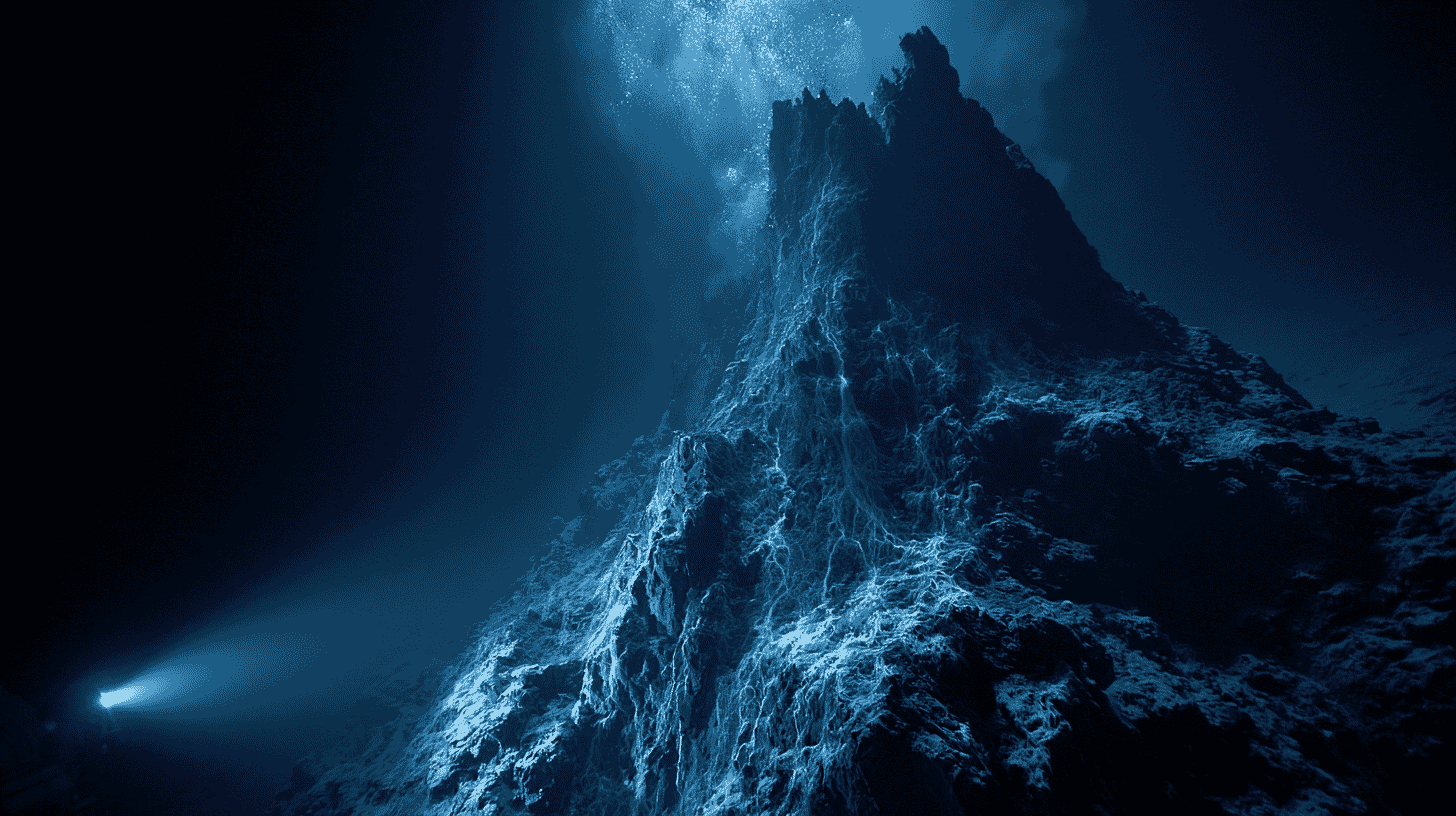
⚡ Every textbook says life on Earth runs on two engines: sunlight and chemistry. A bacterium scraped off the seafloor near Okinawa appears to run on a third.
A team from JAMSTEC, working with Yokohama City University and the University of Tokyo, has shown that a microbe living around deep-sea hydrothermal vents can grow on electric current alone, using it to build its body out of carbon dioxide. The paper appeared in The ISME Journal on June 23, 2026, and JAMSTEC announced the result two days later. The first authors, Hinako Masukawa and Runa Kobayashi, were graduate students at the time of the work.
Photosynthesis, chemosynthesis, and now electrosynthesis
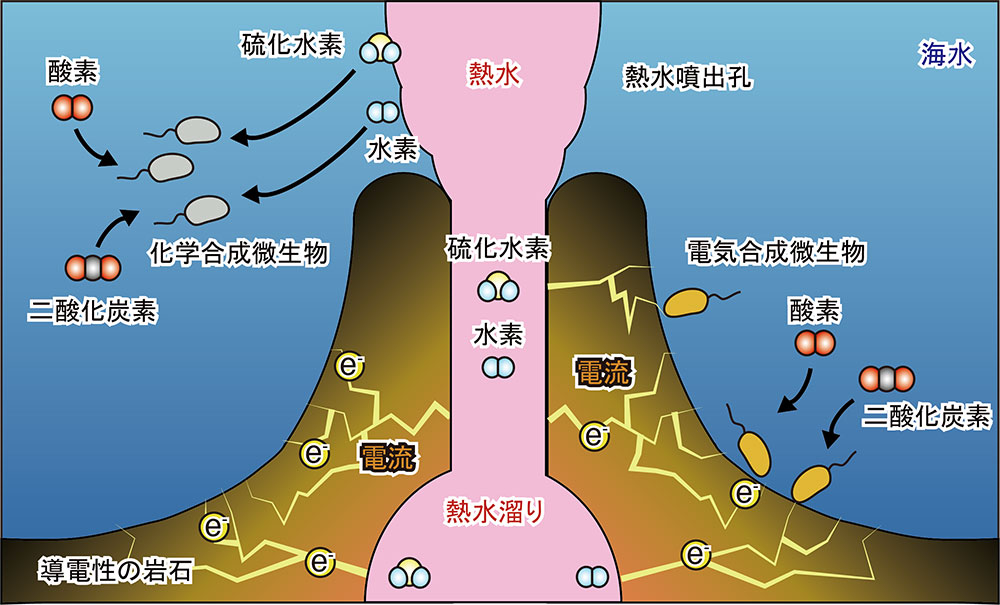
Plants run on light. In the dark of the deep sea, the vent communities discovered in the late 1970s run on chemistry instead: bacteria strip electrons off hydrogen sulfide or hydrogen gas dissolved in the water, and use that energy to turn CO2 into the stuff of cells. Both routes end in the same place. What differs is where the electrons come from.
Electrosynthesis is a third answer to that question, and a stranger one. Some microbes can trade electrons directly with solid objects outside their own cell wall, a group biologists call electroactive. Push electrons out to a mineral and you get an electrogen, the kind of bug that powers a microbial fuel cell. Pull them in from a mineral and you get an electrotroph. When an electrotroph uses those imported electrons to fix CO2, the process gets its own name: electrosynthesis. Swap "electro" for "photo" and you have the familiar word.
Labs have been doing this deliberately for years, coaxing acetate and methane out of engineered reactors. Whether anything in nature had ever bothered to evolve the trick was a separate question, and much harder to answer. Weak currents run through all sorts of environments, but they run slowly, and any microbe living on them has to compete with neighbours feeding on richer, faster chemistry.
The seafloor is already wired
Which is where the vents come in. Seawater seeps into cracks in the ocean floor, gets cooked by the heat below, and comes back up hot and chemically reduced. As it hits cold, oxygen-bearing seawater, dissolved minerals drop out and pile up into the chimneys that make vent photography so spectacular.
Those chimneys and the mineral crust around them are built largely of metal sulfides such as pyrite and chalcopyrite, and metal sulfides conduct electricity. So the seafloor ends up as a slab of conductor sandwiched between a reducing fluid below and an oxidizing ocean above. It is, functionally, a battery, and it never runs flat, because both the fluid and the seawater keep arriving.
Masahiro Yamamoto, a deputy senior scientist at JAMSTEC and one of the paper's corresponding authors, has spent over a decade documenting this. In 2013 his group ran a fuel cell off a vent and used the output to light a lamp on the seafloor. In 2017 they reported that the effect was not confined to one dramatic chimney but spread across an area roughly 150 meters on a side, including patches nowhere near an active vent. By JAMSTEC's measurements the gap between the hot fluid and the overlying seawater comes to about 600 millivolts, roughly 40 percent of what you get from a AA battery. Not much. But it is always on.
Source: JAMSTEC
A rock as an electrode
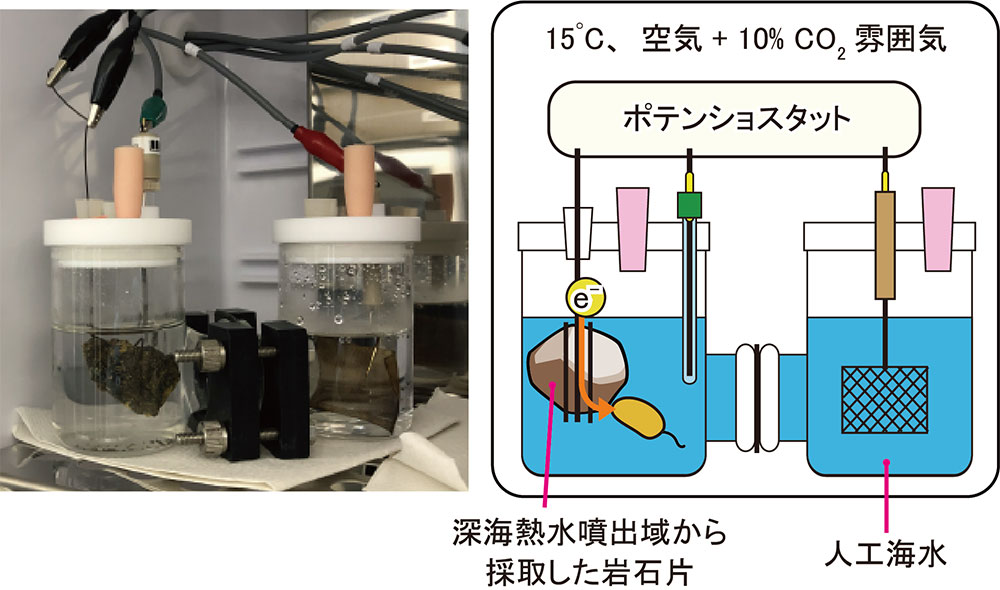
The experiment starts with a piece of that rock. The team used a highly conductive sulfide sample collected from the Iheya North site in the Mid-Okinawa Trough, roughly 1,000 meters down, brought up during cruise KR18-14 by the research vessel Kairei and the remotely operated vehicle Kaiko Mk-IV.
Back in the lab, a chip of the rock was bound with titanium wire and dropped into a glass cell filled with artificial seawater. The recipe contained salt, sulfate, phosphate, trace metals, and no organic matter whatsoever. The chamber sat at 15°C under an atmosphere of 10 percent CO2, and the rock was held at minus 0.32 volts against a silver/silver-chloride reference, chosen to match the potential someone had already measured coming out of a real vent. Electricity in, CO2 in, nothing else on the menu.
Source: JAMSTEC
The medium was swapped once a week and the community sequenced. By the twelfth week one genus was pulling ahead, and by the seventeenth it dominated: Thiomicrorhabdus, a rod-shaped sulfur-oxidizing group already familiar from sulfidic seawater. The specific organism, reconstructed from the metagenome, was labelled SREC-4.
Then came the obvious objection. Natural rock is not a clean substrate. It carries reduced metals, leftover sulfur, possibly traces of organic carbon, any of which could feed a bacterium the ordinary way while the researchers congratulated themselves on something exotic. So they replaced the rock with carbon felt, baked beforehand at 400°C for four hours to burn off anything organic. SREC-4 grew there too. Weaker current, fewer cells, same organism. And in control chambers left at open circuit, with no potential applied, the Thiomicrorhabdus dominance simply never appeared.
Following the carbon
Growth is one thing; proving the carbon in those new cells came from CO2 is another. The team fed the culture CO2 labelled with carbon-13, the rare stable isotope, then measured what ended up inside the cells. In bulk, the carbon-13 share rose to 1.62 percent against a natural baseline of 1.07 percent. Small in absolute terms, but well outside the noise of the uninoculated controls.
To find out which cells had taken it up, they turned to NanoSIMS, an instrument that maps isotope ratios across a sample at sub-micron resolution, and overlaid the result on fluorescent probes that light up Thiomicrorhabdus specifically. The cells glowing with carbon-13 were the same cells the probe had tagged. In that particular culture Thiomicrorhabdus accounted for 76.2 percent of the community and SREC-4 alone for 73.8 percent; nothing else present was capable of building its own carbon from scratch.
The genome closed the loop. SREC-4 carries the Calvin cycle, the same CO2-fixing machinery plants use, alongside the Sox pathway for sulfur oxidation typical of its relatives, plus a cluster of genes for pulling electrons in from outside the cell, closely matching one found in ISEC-1, a related bacterium the same group obtained at the same vent field and reported in 2022.
How to read a figure of 0.9 percent
The efficiency numbers are not flattering. Of all the electrons the cells consumed, at most 0.9 percent ended up in fixed carbon. The rest went to respiration: keeping the lights on rather than building anything.
By the standards of engineered systems that is dismal. Purpose-built microbial electrosynthesis reactors typically run at minus 0.8 to minus 1.2 volts against the same silver/silver-chloride reference, far harder than nature pushes, and post much higher conversion figures. Measured per electron, SREC-4 also yields fewer cells than the chemosynthetic bacteria that dominate vent ecosystems.
But that comparison cuts both ways, and the authors make the point themselves. Chemosynthesis depends on specific dissolved molecules reaching the cell by diffusion, which means it works where the plumbing happens to deliver and stops where it does not. An electric current propagates through conductive rock. It reaches the cold, quiet crust hundreds of meters from any visible chimney, exactly the patches the 2017 survey found charged. A modest, dependable income can beat a rich but patchy one.
There is an engineering reading of all this too. Those purpose-built reactors exist because turning surplus renewable electricity into chemicals (acetate, methane, feedstock, protein) is an attractive way to make CO2 into something other than a problem. The field's stubborn difficulties are microbial: which organisms will take electrons off an electrode, how to keep them alive, how to grow them at all. JAMSTEC's own announcement gestures at this, raising electricity-driven biological production as a possible payoff. What this study offers is not a better yield but a lineage that evolved the electron-uptake hardware on its own, and a way to enrich such organisms from the wild, which has historically been the hard part.
Two caveats belong here. This is an enrichment culture, not a pure isolate, so SREC-4 has never been grown alone. And its genome is metagenome-assembled, meaning some conclusions about its metabolism rest on genes rather than on biochemistry performed directly on the organism.
The list of habitable places gets longer
The broader finding may be the survey work. When the team combed genome databases for that electron-uptake gene cluster, they found it in other Thiomicrorhabdus genomes assembled from vent fields in both the Pacific and the Atlantic, and only in genomes from vent fields, clustering neatly on one branch of the family tree. The capacity to eat electricity appears to be a hydrothermal specialty, and hydrothermal fields are everywhere the seafloor spreads.
Then there is the part that always gets the headlines. Europa and Enceladus both hold liquid oceans over rocky floors, and Cassini's measurements at Enceladus, silica nanoparticles and molecular hydrogen in the plume, are widely read as evidence of water reacting with hot rock below. Sunlight cannot reach those oceans, and chemical energy might be scarce. A slow trickle of current through conductive minerals is a third possibility that costs very little to imagine.
Worth restraining the enthusiasm, though. A paper published in Nature Communications in January 2026 argued that Europa's seafloor is probably not actively fracturing today, which would throttle the fluid circulation any such system depends on. As of July 2026, Europa Clipper is still in transit, with arrival at Jupiter set for 2030. ESA has settled on Enceladus as the target of its next flagship, an orbiter and lander known as L4, but that mission is only entering its definition phase: formal adoption is not expected until around 2034, launch around 2042. Nobody has measured a volt anywhere but here.
Yamamoto seems more interested in the nearby cases anyway. Speaking to Science Portal, he noted that the boundary between oxidizing and reducing conditions turns up in unremarkable places: the layer where pale sand turns black as you dig for clams on a tidal flat, or the ground around a metal mine. Vents are the extreme version. He said he wants to look for electrosynthetic bacteria in the others.
Thirteen years of measuring voltages on the seafloor turn out to have been the setup for a question about what life is allowed to eat. Textbooks will probably keep saying two engines for a while yet. But the third one has now been caught running.
Do the biology classes in your country still draw the line at sunlight and chemistry? And would a bacterium that lives on electricity change how you picture what counts as a habitable place?
References
- https://scienceportal.jst.go.jp/newsflash/20260728_n01/
- https://www.jamstec.go.jp/j/about/press_release/20260625/
- https://academic.oup.com/ismej/article/20/1/wrag108/8714129
- https://onlinelibrary.wiley.com/doi/10.1002/anie.201701768
- https://www.nature.com/articles/s41396-022-01316-6
- https://www.nature.com/articles/s41467-025-67151-3






Global Discussion
3 comments