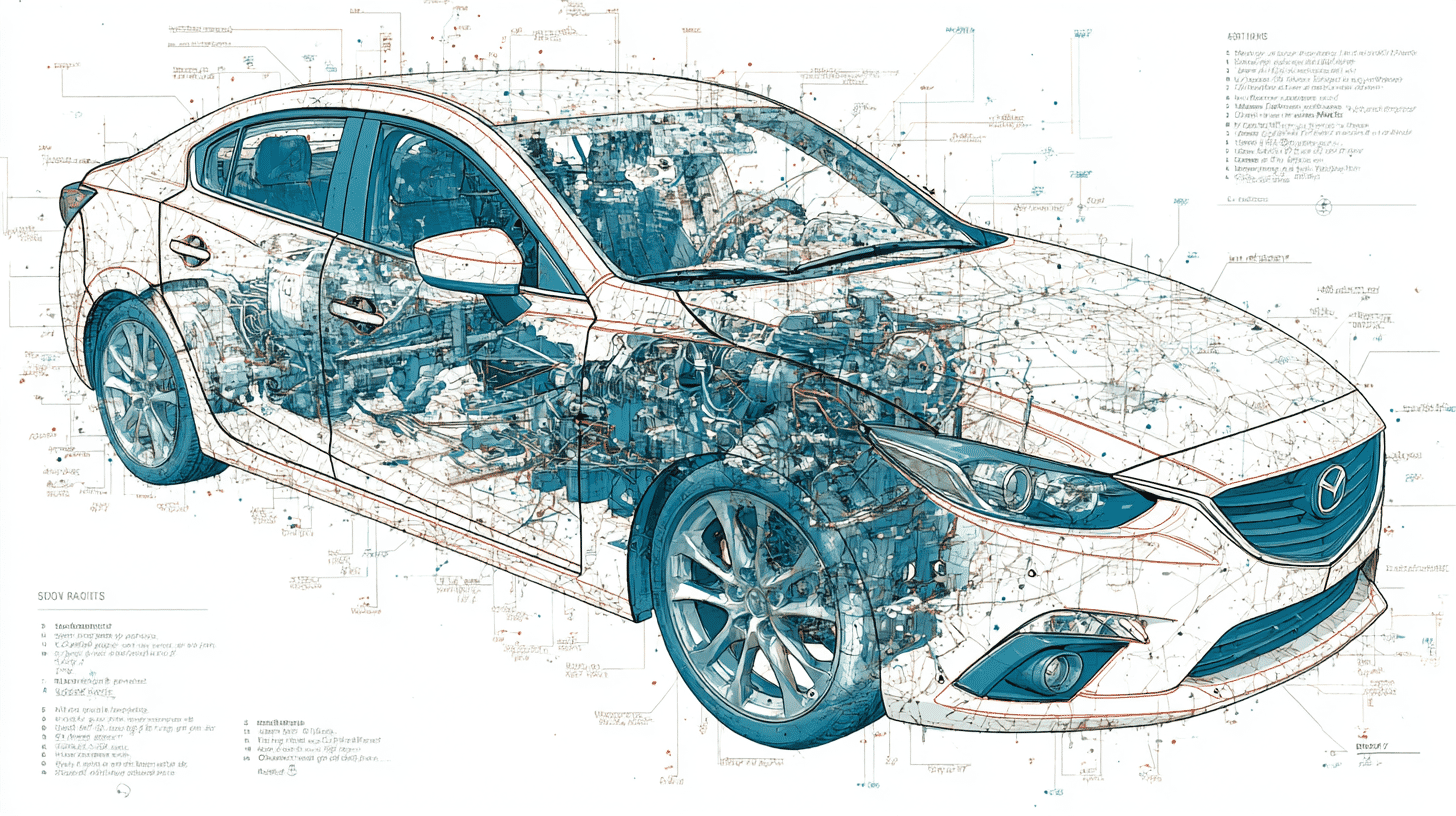
🚙 A Japanese company has spent ten years giving away self-driving software for free. On July 22 it finally asked the stock market what that was worth, and the first answer of the morning was: less than the bankers thought.
Tier IV listed on the Tokyo Stock Exchange Growth Market that day, the first IPO in Japan by a company that does nothing but autonomous driving. The stock opened 7% below its offer price. Here is what the market was actually pricing.
Nine minutes after the bell, a 7% discount
At 9:09 a.m. on July 22, 2026, Tier IV (ticker 593A) printed its first trade at ¥1,009, about $6.15 (dollar figures in this article use the roughly ¥164 to the dollar rate at the time of the listing). That was ¥76, or 7.0%, below the ¥1,085 offer price fixed on July 13. Note that the offer price itself had been set at the very top of the ¥1,015 to ¥1,085 indicative range, so weak demand in the book was not the problem.
The rest of the session was choppy. Shares sank to ¥896, clawed back to ¥1,081, and closed at ¥1,015. At the opening price the company was worth about ¥64.1bn, or $391m. The next morning it opened right at ¥1,085 and briefly touched ¥1,172.
Counting the public offering, the secondary sale and the greenshoe, up to ¥26.7bn ($163m) of stock went into the market on day one. On Japan's Growth board, where the pool of buyers is thin, that is a heavy float. And the company has not told anyone when it expects to make money.
Source: Tier IV press release (PR TIMES)
How do you sell software you give away?
Tier IV was incorporated in December 2015 as a spinout from Nagoya University, and everything it does rests on one artifact: Autoware, the open-source autonomous driving stack released that same year. The company's stated vision is "democratizing autonomous driving," and it means the word literally.
Autoware is free. Anyone can download it, read it, fork it, ship it. It covers the whole loop, from perception through cameras and sensors, to working out where the vehicle is, to planning a route and operating the controls. According to AMD, which began a compute partnership with the project, Autoware now underpins work at more than 500 companies, across more than 30 vehicle types, in more than 20 countries. The Autoware Foundation that stewards the code passed 100 member organizations this year, with a research network spanning more than 50 universities and institutes. As of April 2026, 716 people had contributed code.
None of that is revenue.
What Tier IV actually sells is the distance between open-source code that works in a demo and a bus that carries schoolchildren through a Japanese mountain town in February. That means safety engineering, vehicle integration, sensor and compute units, simulation and machine-learning tooling, and years of patiently nursing pilot programmes for municipalities and bus operators. In the year through September 2025, 43.9% of revenue came from licences, hardware and consulting, 35.4% from local-government and transit deployments, and 20.8% from development contracts with automakers.
What sits underneath all this is substantial. Through March 2026 Tier IV had worked in 39 of Japan's 47 prefectures across 127 separate regions and logged roughly 469,000 km of test driving, with no injury accidents on public roads through May 2026 by the company's own count. Eighteen automakers and tier-one suppliers are collaborating with it, among them Isuzu, which is building Level 4 versions of its ERGA city buses on Tier IV software running on NVIDIA's DRIVE Hyperion platform. The shareholder register reads like a roll call of corporate Japan: SOMPO Holdings, Yamaha Motor, Isuzu, KDDI, Sony Group, Suzuki, and, since June, Toyota by way of a subsidiary.
Waymo closed the door, GM walked out, Baidu stalled
The tidy version of the open-source story, plucky open Japan against closed American and Chinese giants, is only half right.
Waymo is genuinely closed and genuinely enormous. It runs about 3,000 robotaxis across 11 US metro areas, delivers roughly 500,000 paid rides a week, and raised $16bn in 2026 at a $126bn valuation. That is more than 300 times what the market has just put on Tier IV. Waymo owns its software, its vehicles, its depots and its customer relationships, and in plans it published in December 2025 it named Tokyo among the cities where it is laying groundwork.
The counter-example is Cruise. GM bought it in 2016, spent roughly $10bn, and on December 10, 2024 stopped funding robotaxi development altogether, folding the team into its driver-assistance group. GM's own statement cited the time and resources needed to scale and an increasingly competitive market. Full vertical integration is expensive, and it does not always end well.
Baidu complicates the story further, because Baidu is not closed either. It opened Apollo as a developer platform back in 2017, before the Autoware Foundation existed, and its Apollo Go service now operates commercially in 27 cities, with more than 22 million cumulative rides and a weekly peak above 350,000 in March 2026.
So the real split is not open against shut. It is about who holds the keys. Apollo is code published by Baidu, on Baidu's roadmap, feeding Baidu's fleet. Autoware is governed by a non-profit foundation of more than a hundred members, where Tier IV is the biggest contributor but not the owner. The Chinese logistics firm Neolix, which operates over 15,000 autonomous delivery vehicles, joined that foundation as a premium member in January 2026. A Japanese company's flagship technology is being improved by a Chinese competitor, which is either the strategy working exactly as designed or the reason it is so hard to monetize, depending on which analyst you ask.
One further argument for openness got much louder in the spring of 2026. On March 31, more than 100 Apollo Go robotaxis stopped simultaneously on roads in Wuhan, leaving passengers stuck inside for up to two hours. Bloomberg later reported that Chinese regulators had frozen new autonomous vehicle permits nationwide. The cause has never been explained publicly in detail. When a fleet fails and the code is proprietary, the public has to take the operator's word for what went wrong. That is precisely the problem an open stack claims to solve, and it is an argument that lands better with regulators than with fund managers.
What the losses are buying
Revenue for the year through September 2025 was ¥6.41bn ($39m). Research spending over the same twelve months came to ¥8.55bn ($52m), meaning the company spent more inventing the product than it earned selling it. The operating loss came to ¥10.51bn ($64m); after non-operating items the net loss was ¥4.8bn ($29m). Cash at year-end had fallen to ¥6.93bn ($42m).
For the year ending September 2026, management forecasts revenue of ¥8.48bn ($52m), up 32.4%, with the operating loss widening to ¥11.24bn ($69m). The prospectus states plainly that reaching profitability will take time. IPO proceeds are earmarked for ¥8.7bn of research and development, including a dedicated self-driving chip, ¥7.2bn for mass production and supply chain, and ¥3.4bn for hiring.
Policy is pushing in the same direction. Japan's revised road traffic law opened the door to driverless Level 4 operation in April 2023, and the third national transport policy plan, approved by cabinet in January 2026, targets 10,000 autonomous service vehicles by fiscal 2030 and more than 100 unmanned mobility services by fiscal 2027. Tier IV's development customers grew from 7 to 13 between September 2024 and March 2026.
But pilots are not production. The number that matters from here is not how many towns have tried an autonomous shuttle. It is how many vehicles come off a line with Autoware inside and a per-unit licence attached. Until that shows up in a quarterly filing, the 7% discount is the market saying, politely, that it has seen a lot of demos.
Japan is betting that the open road is also the profitable one. Where you live, would you rather ride in a vehicle whose software anyone can inspect, or one built entirely by a company that will never show you the code?
References
- https://prtimes.jp/main/html/rd/p/000000130.000040119.html
- https://jioinc.jp/investleaders/ipo_tier4/
- https://www.amd.com/en/blogs/2025/advancing-open-autonomous-driving-perception-at-scale.html
- https://autoware.org/autoware-foundation-2-0-growing-together-toward-scalable-autonomy/
- https://techcrunch.com/2026/03/27/waymo-skyrocketing-ridership-in-one-chart/
- https://www.sec.gov/Archives/edgar/data/1467858/000119312524274336/d917047dex991.htm
- https://electrek.co/2026/06/16/baidu-apollo-go-amigo-switzerland-level-4-approval/
- https://www.bloomberg.com/news/articles/2026-04-29/china-suspends-new-autonomous-driving-permits-after-baidu-outage
- https://www.automotiveworld.com/news/china-suspends-new-av-permits-after-baidus-mass-outage/








Global Discussion
0 comments