On October 1, Nidec named its conventional management approach, built on expansion in every direction and short-term targets, as an internal cause of a ¥632.1 billion writedown, and agreed to sell a unit to Carlyle.
KADOKAWA CEO Takeshi Natsuno kept his board seat on June 24 with 59.68% support, down 30.58 points, while Oasis Management's removal bid drew 26.79%. What the split vote meant, and what the next quarter showed.
Mitsubishi is bringing the Pajero back after seven years with a plan for just 10,000 units. The shares moved anyway. What a nameplate is worth to a carmaker that sold 797,000 vehicles last year.
Astellas and Kyowa Kirin are the first Japanese drugmakers to sign most-favored-nation pricing deals with Washington. A September 29 tariff deadline explains the timing, and Japanese prices sit inside the U.S. formula.
Hafnium keeps advanced chips and jet engines running, yet the world makes about 71 tonnes a year, nearly all of it in France and the United States. An Osaka chemical maker now wants a share of it by 2028.
Metaplanet moved 5,014 BTC between its own custody addresses for about $8 in fees, and the market assumed a sale. Why nobody believed the denial, and what the balance sheet says.
Diamond reports Sony has offered around 200 billion yen for Tamron, whose lenses outsell Sony's own in Japan. An activist fund had already overtaken Sony on the shareholder register.
Tier IV, the company behind open-source self-driving stack Autoware, listed in Tokyo on July 22, 2026 and opened 7% below its offer price. How do you monetize software you give away?
Takeuchi invented the mini excavator, earns 99% of sales abroad, and ranks 2nd in Europe and 5th in North America. The story of a Nagano firm that built a market from nothing, and the US-dependence risk it now carries.
Nintendo published its 86th shareholder meeting Q&A. Beyond the stock-price headlines: Miyamoto says IP runs at nearly 100% profit versus 30% console margins, the DS/3DS backward-compatibility dodge, game-preservation friction, My Number ID checks for Pokemon cards, and the India and China playbooks.
At Nissan's annual meeting, at least one investor called to bring back Carlos Ghosn. The fugitive ex-chairman told Reuters that only he can save the company, but he fled Japan inside a box and cannot legally return. What the absurd pitch actually signals.
Nintendo's stock has fallen more than 50% since its August 2025 peak, even after a record fiscal year. We unpack why, for an overseas investor audience: the Switch 2 price hike, a softer FY27 outlook, and how Nintendo stacks up against US gaming names like Roblox, Take-Two, and EA.
Nissan shareholders voted down the reappointment of outside director Motoo Nagai. A Mizuho-linked board insider, an abstaining Renault, and executive pay in a loss-making year explain how a rare rejection happened.
The Bank of Japan began selling its ETFs, yet its holdings ballooned past 110 trillion yen, over 8% of the Tokyo market. Why the Fed and ECB never bought stocks, how Switzerland differs, and whether central banks should own equities at all.
China overtook Japan in net external assets at the end of 2025, dropping it to third place, yet Japan's holdings hit a record high. Here is what the numbers really mean for the yen.
PM Takaichi met BOJ Governor Ueda on May 22 and asked the central bank to carry out 'appropriate policy.' We explain Japan's central bank independence next to the US Fed and the ECB, and how a weak yen near 159 and the carry trade tie this to global markets.
Top shareholder Oasis Management is pushing to remove KADOKAWA CEO Takeshi Natsuno, triggering a full proxy fight ahead of the June 24 shareholder meeting. We break down the arguments over an 89% EPS drop, the 'isekai over-reliance' critique, and FromSoftware's monetization, and check how our earlier predictions held up.
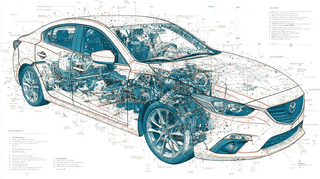
Mazda launched the third-generation CX-5 in Japan on May 21, 2026, starting at 3.3 million yen (around $20,800). With 5 million sold globally, this redesigned SUV is Mazda's bet on hybrids and combustion as the EV boom cools, and how it stacks up against Toyota RAV4, Honda CR-V, Tesla, and BYD.
Japanese toy, video and game distributor Happinet reported its FY26 results, with video game segment profit surging 772% year-over-year to 2.2 billion yen (about $14 million). Behind the spike: Nintendo Switch 2 and its software lineup, plus the ripple effect of a console generation transition through Japan's entire game distribution ecosystem. Here's what was happening behind Nintendo's 19.86 million unit sell-through.
Japan's three megabanks (MUFG, SMFG, and Mizuho) posted a combined net profit of 5.26 trillion yen ($33B) for the fiscal year ended March 2026, breaking the 5-trillion-yen barrier for the first time. We unpack how BOJ rate hikes drove the surge, how the numbers compare to JPMorgan and HSBC, and what Japan's monetary normalization means for global markets.