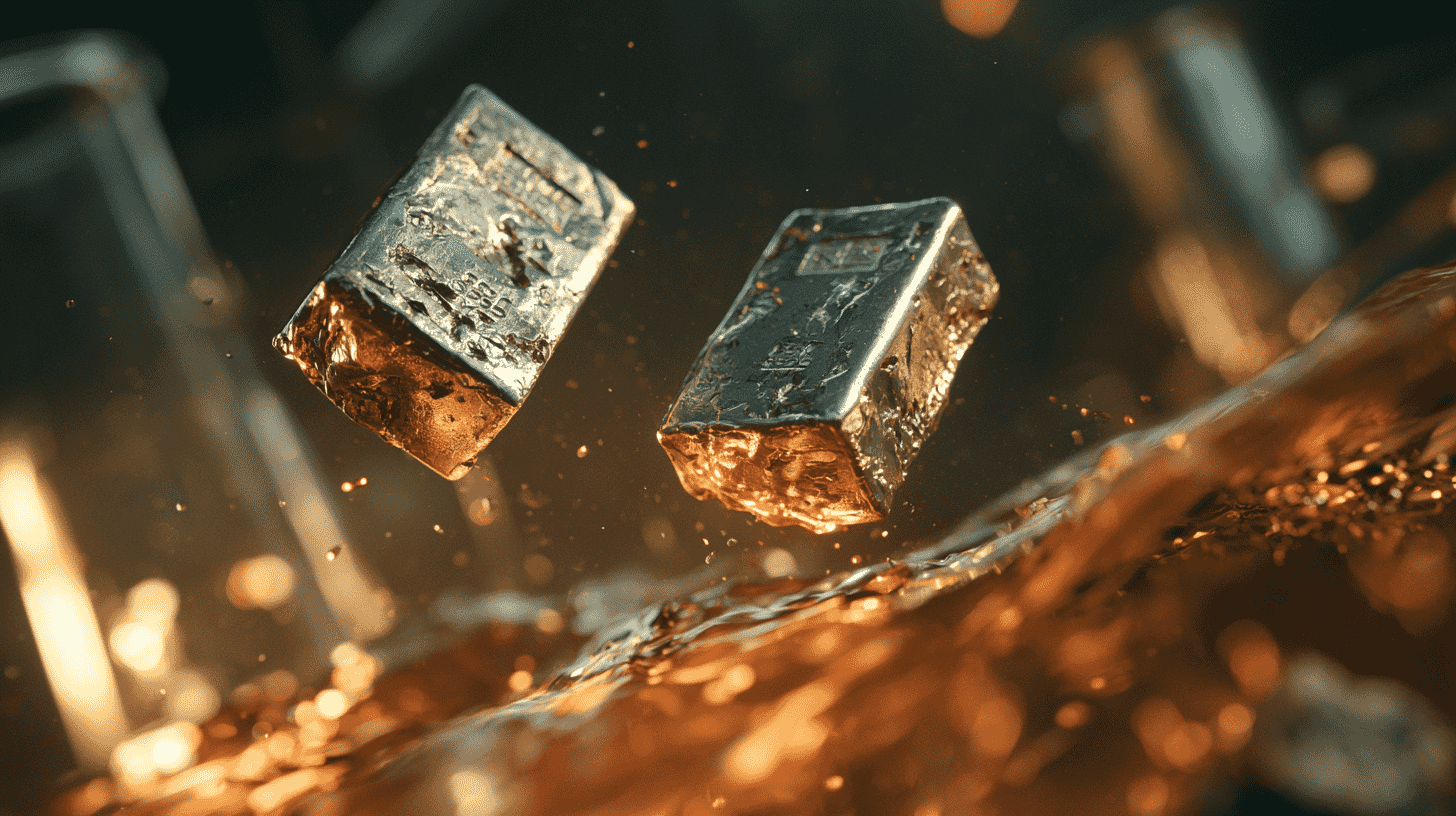
🔬 There is a metal whose annual world output the US Geological Survey cannot put a number on. Hafnium. It rides inside zirconium ore at 1 to 2 percent, and it resembles zirconium so closely that pulling the two apart is hard. Advanced chips and jet engines need it anyway.
Japan has barely produced any of it commercially. On August 25, 2026, an Osaka chemical maker called Daiichi Kigenso Kagaku Kogyo said it had worked out how. Its shares were bid at the daily limit the following morning.
A 71-tonne world
World hafnium output runs at roughly 71 tonnes a year, the 2016 to 2020 average compiled by SCRREEN, an EU project on critical raw materials. A July 2026 analysis by Geopolitical Monitor puts refined output at 70 to 75 tonnes a year, so the order of magnitude has not shifted. Superalloys take 61 percent of it, nuclear control rods 11 percent and catalyst precursors 7 percent, as of 2016. A pinch of hafnium in a jet engine turbine blade raises how much heat the blade can take. In chips, hafnium oxide sits in the transistor as the gate insulator that has kept miniaturisation moving.
Two countries do almost all of it. In the same 2023 SCRREEN document, France accounts for 49 percent, the United States 44 percent, China and Russia 3 percent each. The company lineup varies by source. SCRREEN puts three firms, among them CEZUS in France and ATI Wah Chang in the United States, at more than 90 percent of global supply. The Geopolitical Monitor analysis names Framatome in France, ATI and Western Zirconium in the United States, several refiners in China, and Chepetsky in Russia. Either way the count does not reach ten. In its 2026 Mineral Commodity Summaries, the USGS wrote that world primary hafnium production data and quantitative estimates of hafnium reserves were not available. The market is closed enough that the statisticians cannot get the numbers, and every production figure in circulation, including the ones here, is an estimate.

Source: Alchemist-hp / Wikimedia Commons / CC BY-SA 3.0 DE
The Argus Media annual averages carried by the USGS run $781 per kilogram in 2021, $1,590 in 2022 and $6,130 in 2023, close to eight times in two years. Reuters reported in February 2023 that a rebound in aircraft production had collided with semiconductor demand, leaving a shortfall of 5 to 10 tonnes against output of 80 to 90 tonnes a year. Things eased after that, to $4,560 in 2024 and an estimated $3,800 in 2025, but nothing has gone back to where it started.
Separating a pair of near-twins
Hafnium does not come out of its own mine. Daiichi Kigenso's announcement puts the difficulty down to how close the two elements are: separating them and lifting the purity takes serious technique.
That closeness is not a figure of speech. Atomic radius, ionic radius, electronegativity: on all three the two elements land in nearly the same place, and stacked one above the other in the periodic table they behave in a reaction almost like a single element. The SCRREEN factsheet points at exactly this closeness as the reason separation is difficult. Differences in solubility and reactivity, the usual handles, are not there to grab.
So why does anyone bother to separate them? Nuclear power. Zirconium goes into the cladding around reactor fuel, and any hafnium left in it swallows neutrons. Reactor-grade zirconium therefore has to be stripped of hafnium, and what gets stripped out becomes the product. Turn that around and, as SCRREEN puts it, hafnium recovery does not pay for itself without nuclear demand for the zirconium. That is why production sits in France and the United States.
The workhorse method is solvent extraction, but the conventional mixer-settler is bulky and expensive to run. For Daiichi Kigenso, which has been refining zirconium compounds for more than six decades, that was the line it had not crossed. Recovery from end-of-life products, meanwhile, runs below 1 percent on the UNEP estimate that SCRREEN cites, so recycling has not been filling the gap either.
The startup out of a nuclear village
Emulsion Flow Technologies is based in Tokai, a village in Ibaraki prefecture, and was spun out of the Japan Atomic Energy Agency. It was founded on April 5, 2021 and certified by JAEA as an agency-originated venture on June 3 that year. The emulsion flow method in its name was devised by Hirochika Naganawa, who spent more than 30 years on element separation at JAEA and now serves as the company's director and chief science officer.
Conventional solvent extraction runs in three stages: mix, let it settle, separate. The emulsion flow method sprays uniform droplets from a nozzle and folds all three into a single pumping operation. Against a mixer-settler, JAEA says, throughput rises more than tenfold, running costs drop by 80 percent, and the equipment shrinks to under a tenth the size.
The company's day job was pulling rare metals out of lithium-ion batteries and stripping PFAS out of water. A separation technique born in nuclear basic research got its practical schooling in urban mining, then came round to hafnium in ore. The basic agreement with Daiichi Kigenso was announced on October 4, 2024. The two firms described the plan then as combining EFT's rare metal recycling technology with Daiichi Kigenso's experience in refining zirconium compounds.
Samples this year, volume in 2028
According to the August 25, 2026 announcement, Daiichi Kigenso has established a way to separate and refine, by solvent extraction, the trace hafnium carried in a zirconium intermediate. The feedstock is that intermediate, made by refining zirconium ore at the company's plant in Vietnam. Not scrap: hafnium that had been passing straight through the company's own flow. The technique comes from recycling, the feedstock from ore, and the two are easy to conflate. What comes out is not a lump of metal but what the announcement calls a hafnium compound. That puts it on the far side of the superalloy trade and on the same side as the high-k dielectrics in chips.
The world's hafnium is a byproduct of reactor-grade zirconium. This one is not: it comes off the line that makes industrial zirconium compounds. That would uncouple the supply from whatever the nuclear industry happens to need. The plan is to begin supplying samples within 2026 and to reach volume production in 2028. As of August 2026 the disclosure stops there. No capacity figure, no investment number. The technology is established; the work of scaling it up is ahead.
The market moved quickly. On August 26, the morning after the announcement, Daiichi Kigenso shares were bid at their daily limit, against a previous close of 2,591 yen. Two live keywords, AI chips and economic security, had converged on one stock. Volume production is still two years out.
A vulnerability China did not build
For a few years now, critical minerals in Japan have meant rare earths and Chinese export controls. Gallium and germanium in August 2023, graphite that December, antimony in September 2024, tungsten and several others in February 2025, seven rare earth elements in April 2025. Hafnium does not appear in the list of items JETRO compiled from that run of restrictions.
Japan still counts hafnium among the 35 minerals it treats as critical under its Economic Security Promotion Act. The fragility does not originate in Beijing. Producing countries and producing companies are both few, and they move for reasons set by the nuclear industry. Nobody has to turn a tap for supply to thin out.
Japan is now trying to move over to the side of the trade that extracts the 1 to 2 percent riding along in the zirconium flow. Where do the chipmakers and engine builders in your country buy their hafnium? And how many people inside those companies could answer that?
References
- https://prtimes.jp/main/html/rd/p/000000004.000171462.html
- https://www.japanmetaldaily.com/articles/-/266157
- https://pubs.usgs.gov/periodicals/mcs2026/mcs2026-zirconium-hafnium.pdf
- https://scrreen.eu/wp-content/uploads/2023/12/SCRREEN2_factsheets_HAFNIUM-update.pdf
- https://www.jaea.go.jp/02/press2021/p21060301/
- https://emulsion-flow.tech/en/team/
- https://emulsion-flow.tech/2024/10/04/%E3%82%B8%E3%83%AB%E3%82%B3%E3%83%8B%E3%82%A6%E3%83%A0%E5%8C%96%E5%90%88%E7%89%A9%E3%83%A1%E3%83%BC%E3%82%AB%E3%83%BC%E3%81%A7%E3%81%82%E3%82%8B%E7%AC%AC%E4%B8%80%E7%A8%80%E5%85%83%E7%B4%A0%E5%8C%96/
- https://www.jogmec.go.jp/metal/metal_10_00001.html
- https://www.jetro.go.jp/biz/areareports/special/2026/0101/5229e687b7a111eb.html
- https://www.mining.com/web/aerospace-electronic-demand-drive-hafniums-400-record-surge/
- https://www.geopoliticalmonitor.com/critical-minerals-global-hafnium-supply-demand/
- https://www.framatome.com/medias/framatome-strengthens-its-hafnium-production-capacity-for-nuclear-aerospace-and-space-applications/
- https://diamond.jp/zai/articles/-/1072194




Global Discussion
4 comments