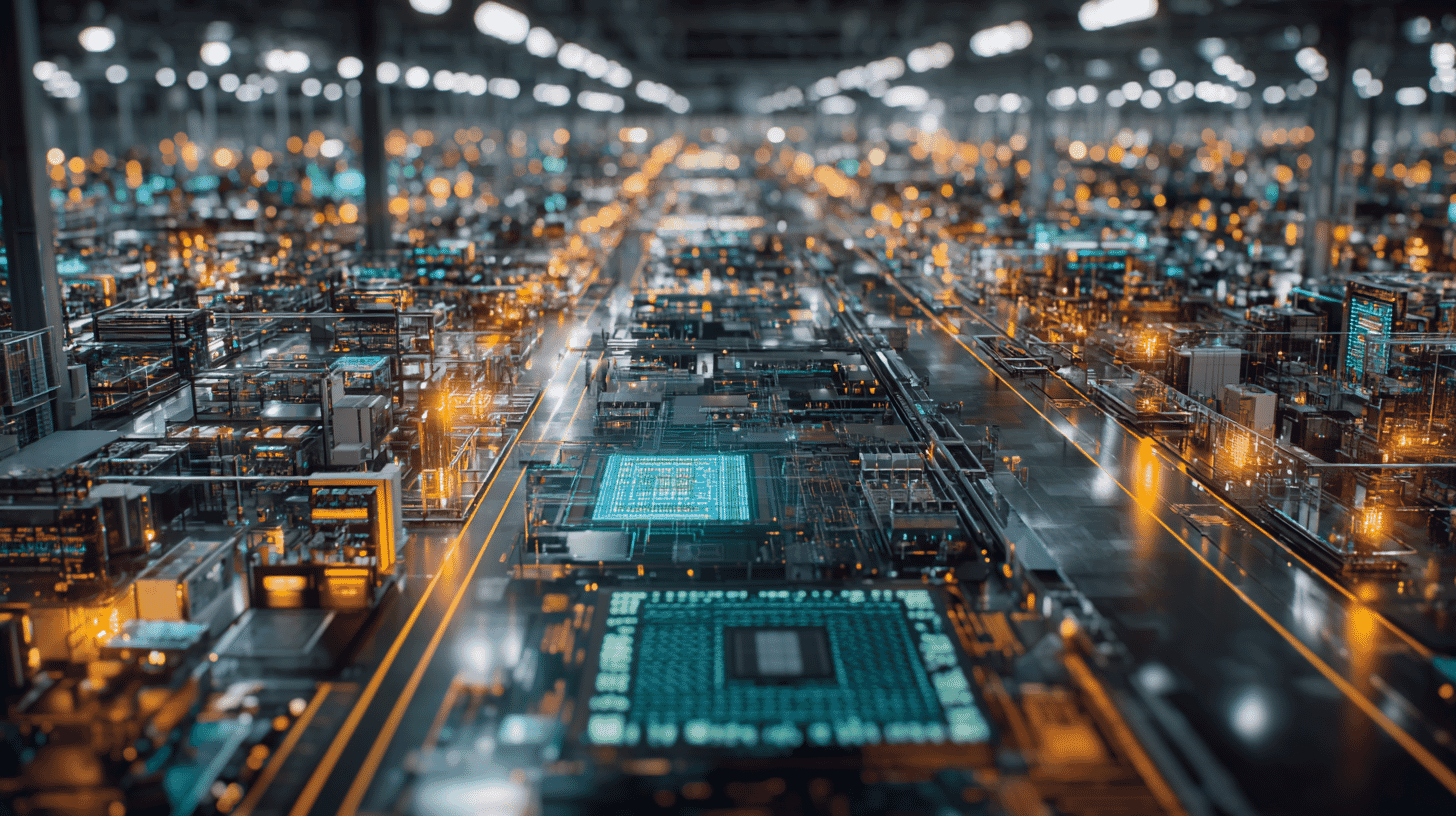
Every time you ask ChatGPT a question, the answer travels through an AI server. Inside that server is a high-performance chip, and holding that chip together is a tiny but critical component called an IC package substrate. One Japanese company makes over half of the world's supply for servers. Now they're investing $3.2 billion to keep up with AI's insatiable appetite.
The Invisible Backbone of the AI Revolution
When people think about the AI boom, names like NVIDIA, OpenAI, and Google come to mind. But behind every cutting-edge GPU powering ChatGPT, image generators, and autonomous vehicles is a less glamorous but absolutely essential component: the IC package substrate.
Think of it this way, if a GPU is the brain of an AI server, the IC package substrate is its nervous system. It's the layer that connects the semiconductor chip to the circuit board, transmitting electrical signals at incredible speeds while managing heat dissipation and power delivery. Without a high-quality substrate, even the most advanced chip in the world cannot function properly.
And the company that dominates this critical chokepoint? Ibiden, a Japanese manufacturer founded in 1912, headquartered in Ogaki City, Gifu Prefecture, far from the neon lights of Tokyo's tech district.
$3.2 Billion to Feed the AI Hunger
On February 3, 2026, Ibiden announced a massive investment plan: approximately ¥500 billion (roughly $3.2 billion) over three fiscal years from 2026 to 2028, specifically to expand production of high-performance IC package substrates for AI servers and high-end computing applications.
The plan unfolds in two major phases. The first phase targets the Kawama Plant (Cell 6) in Ogaki City, Gifu Prefecture, with an investment of approximately $1.4 billion (¥220 billion). Production is expected to begin rolling out from fiscal year 2027. The second phase focuses on the Ono Plant in Ono Town, also in Gifu Prefecture, with an additional $1.8 billion (¥280 billion). The Ono Plant, which began producing AI server substrates in October 2025, currently only utilizes about half of its building capacity, and this investment will push it to full production by the end of fiscal year 2027.
The result? By fiscal year 2028, Ibiden aims to increase its AI server-grade substrate production capacity to approximately 2.5 times its current level.
Why Ibiden Matters More Than You Think
Ibiden isn't just another component maker. In the high-performance server-grade IC package substrate market, the company commands an estimated market share exceeding 50%. For AI server substrates specifically, the kind that go into NVIDIA's data center GPUs, Ibiden has been described as holding a near-monopoly position.
This dominance stems from decades of accumulated expertise. Ibiden entered the printed circuit board business in the 1970s and moved into IC package substrates in the 1980s. Over the decades, as semiconductor chips grew more complex and required ever-finer circuitry, Ibiden kept pace with the technological demands that many competitors could not meet.
Today's AI chips are enormous, power-hungry, and generate massive amounts of heat. The substrates they need must handle ultra-fine wiring patterns, multiple laminated layers, and sophisticated power delivery networks. Ibiden's ability to manufacture substrates meeting these extreme specifications for customers like NVIDIA and Intel has made it essentially irreplaceable in the global AI supply chain.
Together with Shinko Electric Industries (now part of Fujitsu), these two Japanese companies control an estimated 70-80% of the high-end server substrate market. As one industry commentator put it: "Without Ibiden and Shinko Electric, you simply cannot make server-grade processors."
The Kawama Plant: From Intel's Setback to AI's Springboard
The Kawama Plant has an interesting backstory. Originally built as a dedicated facility for Intel, it was completed in fiscal year 2023 at a cost of approximately ¥180 billion. However, just as construction wrapped up, Intel's demand declined, and the plant remained idle, an expensive monument to market timing gone wrong.
But the AI boom changed everything. Ibiden CEO Koji Kawashima revealed that the company has reached an agreement with Intel to repurpose the Kawama facility. Rather than serving Intel exclusively, it will now function as a plant capable of supplying products to Intel's customers as well, effectively opening it up to the broader AI ecosystem. The plant is scheduled to begin production in fiscal year 2027.
This pivot represents a broader strategic shift at Ibiden, from being a supplier tied to specific chipmakers to becoming a versatile infrastructure provider for the entire AI server industry.
A Company Born from Water, Now Powering AI
Few people outside Japan know that Ibiden started as a hydroelectric power company in 1912, harnessing the rapids of the Ibi River in Gifu Prefecture (the company's name literally derives from "Ibi-den," or "Ibi electricity"). Over the following century, it transformed itself multiple times, from power generation to carbide products, to ceramics, to printed circuit boards, and finally to the IC package substrates that now define its identity.
This ability to reinvent itself is deeply embedded in the company's DNA. Today, Ibiden's electronics division accounts for about 52% of total sales and 56% of operating profit, with AI server-related products driving the growth engine. In its most recent quarterly results (April-December 2025), consolidated revenue rose 10.5% year-on-year to ¥298.6 billion ($1.9 billion), while net income grew 25% to ¥31 billion ($200 million).
Looking ahead, Ibiden projects that by fiscal year 2028, it will achieve revenue of ¥600 billion ($3.9 billion) with a 15% operating margin, and by fiscal year 2031, revenue of ¥750 billion ($4.8 billion) with a 20% operating margin, ambitious targets that hinge on the continued expansion of the global AI infrastructure.
The Japanese Advantage in Package Substrates
Ibiden's dominance is not an isolated phenomenon. Japan's semiconductor packaging supply chain is remarkably deep. Ajinomoto (yes, the food company) supplies the critical ABF insulating film used in build-up layers. Resonac (formerly Showa Denko Materials) dominates in low-thermal-expansion core materials. Ushio Electric leads in exposure equipment for high-end substrates. This interlocking web of specialized suppliers makes Japan uniquely positioned in the global packaging ecosystem.
The package substrate market, which was valued at roughly $7-8 billion several years ago, is projected to reach $14-15 billion by 2026 and continue growing at double-digit rates driven by AI demand. Within this rapidly expanding market, Japanese suppliers collectively hold a commanding position that no other country can match.
Risks and Challenges Ahead
Despite the bullish outlook, not everything is smooth sailing. When Ibiden announced its ¥500 billion investment plan alongside its quarterly earnings, the stock actually plunged over 12% the following day. The reason? Ibiden's full-year earnings forecast fell short of market expectations, reminding investors that massive capital expenditure creates short-term pressure on profitability.
There are other risks to consider. The AI investment cycle, while showing no signs of slowing down, could face disruption from geopolitical tensions, particularly US-China technology restrictions. Competitors like AT&S (Austria) and Samsung Electro-Mechanics (South Korea) are also investing heavily. And the very nature of Ibiden's customer concentration, heavy reliance on NVIDIA and Intel, means that any strategic shift by these chip giants could ripple through Ibiden's business.
Additionally, the scale of investment required is staggering for a company of Ibiden's size. With annual revenue of approximately ¥420 billion, committing ¥500 billion over three years means the company is essentially betting one year's worth of revenue on the continued trajectory of AI demand.
What This Means for the Global AI Supply Chain
Ibiden's investment underscores a crucial reality about the AI revolution: it's not just about software and algorithms. The physical infrastructure, the chips, the substrates, the servers, the data centers, requires enormous capital investment and specialized manufacturing capabilities that are concentrated in a surprisingly small number of companies and countries.
Japan, often perceived as having fallen behind in the semiconductor manufacturing race, actually holds critical chokepoints in the supply chain. While TSMC makes the chips and NVIDIA designs the GPUs, companies like Ibiden provide the essential packaging substrates without which none of these advanced semiconductors can reach the market.
As the world races to build out AI infrastructure, Ibiden's ¥500 billion bet is a reminder that the AI revolution depends on a complex, global supply chain, and that some of its most critical links are forged in a quiet factory town in central Japan.
In Japan, Ibiden's massive investment has sparked lively debate, from excitement about Japan's role in the AI supply chain to concerns about the risks of such aggressive capital spending. But what about your country? Does your nation have companies playing critical but under-the-radar roles in the AI infrastructure boom?
References
- https://www.ibiden.co.jp/company/2026/02/post-83.html
- https://eetimes.itmedia.co.jp/ee/articles/2602/05/news037.html
- https://news.mynavi.jp/techplus/article/20260204-4077890/
- https://asia.nikkei.com/business/technology/artificial-intelligence/nvidia-supplier-ibiden-to-expand-ic-substrate-output-amid-ai-boom
- https://www.digitimes.com/news/a20260204PD227/ibiden-expansion-capacity-production-plant.html







Global Discussion
15 comments