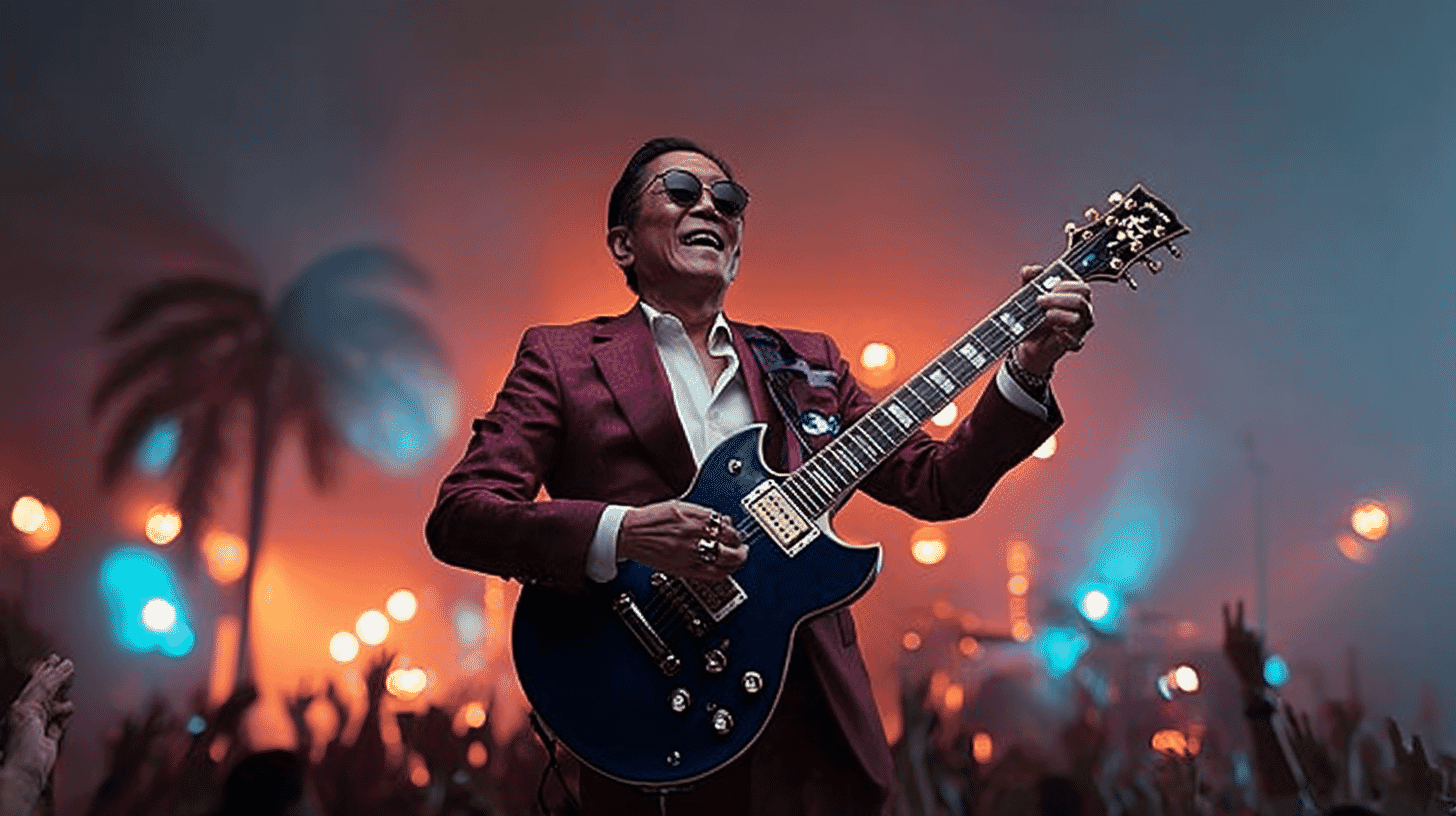
A 73-year-old Japanese guitarist has become one of the hottest concert tickets in America, with resale prices reaching $697. His audience is mostly twenty-somethings who found him on YouTube, and over 90% of his streaming plays come from outside Japan. Meet Masayoshi Takanaka, the Japanese fusion guitarist whose second act is bigger than his first.
The Numbers: 90%+ Overseas Streaming
Masayoshi Takanaka, born March 27, 1953 and one of Japan's most celebrated guitarists, is experiencing a global breakthrough that even he did not see coming. More than 90% of his streaming plays on platforms like Spotify now come from overseas listeners, with the core audience being teenagers and twenty-somethings. His 1979 best-of album ALL OF ME has racked up over 6 million views on YouTube, and the comment section reads like a United Nations assembly, overwhelmingly in English, sprinkled with Portuguese, Spanish, and dozens of other languages.
In Japan, Takanaka's music has long been associated with the 50-to-60-something crowd who grew up during the fusion boom of the late '70s. Overseas, it's an entirely different story. Young listeners are encountering his music not as nostalgia, but as a thrilling discovery, fresh, sophisticated, and unlike anything in their existing playlists.
From "I'm Done With Traveling" to Selling Out the Wiltern
When Takanaka turned 70, he decided he was finished with international travel. "I've been everywhere, and I can't stand jet lag anymore," he reportedly said, and threw away his passport.
Then the world came calling.
As radio DJs and social media influencers across the globe began championing Japanese city pop and J-fusion (Japanese jazz fusion), demand for Takanaka exploded. On March 9 and 10, 2025, he performed at the Wiltern Theatre in Los Angeles, his first show in the city since a 1995 session for the album COVERS, a gap of 30 years. Both nights sold out, drawing 5,000 fans total. The shows were released that July as the Blu-ray TAKANAKA SUPER LIVE 2025 BLACK SHIP in L.A.
The audience demographics were stunning. While Takanaka's Japanese concerts typically attract men in their 50s and 60s, the LA crowd was overwhelmingly American fans in their twenties and thirties. Concertgoers had traveled from New York, Atlanta, France, and beyond. The sold-out audience sang along to guitar melodies, screamed after every solo, and created the kind of electric atmosphere rarely seen at instrumental music shows.
Takanaka himself seemed both moved and amused. "I've been waiting for this day for a long time," he told the crowd. "And now, I'm your grandpa's age. But I'm young! My dream is Grammy! Come on!"
Ticket Prices Tell the Story
The 2026 world tour, SUPER TAKANAKA WORLD LIVE 2026, opened in London on March 31 and has since run through the UK, the US, Australia and New Zealand. Every date sold out.
The London show was originally booked at O2 Shepherd's Bush Empire, capacity around 2,000, then upgraded to the roughly 5,000-capacity O2 Academy Brixton, a hall that has hosted Radiohead and the Rolling Stones. It sold out again. It was Takanaka's first major London stage since 1975, when he played Wembley Arena with the Sadistic Mika Band, a gap of 51 years.
On the resale market, the numbers are striking. According to ticket marketplace Gametime, the cheapest seat for the Hollywood Palladium show climbed to $697, more than three times the price of any other act booked at the venue. For comparison, Bring Me the Horizon tickets at the same venue sit around $229. At Brooklyn Paramount in New York and The Masonic in San Francisco, the same pattern holds: Takanaka is the most expensive ticket at every venue on his tour.
Who Is Masayoshi Takanaka?
Born in Tokyo in 1953, Takanaka turned professional at 17, joining Fried Egg as a bassist while still in high school. He then made his name as guitarist in the Sadistic Mika Band, a group that toured the UK with Roxy Music, before going solo in 1976 with his debut album SEYCHELLES.
His 1979 album JOLLY JIVE, featuring the iconic track "BLUE LAGOON," catapulted him to superstar status in Japan. The song became a staple of Japanese pop culture, used in commercials and TV shows for decades. In 1981, he released The Rainbow Goblins, a concept album based on an Italian painter's picture book, which won a Japan Record Award and is now considered his masterpiece by overseas fans.
What makes Takanaka special is his ability to craft instrumental music that feels like singing. His guitar melodies are so catchy you'll find yourself humming them, no lyrics needed. He blends Latin rhythms, funk grooves, and jazz sophistication into a sound that transcends language entirely. As he once joked: "If I could sing like Whitney Houston, I'd be a vocalist. But I can't, so I play guitar."
He's also known for his showmanship, performing in a signature red suit, playing a custom surfboard-shaped guitar, and punctuating solos with baseball bat swings for the crowd.
Why Now? The YouTube-to-TikTok Pipeline
Takanaka's global resurgence didn't happen overnight. It's the result of a decade-long pipeline that started on YouTube and accelerated through TikTok.
In the mid-2010s, YouTube's recommendation algorithm began surfacing vintage Japanese records to fans of jazz, funk, and soul. The same wave that made Mariya Takeuchi's "Plastic Love" (1984) and Miki Matsubara's "Stay With Me" (1979) into global viral hits also brought Takanaka's music to millions of new ears. Canadian artist Grimes sampled his 1981 track "Penguin Dancer" on her song "Butterfly" in 2015, introducing him to an entirely new demographic.
Internet-born genres like vaporwave and lo-fi hip-hop frequently drew on city pop aesthetics, creating a cultural bridge between 1980s Tokyo and 2020s internet culture. TikTok then supercharged the trend, Takanaka's virtuosic guitar work, vintage visual style, and infectious joy on stage proved irresistible in short-form video.
The vinyl market reflects this too. Reissues of Takanaka's early Kitty Records-era albums (SEYCHELLES, TAKANAKA, AN INSATIABLE HIGH, SUPER TAKANAKA LIVE!) have seen roughly half their sales come from overseas buyers.
J-Fusion: The Next Wave After City Pop
Takanaka's breakthrough is part of a larger movement. Japanese fusion music, or "J-fusion", is emerging as the next big global discovery after city pop.
While city pop artists like Takeuchi and Tatsuro Yamashita led the first wave of Japanese music rediscovery, instrumental fusion acts are now capturing attention. Keyboard player Himiko Kikuchi's 1987 album Flying Beagle has surpassed 5.75 million YouTube views. Tower Records Japan has launched a cross-label compilation series called CROSSOVER CITY, uniting five major labels to showcase J-fusion classics.
Live Nation's "City Pop Waves" series is bringing multiple Japanese legacy acts to Western stages for the first time, with Taeko Onuki and Anri also scheduled for U.S. performances in 2026.
A 50-Year-Old Album, a Brand New Audience
Takanaka recorded SEYCHELLES when he was 23. Now, 50 years later, twenty-three-year-olds on another continent are discovering it and falling in love.
"I never imagined that music I made in my twenties would bring me together with today's twenty-somethings in Los Angeles, half a century later," Takanaka has said. "I'm incredibly grateful."
Is city pop or Japanese fusion popular in your country? Have you heard Masayoshi Takanaka's music? Let us know in the comments!
References
- https://mikiki.tokyo.jp/articles/-/42259
- https://barks.jp/news/545600/
- https://atwoodmagazine.com/live-masayoshi-takanaka-los-angeles-2025-concert-review/
- https://gametime.co/blog/a-72-year-old-japanese-guitarist-is-one-of-the-hottest-tickets-in-america-right-now/
- https://takanaka.com/en/news-2/
- https://electricbloomwebzine.com/2025/11/masayoshi-takanaka-city-pop-waves-2026-world-tour.html









Global Discussion
15 comments