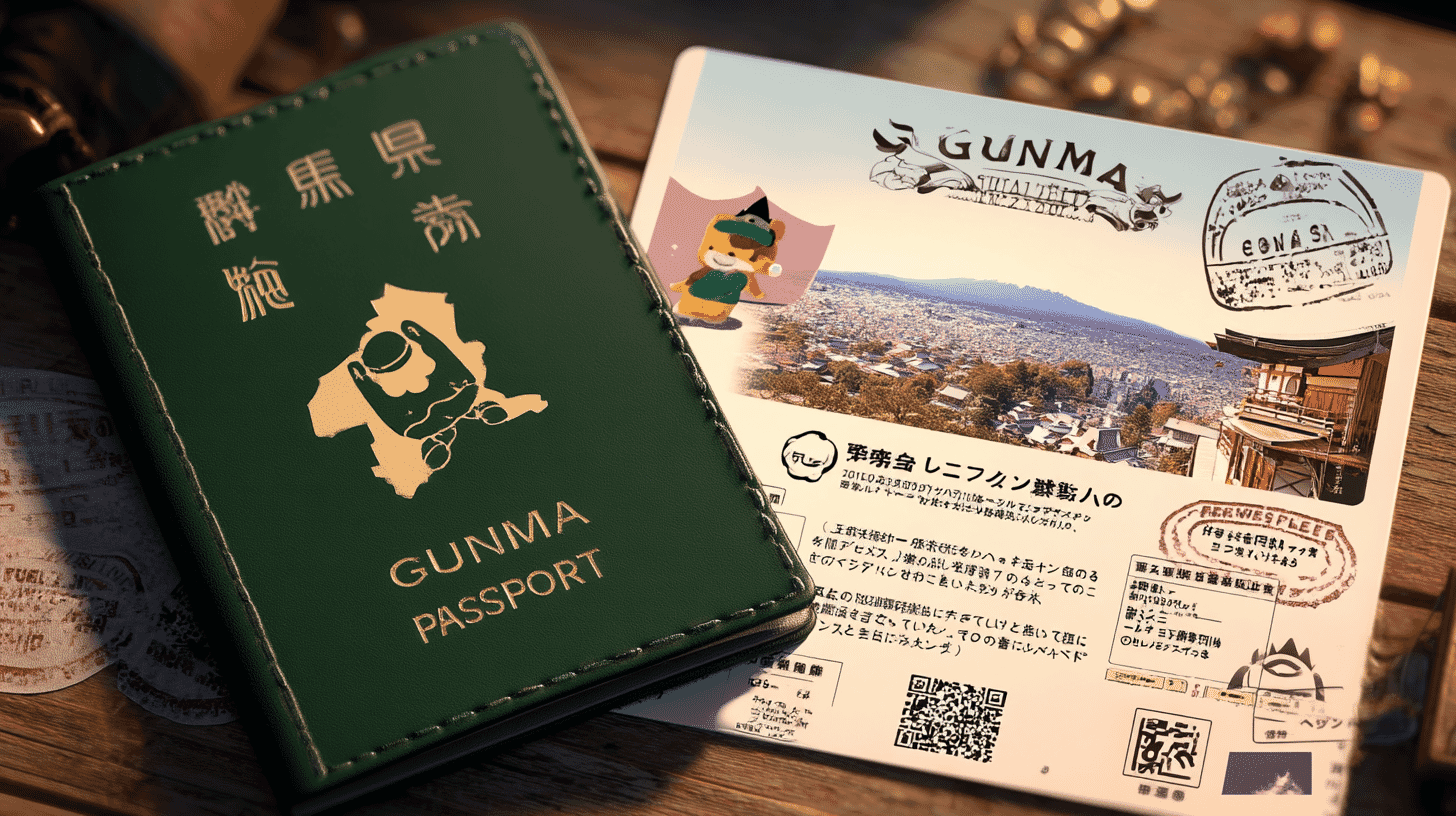
Same green as a Japanese public-service passport. Forty-four pages. A serial number. And all 10,000 copies were claimed on the first day.
This is "GUNMA PASSPORT," a tourism pamphlet from a Japanese prefecture that hit its entire print run in 24 hours. The reason is a 15-year-old internet joke: that Japan is actually two countries, JAPAN and GUNMA.
A Passport for "the Other Country"
According to the Asahi Shimbun, Gunma Prefecture began issuing a passport-style pamphlet called "GUNMA PASSPORT" on May 1, 2026. By the end of opening day, applications had hit the full print run of 10,000 and the prefecture closed the queue. A long line formed at the prefectural office's 11th-floor distribution counter, and 2,705 booklets were handed out across three locations: 2,170 at the Gunma government building, 440 at the Tokyo office and 95 at the Osaka office.
This is no ordinary tourism leaflet. It is the same size as a real Japanese passport, the same official green as a public-service passport, carries individual serial numbers and runs 44 pages. The prefecture cleared the design with Japan's Ministry of Foreign Affairs before calling it the "Gunma Prefecture Passport." Applications go through the prefecture's official LINE account.
Inside you will find prefectural data, history and culture, hot springs, food, industry highlights, the four Japanese prime ministers Gunma has produced (Takeo Fukuda, Yasuhiro Nakasone, Keizō Obuchi, Yasuo Fukuda) and, crucially, a complete list of all 44 cards from "Jōmō Karuta," the regional card game that Gunma children memorise in elementary school. The cover features Gunma-chan, the prefecture's pony-shaped mascot.
But why did 10,000 people scramble for this overnight? You have to understand the Gunma Empire.
The Birth of a Meme: A Cop, a Driver's License, and a Punchline
To Western readers, the closest analogy might be how Americans talk about New Jersey. Gunma sits about 100km north of Tokyo, with a population of roughly 1.9 million, mountains, hot springs and a quiet rural feel. From that geography emerged one of Japan's most durable internet jokes: that Gunma isn't really part of Japan at all.
The legend traces back to a 2chan (now 5chan) post from February 26, 2010. A man wrote that he was stopped by police late at night. The officer began with broken English: "Do you have passport?" When the man answered "no" he was nearly arrested. Asked where he was from, he said "Gunma." The officer misheard him: "Myanmar?" Eventually he had to show his Japanese driver's license to prove he was actually a citizen. He ended the post: "From that day on, my nickname changed from 'Nepal' to 'Gunma.'"
The post went viral. Photographers, illustrators, and shitposters started captioning images of African villages, war zones, and remote tribal communities with "This is the undeveloped land, Gunma." A whole fictional empire emerged: a capital called "Maebashibekofusakhalinsk," an industrial center in "Ota City," a mythical native language nobody can translate, and an ongoing border war with neighboring "Tochigi Empire" (the actual neighboring prefecture, Tochigi).
The manga "Omae wa Mada Gunma wo Shiranai" ("You Don't Know Gunma Yet"), serialized from 2013 and later adapted to anime and live-action, leaned hard into this mythology, depicting a Chiba teenager moving to Gunma and being warned, "Nobody comes back alive."
The North Kanto Last-Place Race
Gunma sits in a region called Kita-Kantō, or "North Kanto," along with Tochigi and Ibaraki. The three prefectures share a peculiar national reputation: a perpetual race to the bottom of Japan's annual "Prefectural Attractiveness Ranking," published by Brand Research Institute since 2009.
Ibaraki has finished dead last many times over the years, and Gunma and Tochigi have circled the bottom of the table alongside it. The 2025 edition scrambled the usual order: Saitama came 47th for the first time, while Saga, last the previous year, climbed two places to 45th. The ranking is taken seriously enough that prefectural governors issue press statements about it, and sometimes get visibly angry about poor results.
Gunma natives, however, take it differently. The local response has been to lean into the joke. Tochigi residents reportedly get furious at "Ibaragi" being mispronounced as "Ibaragi." Ibaraki natives feel slighted at being unranked. But Gunma? Gunma sells passports.
Plot Twist: Gunma Is Actually Industrial Backbone
Here's what the meme misses: Gunma is genuinely punching above its reputation.
It's the 19th-most populous prefecture in Japan. Its largest city, Takasaki, is the only non-major-metropolitan junction connecting two Shinkansen (bullet train) lines, the Joetsu and Hokuriku. During the COVID-19 pandemic, it emerged that virtually all domestically produced ventilators in Japan came from Gunma factories. The heat shield on the return capsule of the famous Hayabusa asteroid probe? Made in Gunma. Major hydroelectric infrastructure runs through its mountains. The prefecture also leads or ranks high in many agricultural categories.
There is a running joke among Japanese tech-watchers that Gunma could secede and survive, because it has its own food, its own energy and its own industry. It has also topped the national ranking of preferred destinations for domestic relocation compiled by the Furusato Kaiki Shien Center, a striking contrast to its position near the bottom of the attractiveness table.
A Government That Gets the Joke
What makes the Gunma Empire phenomenon unique globally is that the prefecture's government has actively embraced it.
In 2011, then-Governor Masaaki Ōsawa was asked on a livestreamed program about photos of African landscapes being passed off as Gunma online. His response: "Gunma is two-thirds covered in forest and full of nature. Depending on how you look at it, yes, it might resemble parts of Africa, but that just means it's an attractive prefecture. If we're 'undeveloped,' it means we have room to grow." This is widely considered the moment Gunma's government officially endorsed the meme.
In 2014, the prefecture officially commissioned actor Hiroshi Fujioka to lead a "Gunma Expedition Team" to investigate "whether Gunma Empire really exists." The current governor, Ichita Yamamoto, continues the tradition of welcoming the joke rather than fighting it.
When GUNMA PASSPORT launched, the official tourism account "Gugutto Gunma" (@Gunma_kankou) was flooded with comments like "Required for all citizens of the empire" and "So you really do need a passport to enter Gunma."
The Smart Marketing Underneath
Strip away the meme layer and GUNMA PASSPORT is a fairly standard tourism initiative. Other Japanese prefectures have tried similar passport-style stamp rallies, Kōchi Prefecture's "Ryōma Passport," named after samurai hero Sakamoto Ryōma, has been running for years.
What set Gunma's apart was the cultural fit. The official passport-replica design landed perfectly on top of 15 years of accumulated meme energy. Combine that with the collectibility (35 town stamps to chase), the inclusion of every Jōmō Karuta card (a deep cultural touchstone for anyone who grew up in the prefecture), and the cuteness of Gunma-chan on the cover, and you get a campaign that converts both ironic internet humor and earnest local pride into the same line at the prefectural office.
The prefecture has said it will not, as a rule, replace lost copies, which is a separate question from whether it prints more.
Update (July 2026): it did. Responding to the demand, Gunma ordered a reprint of 30,000 additional booklets to be distributed by late summer, reopened applications on June 29 in three rounds capped at 10,000 each, and began handing them out from July 7, with a special counter over the long weekend starting July 18.
What's Your Country's "Joke Region"?
Gunma offers a rare case study: an internet meme born from prefectural insecurity, allowed to mature for 15 years, then channeled into an official tourism campaign that sold out instantly. Few places anywhere have managed to turn collective ribbing into civic pride this gracefully.
Most countries have their own "Gunma." In the United States, New Jersey takes endless flak as New York's awkward neighbour. In France, the northern Ch'ti region carries similar baggage.
What about where you live? Is there a region or city that everyone makes fun of, affectionately or otherwise? Do the locals embrace the joke or resent it? Has any local government leaned in like Gunma has? Tell us in the comments, we'd love to map the world's "Gunma Empires."



Global Discussion
13 comments