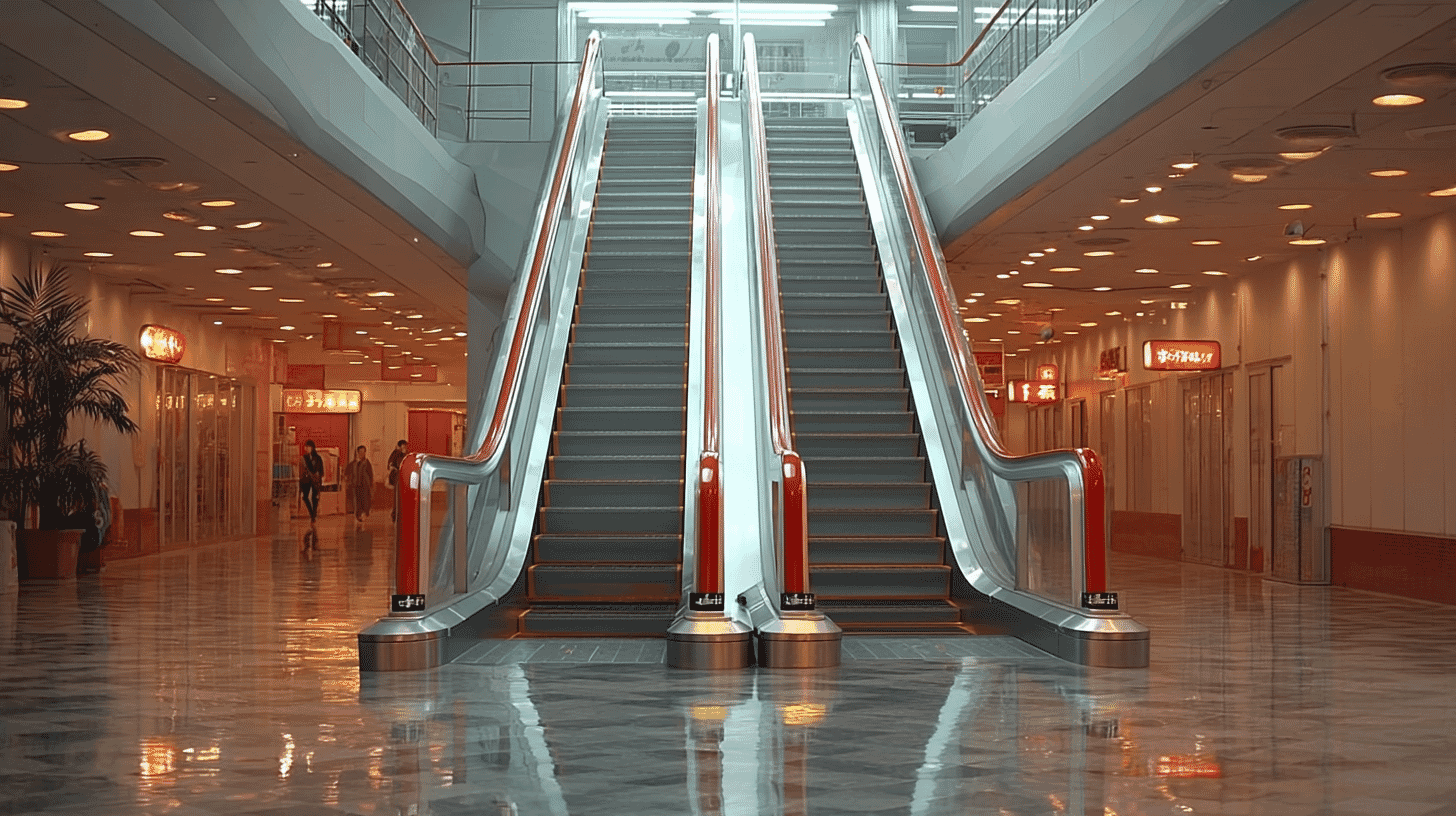
🛗 On a normal escalator, the rubber handrail curls under in a U-turn at the landing and disappears inside the machine. Every escalator you have ever ridden does this. Two escalators in Nagoya didn't. Their handrails dropped straight down into the floor, vertically, and vanished. They were the last two like it on Earth. They ran from 1967 until February 28, 2026, when the department store around them closed.
The Handrail Just Falls Into the Floor
Have you ever looked at what happens at the end of an escalator handrail? Almost universally, it loops back on itself and gets swallowed by the mechanism. That's the design the entire world settled on.
The pair at the Meitetsu Department Store in Nagoya, connecting the 8th and 9th floors, did not loop. The handrail ran to the edge and dropped vertically into the floor. Stamped on the boarding plate: "Toshiba."
According to Toshiba Elevator, based in Kawasaki, this is the C-type escalator, manufactured from the late 1960s into the early 1970s. A 1970 catalog explained the reasoning: mount the balustrade posts vertically, space them widely apart, and hide the handrail return under the floor, all to emphasize clean straight lines. It was a design decision, nothing more. Internally, the machine is essentially an ordinary escalator.
How It Ended Up Being the Last One
The explanation is unglamorous. Toshiba Elevator says the design didn't catch on, and the industry stuck with the conventional looping type. That's it. No scandal, no engineering disaster.
Why Meitetsu picked it in 1967, when the store had its grand opening, turns out to be equally practical. Shoji Hayashi, who spent over 50 years maintaining these escalators for the store's facilities department, told CBC Television that he'd heard they were chosen because they were cheaper than the foreign-made units that dominated the market at the time. The tradeoff was upkeep: with no spare parts left in existence, repairs dragged. Escalators are generally reckoned to have a service life of around 30 years. These two ran roughly twice that.
Tokyo's Toho Twin Tower Building in Hibiya had one as well, until the building closed and was demolished at the end of 2019. After that, the two in Nagoya were the only C-types left anywhere.
Seventy-One Years, Then the Lights Went Out
Meitetsu Department Store opened in December 1954 and spent seven decades as the landmark on the east side of Nagoya Station. Out front stands Nana-chan, a 6.1-meter mannequin who gets seasonal costume changes and functions as a municipal meeting point.
Then in 2000, JR Nagoya Takashimaya opened at the same station. Competition sharpened, e-commerce did its thing, and sales fell from roughly 79.3 billion yen in 2000 to about 41.3 billion in 2025, a halving over 25 years (about $490 million to $255 million at current rates). A business tie-up with Isetan and others didn't reverse it. On February 28, 2026, the store closed after 71 years.
Here's where the original plan and reality diverged. Demolition was supposed to start within fiscal 2026 as part of Meitetsu's Nagoya Station redevelopment. But in December 2025, Meitetsu announced it was re-examining the whole plan, citing soaring material costs and a labor shortage. Neither demolition nor construction has a date. Facing the prospect of a giant empty building on the most valuable block in the city, Meitetsu went looking for tenants.
On July 10, 2026, Nagoya Railroad announced that Yodobashi Camera will open across floors B1 to 4 of the Meitetsu Building sometime this summer, its first store in the Nagoya Station area. A supermarket, Saporé, is slated for winter. The building is not coming down any time soon.
Nana-chan, for the record, survived. Her stay was confirmed on February 10, 2026, and on April 1 she was formally transferred from the department store to parent company Nagoya Railroad.
The Last Day, and a Crowd on the 8th Floor
As closing approached, people came from across the country to see the escalators. On February 27, the day before the end, a crowd formed on the 8th floor, phones up. A panel beside the escalator noted that it was famous among escalator enthusiasts, which is a sentence that tells you something about Japan.
The store has said it is considering options including display or preservation, but that nothing has been decided. Even with demolition now indefinitely postponed, there's no indication the two will run again.
Nagoya Still Has Weird Escalators
In Inazawa, Aichi Prefecture, Mitsubishi Electric Building Solutions runs the only factory on the planet that builds spiral escalators, the kind that curve as they climb. Since developing them in 1985, the plant has shipped 37 within Japan and 74 abroad. Because the rails twist in three dimensions, both the rails and the handrails are bespoke, made by a small group of specialists. You can ride one at the Yokohama Landmark Tower, among other places.
For about 60 years, two escalators in a Nagoya department store did something no other escalator on Earth did, and most of the people riding them never noticed. They only got famous once they were doomed. Japan is full of this: world-unique infrastructure sitting around unremarked until someone announces it's leaving.
Is there something like that where you live? A building or a piece of infrastructure nobody looks twice at that turns out to be the only one of its kind?
References
- https://news.yahoo.co.jp/articles/9d53dda770eee7a231bf5e55be6bf373b6eca490
- https://news.yahoo.co.jp/articles/8bef20604c9093a9a50705fd418c6d594093f076
- https://news.yahoo.co.jp/articles/7ed6e1ce806a3b53742ceeaac7a17ad64d4f1a63
- https://www.nagoyatv.com/news/?id=030024
- https://trafficnews.jp/post/636378
- https://www.nikkei.com/article/DGXZQOFD106QP0Q6A710C2000000/
- https://www.watch.impress.co.jp/docs/news/2124271.html




Global Discussion
13 comments