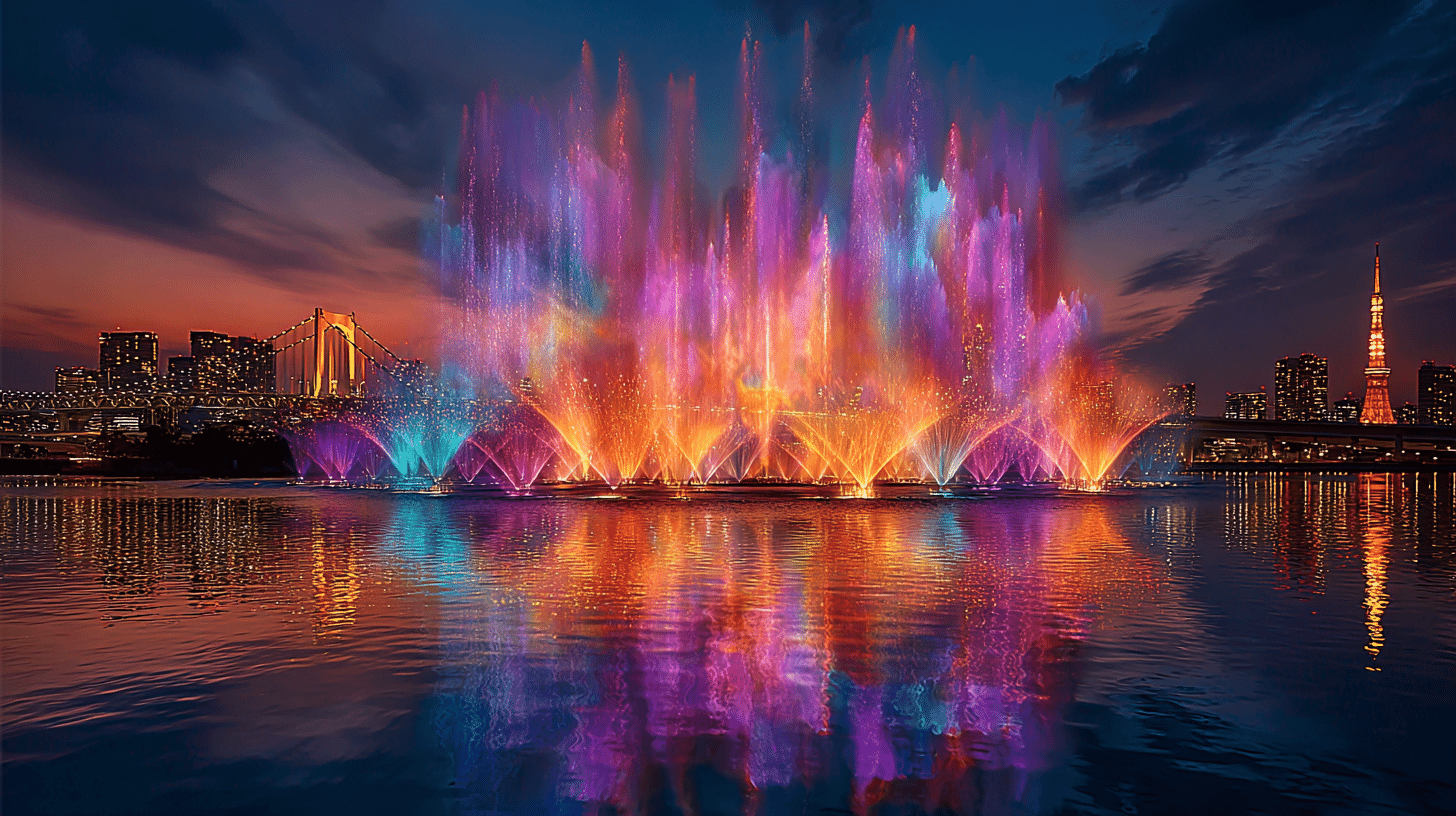
Tokyo has entered the fountain show business, at a scale that invites comparison with Dubai and Las Vegas. The soundtrack is the surprise: music from Dragon Quest, one of the most beloved video game franchises ever made. It runs 10 times a day, every day, and it is free.
Tokyo's Answer to the World's Greatest Fountain Shows
On March 28, 2026, the Tokyo Aqua Symphony (東京アクアシンフォニー) officially opened at Odaiba Seaside Park in Tokyo's Minato Ward. Built by the Tokyo Metropolitan Government at a cost of approximately $17 million, this massive fountain installation aims to revitalize the Tokyo waterfront district that had been struggling to regain its pre-pandemic momentum.
What makes this fountain special isn't just its size, though the numbers are impressive. The central jet shoots water up to 150 meters (about 490 feet) into the air, roughly the height of a 50-story building. Surrounding it, a 250-meter-wide (820 feet) array of fountains creates the shape of cherry blossom petals on the water's surface, inspired by Somei-Yoshino, the most iconic variety of Japanese cherry blossoms and the official flower of Tokyo.
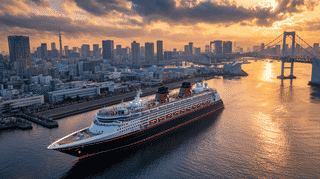
The whole spectacle unfolds against a backdrop that no amount of money can buy: the illuminated Rainbow Bridge on one side and Tokyo Tower glowing on the other. It's a view that instantly screams "Tokyo."
The name was chosen through an open public contest that received about 7,500 submissions. Local elementary and middle school students then voted on the finalists, a process that reflects the Japanese concept of community ownership in public projects.
Dragon Quest Music Meets 150-Meter Water Jets
What sets Tokyo Aqua Symphony apart is the music. Instead of pop hits or classical standards, the show features music from Dragon Quest, the legendary Japanese RPG series that has sold over 88 million copies worldwide.
The opening lineup ran to three shows:
"SAKURA FUBUKI" (Original Composition), A powerful piece featuring traditional Japanese instruments. "Sakura fubuki" literally means "cherry blossom blizzard," describing the breathtaking moment when cherry petals swirl through the air like snow. The fountains mirror this imagery, with water dancing upward in petal-like formations.
"Roto's Theme" (Dragon Quest Main Theme), The iconic opening march composed by the late Koichi Sugiyama. Even if you've never played Dragon Quest, this heroic melody, performed by the Tokyo Metropolitan Symphony Orchestra that worked with Sugiyama for decades, will make you feel like you're about to embark on an epic adventure. Now imagine hearing it while a 490-foot water column erupts into the Tokyo night sky.
"And Into the Legend" (Dragon Quest III), Widely considered one of the greatest video game endings ever composed, this emotional piece transforms the fountain into a canvas of light and water, shifting between delicate, flowing movements and explosive, firework-like bursts.
On April 27, 2026, a fourth program built around Pachelbel's Canon joined the rotation. The city says it will keep adding and swapping pieces with the seasons.
When, Where, and How Much?
The fountain show runs daily from 11:00 AM to 9:00 PM, with approximately 10 performances per day, each lasting about 10 minutes. Best of all: admission is completely free. You can watch from anywhere in the park, on the bridge, from waterfront terraces, or lounging on the seaside lawn.
Daytime shows emphasize the refreshing beauty of water against the sky, while nighttime performances add dramatic lighting that transforms the fountain into a luminous spectacle. The evening shows, when Rainbow Bridge's lights merge with the fountain's glow, are particularly stunning.
On busy days the show starts on the hour, every hour except 4:00 PM. Light rain is fine; strong winds, heavy rain or maintenance can cancel or alter a performance. Check the official website (tokyoaquasymphony.jp) for the latest schedule.
Getting There:
- Yurikamome Line: "Daiba" Station, 3-minute walk
- Yurikamome Line: "Odaiba-kaihinkoen" Station, 10-minute walk
- Rinkai Line: "Tokyo Teleport" Station, 10-minute walk
How Does It Stack Up Against Dubai and Las Vegas?
The Dubai Fountain spans 275 meters (902 feet) with jets reaching 150 meters (500 feet). For years it was billed as the world's largest choreographed fountain. Built at a cost of $218 million, it performs against the backdrop of the Burj Khalifa, the world's tallest building. It features 6,600 lights and 25 color projectors.
The Bellagio Fountains in Las Vegas stretch across an 8-acre artificial lake with over 1,200 nozzles pushing water up to 140 meters (460 feet). Built for $40 million, they perform to everything from Frank Sinatra to DJ Tiesto.
Tokyo Aqua Symphony matches Dubai in maximum height (150 meters) and offers a 250-meter spread. But here's what truly differentiates it:
First, it's built on the actual ocean. Both Dubai and Bellagio use artificial lakes, but Tokyo's fountain sits on floating platforms in Tokyo Bay itself. Tides, sea winds, and ocean conditions mean every show is subtly unique.
Second, the cultural content. Where Dubai features Arabian and classical music and Bellagio plays American pop standards, Tokyo chose video game music, specifically Dragon Quest, a franchise with deep cultural significance in Japan and a massive global fanbase. It's a bold statement about Japan's creative identity.
Third, the cost efficiency. At roughly $17 million, less than one-twelfth of Dubai's price tag and less than half of Bellagio's, Tokyo has delivered a competitive product at a fraction of the cost.
Beyond the Fountain: What Else to See in Tokyo Bay
If you're visiting for the fountain show, the surrounding area offers plenty more to explore.
teamLab Borderless (Azabudai Hills), This immersive digital art museum, relocated from its original Odaiba location, remains one of Tokyo's most popular attractions. Visitors walk through rooms where digital art flows across walls, floors, and ceilings without borders.
Life-Size Unicorn Gundam (DiverCity Tokyo Plaza), Standing at nearly 20 meters tall, this full-scale replica of the Unicorn Gundam from the anime series features timed transformation sequences that are impressive even if you're not a mecha fan.
Toyosu Market, The world's largest wholesale fish market, just a few Yurikamome stops from Odaiba. Early morning tuna auctions and incredibly fresh sushi make it a must-visit.
Amphibious Bus "KABA", Departing from near Odaiba Seaside Park, this bus drives straight into Tokyo Bay, passing under Rainbow Bridge. Combined with the fountain show, it makes for an unforgettable waterfront experience.
Hilton Tokyo Odaiba, The hotel's Japanese restaurant "Sakura" has launched a limited terrace course featuring live lobster and T-bone steak, specifically designed for diners to enjoy while watching the fountain show.
The $17 Million Question: Worth It?
The Tokyo Metropolitan Government projects 30 million annual viewers, including those watching from across the bay, and an economic impact of roughly $63 million per year. Annual operating costs are put at about $1.3 million, with construction funded through proceeds from waterfront land sales rather than general tax revenue. These are the city's own estimates, and members of the metropolitan assembly have questioned whether the viewer figure is achievable.
Not everyone is convinced. Some Tokyo residents question whether $17 million could have been better spent, and critics draw comparisons to the controversial projection mapping project at the Tokyo Metropolitan Government Building. Skeptics ask whether another large-scale spectacle is really what the city needs.
Supporters counter that the cost is remarkably modest for a world-class attraction, Dubai spent roughly 12 times more, and that a free, daily entertainment venue generates sustained foot traffic that benefits the entire waterfront economy. The fact that local school children helped choose the name adds a community dimension that pure tourism projects often lack.
Does your country have a famous fountain show? How do you think Tokyo's new attraction compares to Dubai's or Las Vegas's? We'd love to hear your thoughts!


Global Discussion
15 comments