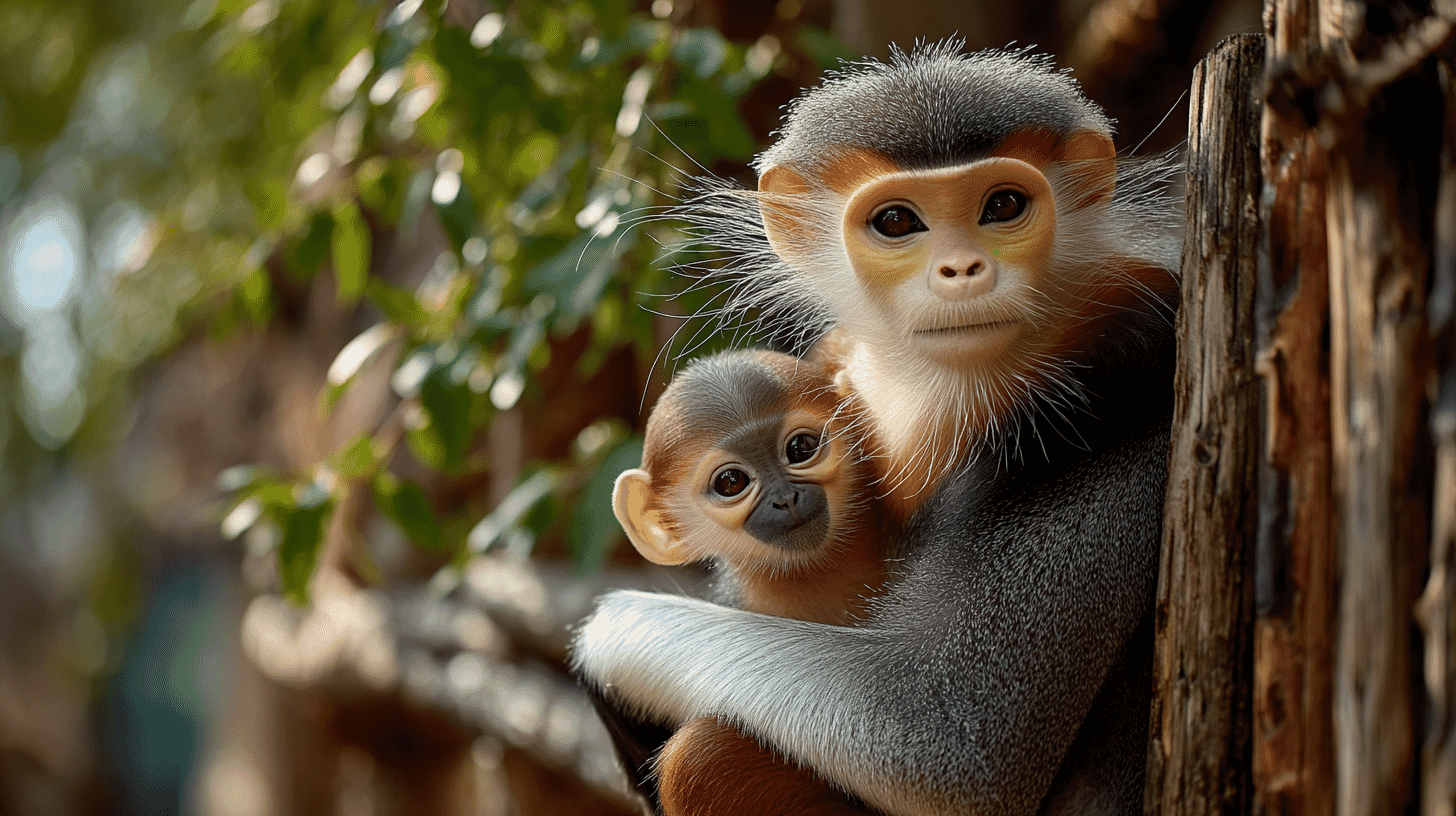
🐒 A monkey nicknamed "the most beautiful in the world" has had a baby in Japan, and the whole country has decided to follow her life story. At Yokohama Zoorasia, a tiny red-shanked douc langur named Mee is learning to leap, cross logs, and nibble her first leaves. She is a critically endangered animal kept in only two zoos in the entire country. The way Japan is treating her, naming her by public vote and blogging her every milestone, says something about how this country relates to animals.
Meet Mee, and the monkey wearing a costume
The red-shanked douc langur really does earn its nickname. Conservationists sometimes call it "the most beautiful monkey in the world"; others go with "the costumed monkey." Both fit.
Picture this: maroon-red "stockings" running from knee to ankle, like the animal pulled on a pair of long socks. White forearms, as if it slipped into evening gloves. A golden-orange face framed by long white whiskers, a silvery-grey back, and a long white tail. It looks less like it evolved and more like it got dressed.
This vivid creature is native to the forests of Vietnam, Laos, and Cambodia, where it spends almost its entire life in the treetops. Adults are around 60 centimeters long, with a tail just as long again, and they live in social groups that average around 18 members.
The baby at the center of this story was born on January 26, 2026, at Yokohama Zoorasia, a large zoo in Yokohama's Asahi Ward, just southwest of Tokyo. She is female, and she is the third generation of red-shanked doucs born at this zoo: her mother Hoa was herself born there. Four months on, she is doing exactly what a healthy young monkey should. She clings to her parents most of the time, but increasingly breaks away to bounce around on her own and, by late April, confidently walking across logs. The keepers report she has started sampling the leaves and vegetables her parents eat.
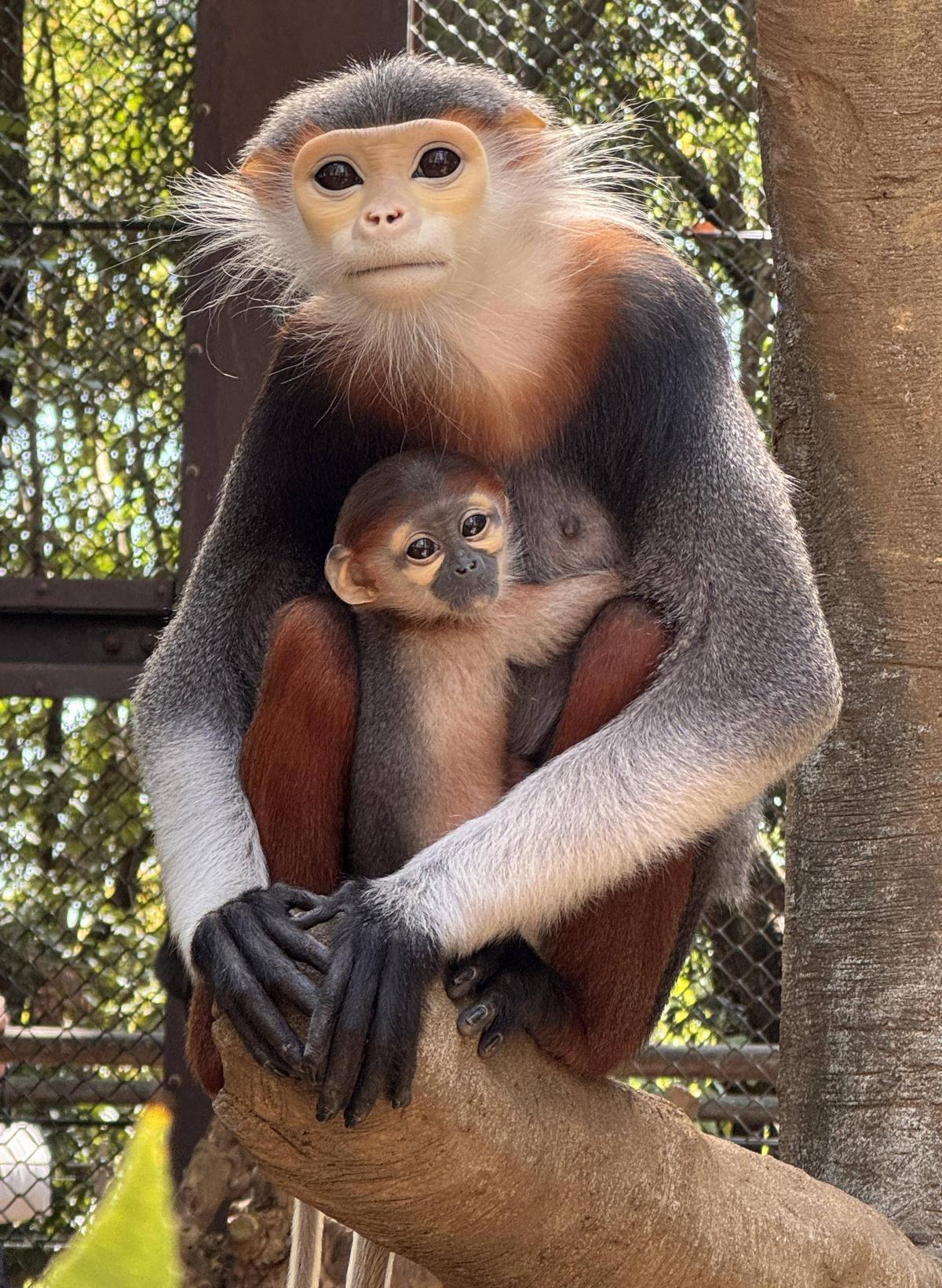
Source: Yokohama Zoorasia official blog
How a baby monkey got her name
Here is where the story turns very Japanese.
Rather than simply assigning a name, the zoo's keepers drew up a shortlist of three candidates, all taken from the Vietnamese language, a nod to the species' home country, and each loaded with a specific wish for the baby's future.
The options were Mee, meaning "beautiful"; Tee, meaning "poem"; and Vee, meaning "small and lovely." The keepers explained their reasoning for each. Mee carried the hope that she would grow up to live up to her species' title as the world's most beautiful monkey. Tee was offered with the wish that, like a poem, she would move and connect people. Vee acknowledged that she is tiny now, but expressed the hope she would grow strong and lively.
The public then voted, and Mee won. It is a small ritual, but a telling one. By the time visitors come to see her, they are not looking at "a douc langur." They are looking at Mee, a specific individual whose name they may have helped choose.
Why a birth in a Japanese zoo matters
Behind the cuteness is a serious conservation story.
The red-shanked douc is listed as Critically Endangered by the International Union for Conservation of Nature, the category just one step short of extinct in the wild. The 2020 assessment that raised it from Endangered estimated a decline of more than 80% over the previous three generations, or 36 years.
The threats are familiar but relentless: forests cleared for logging and agriculture, decades-old damage from past wars, hunting for meat and for traditional medicine, and the capture of infants for the illegal pet trade. The species is especially vulnerable to hunters because of an unlucky instinct. When threatened, doucs tend to freeze in the canopy rather than flee, which makes them easy targets.
Against that backdrop, a healthy birth in human care carries real weight. In Japan, only two facilities keep this species at all: Zoorasia and Tokuyama Zoo in Shunan, Yamaguchi Prefecture. A third-generation birth means the Zoorasia group is genuinely reproducing, not just surviving, which is exactly what a long-term conservation breeding program is supposed to look like. For most visitors, Mee will be the only red-shanked douc they ever see in their lives.
The Japanese habit of turning animals into individuals
Mee's story raises a question worth sitting with. Why does Japan name animals by public vote, blog their milestones, and follow a single monkey like a member of the family?
The most famous example is the giant panda Xiang Xiang, born at Tokyo's Ueno Zoo in June 2017. The public submitted 322,581 name suggestions. Her growth was tracked on national television, and Kansai University professor emeritus Katsuhiro Miyamoto put the economic impact of her five years and eight months in Japan at 60 to 65 billion yen, roughly 400 million dollars at 150 yen to the dollar. When she was sent to China in February 2023, fans queued for hours to say goodbye. Japan's pandas are now gone altogether: Adventure World returned its four in June 2025, and Ueno's Xiao Xiao and Lei Lei followed in January 2026, leaving the country without a single panda for the first time in half a century.
It would be wrong to claim this is unique to Japan. Berlin Zoo's polar bear Knut and Cincinnati Zoo's hippo Fiona became global celebrities, and the Smithsonian's National Zoo in Washington named its panda cub Xiao Qi Ji through a public vote too. Animal fandom is not a Japanese invention.
What does feel distinctive is the reach. In Japan, the full individual-story treatment is not reserved for superstar pandas. It is extended, as a matter of routine, to a relatively obscure langur most visitors had never heard of. Zoorasia's keepers write blog posts in the voice of a doting family member: "she's started jumping around on her own," "look for her tucked against her parent's belly." The naming vote, the careful explanation of each name's meaning, the steady stream of growth updates: this is the standard package, applied to almost every notable birth.
Behind that lies a long tradition, from folklore to modern mascots, of treating animals as characters with personalities rather than as anonymous specimens. Giving an endangered langur a name and a public following is that old instinct meeting a modern conservation goal. It is much harder to feel distant from a vanishing species once it has a face, a name, and a baby photo you helped title.
For now, Mee is simply busy being a baby, occasionally letting go of her mother to see what the world feels like on her own.
What about where you live? When a zoo welcomes a rare baby animal, does the public get to name it? And do people follow that one individual's life the way fans here are now following Mee?
References
- https://news.yahoo.co.jp/articles/9db4d9d8340811487963ed9361f42549cdb93255
- https://www.hama-midorinokyokai.or.jp/zoo/zoorasia/details/2026/post-558743.php
- https://en.wikipedia.org/wiki/Red-shanked_douc
- https://www.worldlandtrust.org/species/red-shanked-douc/
- https://neprimateconservancy.org/red-shanked-douc-langur/
- https://www.nippon.com/en/nipponblog/m00129/

Global Discussion
3 comments