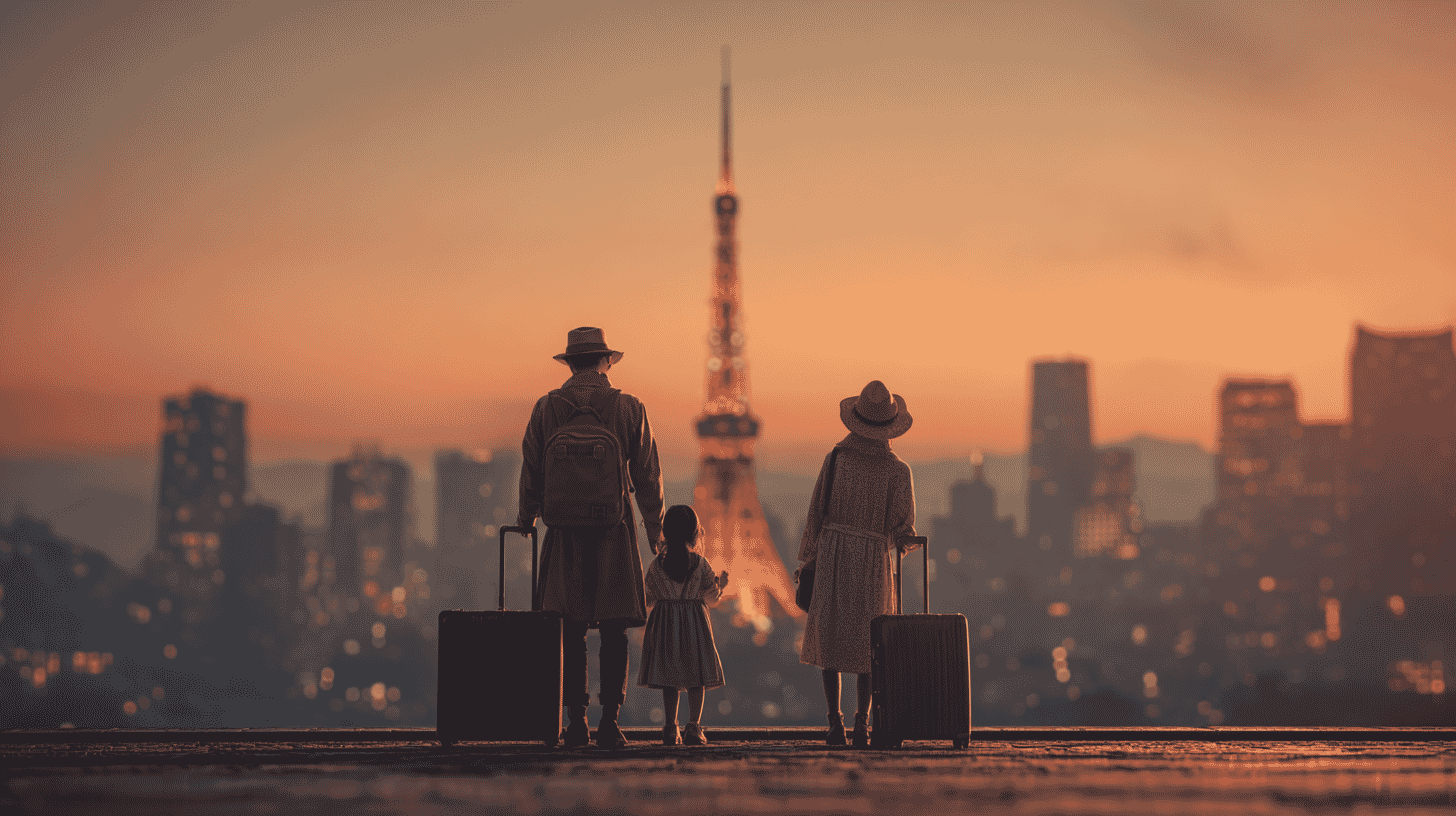
🏙️ In Tokyo's 23 wards, 62% of new apartments bought by overseas residents went to buyers with a Taiwanese address. That's the headline from data Japan's government released for the first time in November 2025. In 2024, 6 million Taiwanese tourists spent over $7 billion in Japan, both record highs. Only 1.3 million Japanese visited Taiwan in return, a 6-to-1 imbalance. Behind these numbers: five forces converging at exactly the same moment in history.
Japan's First Breakdown by Buyer's Country of Residence
On November 25, 2025, Japan's Ministry of Land, Infrastructure, Transport and Tourism (MLIT) released, for the first time, a breakdown of overseas-resident buyers in Japan's new condominium market, drawn from property registration records covering roughly 550,000 newly built units registered between January 2018 and June 2025 across the three major metropolitan areas and four regional cities.
One caveat matters. Japanese property registration does not record nationality. What this survey captures is the country or region where the buyer is resident, not their citizenship, and purchases by foreign nationals or companies based inside Japan fall outside it entirely.
In Tokyo's 23 wards, the share of newly built apartments purchased by overseas residents jumped from 1.6% in 2024 to 3.5% in the first half of 2025. In the central 6 wards (Chiyoda, Chuo, Minato, Shinjuku, Shibuya, Bunkyo), the share rose from 3.2% to 7.5%, with Shinjuku-ku alone hitting 14.6%.
But the breakdown is what stunned observers. Of the 308 apartments bought by overseas residents in the first half of 2025: Taiwan accounted for 192 units (62%), China just 30, and Singapore 21. The Taiwanese share was more than six times China's, a near-total inversion of the "Chinese property bingeing" narrative that dominated Japanese media a decade ago. Some Taiwanese clients close deals at an average of 700 million yen ($4.5 million) per property, often paying entirely in cash.
MLIT itself, though, does not read the data as evidence that foreign buying is driving new-apartment prices up. Resales within a year of purchase ran at 9.3% in the 23 wards and 12.2% in the central six, but only 7.0% of that short-term churn involved overseas residents; domestic investors dominate it. Land Minister Kaneko said speculative, non-residential transactions are undesirable "whether the buyer is Japanese or foreign," and that the survey would continue.
The Five Forces Behind "Why Now"
Force 1: A 38-year low for the yen
As of May 2026, USD/JPY trades around 156–157. The Taiwan dollar (TWD) is similarly strong against the yen at historic levels. Thirty years ago, "the price of one parking spot in Tokyo equaled one apartment in Taipei." That relationship has now flipped.
CTBC Bank Chairman Chen Jia-wen has been blunt: "Taiwanese investment in Japan is overwhelmingly real estate, not financial assets." CTBC's Tokyo Star Bank subsidiary offers Taiwanese-targeted home loans, with outstanding mortgage balances reaching 40–50 billion yen ($255–320 million) in just one to two years.
Force 2: Taipei property prices now exceed Tokyo's
Counter-intuitive but true: Taipei housing now costs more per square meter than central Tokyo, once the measurement methods are standardized. Japanese listings count only the private interior area, while Taiwanese listings include shared common areas. Adjusted for that difference, Taipei is roughly 40–50% more expensive than Tokyo per usable square meter, according to Sinyi Realty's Japan CEO.
Translation: For wealthy Taiwanese, buying a Tokyo tower condo is no longer "stretching for an overseas asset", it's "fleeing an overheated home market for somewhere cheaper."
Force 3: TSMC Kumamoto built a physical bridge
Taiwan Semiconductor Manufacturing Company (TSMC) began mass production at its first Kumamoto plant in 2024. In February 2026, TSMC announced it was upgrading its second Kumamoto fab from a planned 6–7nm process to 3nm production, with total investment expanding to roughly $17 billion.
Land prices in Kumamoto's Ozu and Kikuyo towns have risen over 30% year-on-year as Taiwanese supply chain personnel relocate. Eight Taiwanese banks now operate Tokyo-centered Japan branches, providing the mortgage, remittance, and tax infrastructure that makes "buy a house in Japan" institutionally simple for Taiwanese buyers.
Force 4: Hedging Taiwan Strait risk
Cross-strait tensions have escalated since former U.S. House Speaker Nancy Pelosi's August 2022 visit to Taiwan. President Lai Ching-te's DPP government, inaugurated in 2024, has continued under sustained Chinese military pressure.
Wealthy Taiwanese watched Hong Kong's transformation closely from 2019 onward, the protests, the National Security Law, the wealth migration. For them, "physically distributing assets across multiple jurisdictions" is no longer emotional preparation; it's portfolio management. Japan offers something rare: geographic proximity, pro-Taiwan public sentiment, low crime, stable governance, and, crucially, no foreign-buyer restrictions.
Force 5: Taiwan's own AI/semiconductor boom
Taiwan's Directorate-General of Budget, Accounting and Statistics (DGBAS) reported a preliminary 2025 real GDP growth rate of 8.68% in February 2026. AI-related demand and semiconductor exports are driving the boom. Cash is piling up on wealthy Taiwanese balance sheets, looking for places to deploy.
Tourism Built the Trust First
The investment surge cannot be separated from the tourism surge that preceded it. In 2024, Taiwanese visits to Japan hit a record 6,044,400, with total spending topping ¥1.09 trillion ($7 billion), the first time any single nationality crossed the trillion-yen mark.
What stands out is the 80% repeat-visit rate. Beyond Mt. Fuji, Tokyo Disney, Hokkaido, and Kyoto, Taiwanese travelers now flow into the Tateyama Kurobe Alpine Route, Shirakawa-go, Kamikochi, and Lake Kawaguchi. SNS-driven discovery brings Taiwanese visitors to corners of Japan that few first-time tourists reach.
This matters for real estate. "Buy a city you've already visited many times" feels qualitatively different from "buy an investment vehicle." Unlike Chinese investors who often treat Tokyo as a financial product, Taiwanese tend to buy neighborhoods they personally know. That's why Minato Ward, Shinjuku Ward, and the bayfront tower zones dominate purchase activity, those are the places Taiwanese tourists already feel at home.
Reading the "6-to-1 Imbalance" Correctly
Yes, 6 million Taiwanese visited Japan in 2024 while only 1.3 million Japanese visited Taiwan, a 6-to-1 gap that Taiwan's tourism authority has officially flagged as a problem. But "Japanese aren't going to Taiwan anymore" is the wrong reading.
| Destination | 2024 Japanese visitors | vs. 2019 |
|---|---|---|
| All Japanese outbound (total) | 13 million | About 65% (35% drop) |
| South Korea | Sharply higher | Roughly 100%+ (the exception) |
| Taiwan | 1.32 million | About 60% |
| Hawaii | Slowly recovering | Estimated ~50% |
| Guam | 136,000 (8 months) | About 31% (59% drop) |
| China | Sharply lower | Roughly 30–40% |
Japanese outbound tourism overall is at 65% of 2019 levels. Guam is at 31%, China 30–40%, Hawaii around 50%. Taiwan's 60% is roughly the global average, actually a relatively strong recovery. The only outlier is Korea, where won weakness, geographic proximity, and K-pop demand all align.
In other words, the 6-to-1 gap is not "Taiwan losing appeal." It's "a weak yen suppressing all Japanese outbound travel everywhere." When the yen stabilizes, Taiwan is one of the first destinations likely to recover, not the last.
What Makes Taiwanese Money Welcome Where Chinese Money Wasn't
There is a real, visible temperature difference in how Japanese citizens react to Taiwanese versus Chinese property buyers. Part of it is tourism familiarity. But a larger part is decades of mutual disaster aid.
When the 2011 Tohoku earthquake struck, Taiwan, a small island of 23 million people, donated over 20 billion yen ($130 million) in relief funds, more than any other country or region. Per capita, that's roughly $5.50 from every Taiwanese person. After the April 2024 Hualien earthquake, Japan returned the favor with rescue teams and a wave of grassroots donations through the furusato nozei hometown tax system.
Add in mutual mask and vaccine support during COVID-19, plus the warmth of pro-Japan sentiment dating back to the colonial era and post-war ties. The result is a relationship that doesn't fit the usual template of "wealthy foreigners buying up our cities." It looks more like two neighbors who have proven, repeatedly, that they show up for each other.
The economic upsides are concrete: regional inbound tourism distribution easing Tokyo's overtourism strain; Kumamoto and Kyushu economies revitalized by TSMC supply chain anchoring; Japanese employment created by Taiwanese corporate expansion. These are not just "foreign money flooding in", they're durable two-way value flows.
But the Friction Is Real
Tokyo's housing market structure is shifting in ways that hurt ordinary Japanese families. The 2025 average new-build condo price in Tokyo's 23 wards reached ¥136 million ($870,000), and the central 6 wards averaged ¥195 million ($1.24 million). For typical dual-income households, central Tokyo apartments are now mathematically out of reach.
Alongside the November 2025 disclosure, MLIT said it would keep running the survey. As it stands, the registry cannot confirm an owner's nationality, and acquisitions by foreign nationals or companies resident in Japan are not captured at all. Analysts have pressed for a more complete picture before policy is built on the numbers.
"Foreigners are pushing up prices" is a simplification. Domestic supply constraints, construction cost inflation, and concentrated central-Tokyo demand are all in the mix. But 14.6% in Shinjuku and 7.5% in central 6 wards are scales at which neighborhood-level price formation is genuinely affected.
How Other Countries Have Responded
Foreign buyers driving up housing prices is not unique to Japan. Several major economies have already moved to restrict it.
| Country | Restriction | Started |
|---|---|---|
| Canada | Ban on foreign residential purchases | 2023 (extended through 2027) |
| New Zealand | Effective ban on foreign home ownership | 2018 |
| Australia | Temporary ban on existing dwelling purchases by foreigners | 2025–2027 (2 years) |
| Singapore | 60% stamp duty for foreign buyers | 2023 |
| Hong Kong | Tiered taxation on non-permanent residents (partly relaxed) | Phased |
| Japan | No restrictions | , |
Japan is one of the few major developed economies with no foreign-buyer restrictions on residential property, earning the nickname "the last free market." Openness to foreign capital is a strength, but balancing it with housing market stability is now a question Japan's parliament and ministries can no longer postpone.
Tokyo's "Bargain" Status, by the Numbers
How undervalued is Tokyo from a global investor's perspective? Per Global Property Guide, central Tokyo's average residential price per square meter sits around $5,377. Compare:
- Hong Kong: ~$22,291
- Singapore: ~$19,300
- London center: $12,000–18,000
- Manhattan: $15,000–20,000
By raw price per square meter, Tokyo is genuinely cheap among global capitals. Central Tokyo office yield gaps run around 1.9%, beating New York (1.7%) and London (1.2%). Investment returns also favor Tokyo.
That said, Taiwanese buyers' motives are not purely capital-gains driven. "Family base," "education hub for children," "second home," and "physical asset diversification" all weigh heavily in the decision, motivations that look very different from the pure-yield calculus typical of Chinese institutional buyers.
Closing: How to Design a Two-Way Relationship
The Taiwan-to-Japan capital flow is not a temporary symptom of weak yen and geopolitical anxiety. It's the result of 20 years of accumulated tourism familiarity, a TSMC-built physical industrial bridge, mutual disaster trust earned over decades, and a currency tipping point all stacking up at the same moment.
The question for Japan now is whether this relationship gets stuck at "6-to-1" or grows into something genuinely two-way. Two challenges sit on Japan's side: how to keep room for Japanese families in the housing market, and how to actually visit Taiwan back, are Japanese citizens making the most of this remarkable, geographically close, relatively affordable neighbor, even amid the yen weakness?
Taiwan is one of those rare neighbors that has shown up consistently with goodwill and concrete help. Letting that relationship harden into a one-way money pipe would be a missed opportunity for both sides.
Is foreign money reshaping the housing market in your country? Is that something to welcome, or something to regulate? Tell us how it looks where you live.
References
- MLIT, "Survey on New Condominium Transactions Using Real Estate Registration Information" (Nov 25, 2025)
- NHK, "Taiwan Money Pouring into Capital Region Real Estate"
- Toyo Keizai, "Why Taiwanese Tourists Have Grown 6x in 20 Years, with 80% Repeaters"
- nippon.com, "Why Taiwanese Buy Tokyo and Osaka Tower Condos in Cash"
- Record China, "How Much Do Taiwanese Love Buying Property in Japan?" (Feb 17, 2026)
- JNTO Visitor Statistics (2024 Annual)
- JTB Tourism Research & Consulting, "Japanese Outbound Tourism Trends 2026"
- Taiwan Tourism Bureau Press Release (1.32M Japanese visitors to Taiwan in 2024)





Global Discussion
14 comments