
✈️ The yen is hovering around 159 to the dollar, one of its weakest readings in decades, and Japan has spent the past two years racking up record-breaking tourism numbers. So why did foreign arrivals just fall 5.5% in April? The Japan National Tourism Organization (JNTO) reported on May 20 that 3,692,200 visitors entered the country in April 2026, down from the same month last year. For the first time this year, the January–April cumulative total also slipped into negative territory. The story behind that dip is more nuanced than "people don't want to come anymore," and it has some interesting implications for anyone thinking about booking a trip.
The headline number, and what's hiding inside it
April 2026's 3.69 million arrivals was the strongest single month of the year so far, beating March's 3.62 million. But because April 2025 was an even bigger month, the year-on-year comparison turned negative. Through the end of April, Japan had welcomed 14,375,800 foreign visitors, just 0.5% short of the 2025 pace, but the first time the cumulative figure has trailed last year in 2026.
This is the second monthly decline of the year. January was down 4.9% on a similar combination of factors. February and March both posted gains. Now April has reverted to negative, which means the question is no longer whether this is a one-off blip.
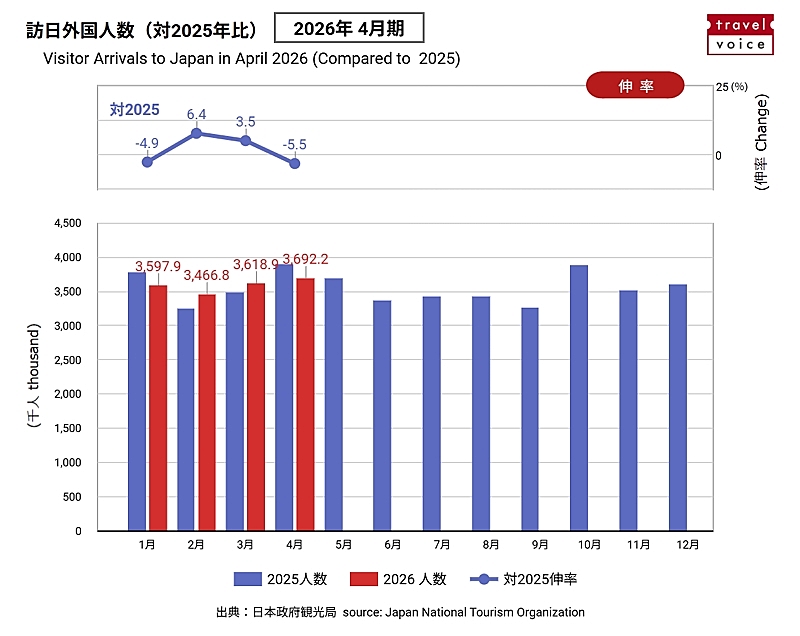
Source: JNTO via Travel Voice
Three forces pulling the number down
Three things converged in April, and all of them are worth understanding individually because they have very different time horizons.
China is the biggest single drag. Chinese arrivals collapsed 56.8% year-on-year, to just 330,700. That's the fifth straight month of double-digit declines for what was, until late 2025, Japan's most important inbound market by both visitor count and spending. The trigger was political: in November 2025, comments from Prime Minister Sanae Takaichi about a potential Taiwan emergency drew sharp protest from Beijing. China's Foreign Ministry and Education Ministry both issued advisories telling citizens to avoid travel and study in Japan, and the three major state-owned airlines offered free cancellation and changes on Japan-bound tickets.
According to aviation data analyzed by Aviation Week citing the UK consultancy OAG, Chinese carriers cut their Japan-route seat capacity by roughly 23% between November 2025 and December 2025, and Bloomberg reported that Beijing has instructed airlines to keep flight numbers reduced through at least March 2026. Routes from secondary cities like Xi'an, Ningbo, Wuhan, and Zhengzhou have essentially vanished. Even where flights still operate, group tour bookings, the bread and butter of mass Chinese tourism, have largely dried up. December 2025 was down 45.3%, January down 60.7%, February down 45.2%, March down 55.9%, April down 56.8%. There is no sign of a near-term turnaround.
Easter shifted onto the wrong side of the calendar. This sounds trivial but it really matters for European arrivals. In 2025, the Easter holiday started in April. In 2026, it began in late March. School breaks and family travel from countries like Italy, Germany, and Spain therefore landed in March rather than April, so the year-on-year comparison looks bad. Italy fell 34.2%, Germany 15.2%, Spain 21.6%. Pull March and April together, though, and the picture is much steadier: March 2026 was actually a record-high month overall, with several European markets posting strong gains.
The Middle East crisis is cutting flights, including connecting ones. Tensions across the region have led to airline cancellations and route changes, with the Gulf hubs that connect Europe to Japan particularly affected. Direct arrivals from eight Middle Eastern countries dropped 21.4% in April, to just 22,300. More importantly, European passengers who'd normally route through Dubai, Doha, or Abu Dhabi are facing either cancelled flights or longer detours, which dampens demand at the margins.
The under-the-radar good news
For all the gloomy headlines, nine markets actually set new April records: South Korea, Taiwan, Singapore, Malaysia, Vietnam, India, the United States, France, and Russia. France set a single-month all-time high, full stop. South Korean visitors were up 21.7% to 878,600, and Korea is now consistently Japan's largest source market. Taiwan grew 19.7% to 643,500. American visitors essentially held flat with a 0.8% gain, at 330,000, running level with China's 330,700; in JNTO's ranking China stayed third and the United States fourth.
What's happening, structurally, is that the inbound mix is rebalancing. China was, for years, the single dominant pillar. Korean, Southeast Asian, and Western demand is growing fast enough to nearly fill the hole China is leaving, but "nearly" isn't "completely," and that's why the totals are slipping.
So why doesn't the weak yen save the day?
This is the question a lot of overseas travelers are asking, and it deserves a direct answer.
The yen-to-dollar rate sat at roughly 159 on May 20, 2026, dramatically weaker than the 110 range of pre-pandemic 2019. In theory, that should make Japan one of the best-value developed-country destinations in the world. And for Americans, Australians, and many Europeans, it largely still does. The U.S. visitor count is essentially holding flat at a high level, not falling.
But the weak yen is a price signal, not a political one. It doesn't override a government travel advisory in China, it doesn't put cancelled Middle East flights back in the sky, and it doesn't move Easter to a different week. Those are the actual things that moved April's number.
There's also a second-order effect worth noting. Even as the yen stays weak, hotel rates in central Tokyo, Kyoto, and Osaka have risen sharply, JR rail passes for foreign visitors went up roughly 70% in 2023, and several attractions now charge dual-price systems. So the on-the-ground bargain is less spectacular than the headline exchange rate would suggest, particularly at the high-volume tourist nodes.
Is now actually a good time to come?
For travelers who can be flexible, the honest answer is yes, with caveats.
The decline doesn't mean Kyoto suddenly emptied out. Arashiyama's bamboo grove and Fushimi Inari were already so saturated that a 5% drop in national arrivals barely registers there. Mount Fuji has had a paid permit and a daily 4,000-climber cap since 2024, regardless of broader trends. The marquee sights will still feel crowded.
Where the decline is actually noticeable is in Chinese group-tour itineraries: the bus-borne, shopping-heavy circuits that move predictably between Ginza, Shinjuku, Asakusa, and outlet malls. Department stores have already reported double-digit drops in tax-free sales, and certain hotel categories that catered heavily to Chinese groups have softer occupancy than a year ago. So the experience at duty-free counters, certain hotel chains, and a few specific neighborhoods will be measurably less hectic.
For broader Japan, meaning the Setouchi region, Tohoku, Kyushu, Hokuriku and the smaller historical towns, 2026 is shaping up as one of those windows where weak yen, solid infrastructure, and slightly thinned crowds line up. Travel industry analysts now expect total 2026 arrivals to come in roughly 3% below 2025, which would still make it the second-best year ever, just shy of last year's 42.68 million record.
What to actually watch from here
Update since publication: JNTO estimates put May 2026 arrivals at 3,559,900, down 3.6% year on year, and June at 3,148,600, down 6.8%. That makes three straight months below the previous year, with the first half of 2026 totalling 21,084,800, down 2.0%. China stayed the outlier in June at 340,700, down 57.3% and falling for a seventh consecutive month, while South Korea (787,100, up 7.8%), Taiwan (670,400, up 14.6%), the United States (354,500, up 2.7%) and Hong Kong (214,300, up 28.5%) kept climbing. Fifteen markets set June records. The reading below, that one country is dragging the total down while the rest grow, has held up.
The single biggest variable is China. If the diplomatic chill continues into the summer, the second half of 2026 will see sustained year-on-year declines, because last year's strong summer months will be hard comparisons. Conversely, if Beijing eases its advisory and airlines restore capacity, the rebound could be sharp.
The Middle East situation is the second variable, largely outside Japan's control, but with direct consequences for European traffic.
The third, and most overlooked, is whether the rebalancing toward Korean, Southeast Asian, and Western visitors actually changes how Japan markets itself. The Fifth Tourism Vision finalized in March 2026 explicitly emphasizes shifting from sheer headcount to per-visitor spending and regional dispersion. April's data, paradoxically, may give Japanese policymakers a little breathing room to make that pivot without the political pressure of "the numbers are still going up."
A 5.5% dip after years of relentless growth isn't a collapse. It's a market correction driven mostly by geopolitics and a calendar quirk. For overseas travelers, the headline gives a slightly misleading picture: Japan is no less open, no less interesting, and, thanks to the yen, no less affordable than it was last month. Has tourism in your country gone through a similar political or geopolitical shock? We'd love to hear how it played out where you live.
References
- https://www.travelvoice.jp/20260520-159837
- https://www.jnto.go.jp/news/press/20260520_monthly.html
- https://honichi.com/news/2026/05/20/inbound202604/
- https://www.nikkei.com/article/DGXZQOUA201O20Q6A520C2000000/
- https://www.japantimes.co.jp/news/2026/05/20/japan/tourism-decline-april/
- https://president.jp/articles/-/110546
- https://toyokeizai.net/articles/-/934388









Global Discussion
5 comments