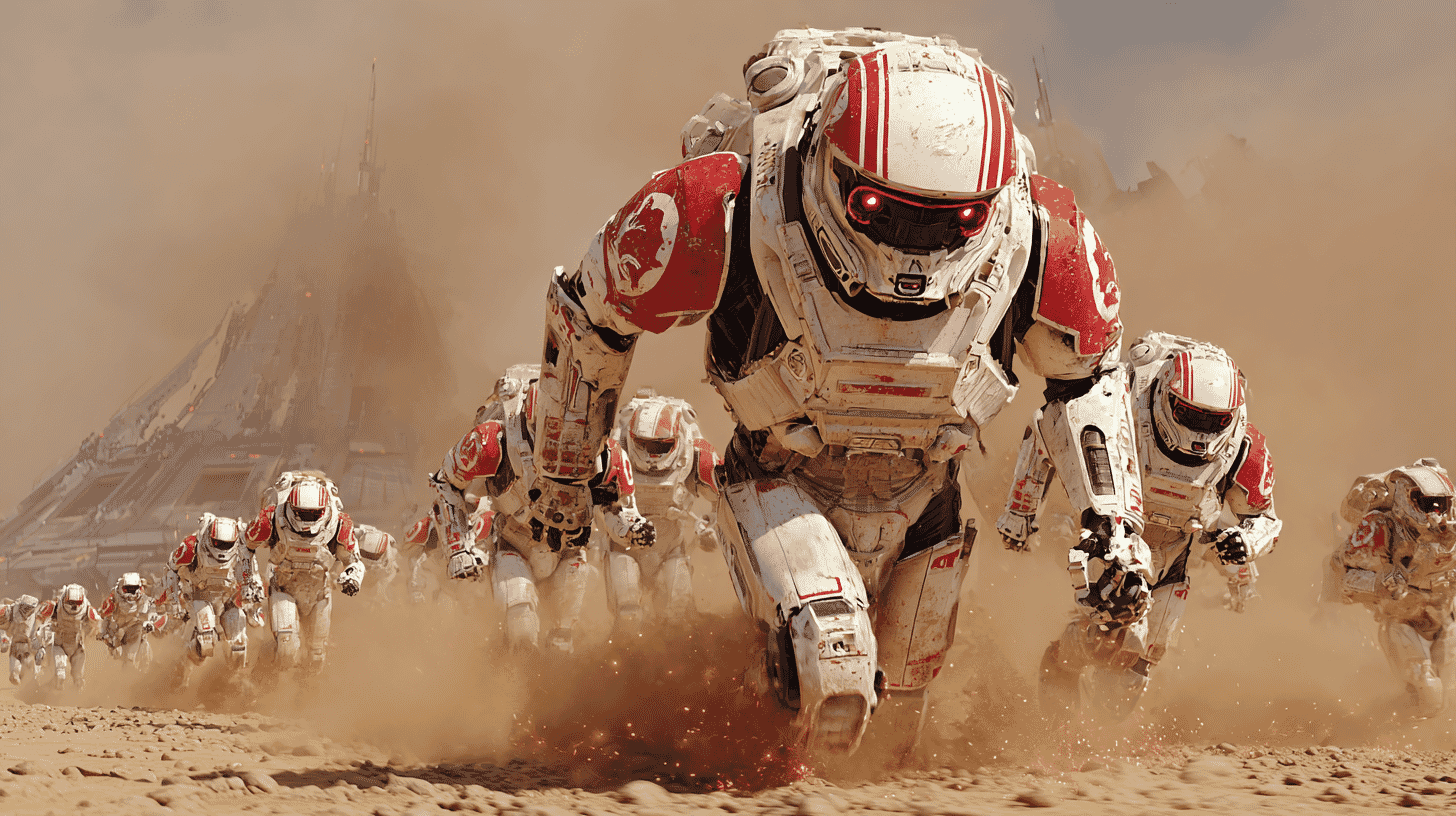
🤖 China's humanoid robots are coming to "Robot Kingdom" Japan. With 39% global market share and over 5,100 units shipped, world No.1 humanoid maker AGIBOT has opened a Japanese subsidiary and a 50-robot training center outside Tokyo starts up in July 2026. Their bold claim: "This market will surpass the auto industry." Is that hype, or a preview of the next industrial revolution?
Who Is AGIBOT?, From Shanghai Startup to Global No. 1 in Two Years
In February 2023, a startup called Shanghai Zhiyuan Innovation Technology, known as AGIBOT, was founded in Shanghai. Co-founder Peng Zhihui is a former AI researcher at Huawei and a tech influencer known in China as "Zhihui Jun," with millions of followers.
In just two and a half years, AGIBOT grew to roughly 1,400 employees. Backed by major investors including Tencent, the company moved fast from prototype to mass production. It unveiled production-ready models in August 2024, delivered 1,000 units by January 2025, and surpassed 5,100 cumulative shipments by year's end. According to London-based research firm Omdia, AGIBOT shipped 5,168 units in 2025, 39% of the roughly 13,300 shipped worldwide, ahead of Unitree at 4,200 and UBTECH at 1,000. The ranking is contested: Unitree says it delivered more than 5,500 complete humanoids that year, a figure it says excludes wheeled dual-arm systems, while AGIBOT's total includes wheeled machines. "World No. 1" depends on where the analyst draws the line.
AGIBOT's competitive edge lies in vertical integration. The company designs and manufactures hardware, develops its own AI models, and operates large-scale data collection infrastructure, all in-house. Its "One Robotic Body, Three Intelligences" architecture unifies conversational ability, manipulation skills, and locomotion capability into a single platform. AGIBOT claims that only two companies in the world can develop every layer of this stack in-house: Tesla and AGIBOT.
The current product lineup includes the A2 (a full-size bipedal robot standing 169cm/5'7"), the X2 (a compact 130cm/4'3" model optimized for social interaction), and the G2 (a wheeled model designed for industrial applications). The A2 set a Guinness World Record in November 2025 by walking over 106 kilometers continuously over three days.
Landing in Japan, Why Now, Why Here?
In December 2025, AGIBOT established its first subsidiary outside China, in Japan. Zhang He, the company's East Asia Business Division head, was appointed as representative of the Japanese entity. Zhang is Chinese-born but studied at a Japanese university and previously worked at a Japanese company, giving him deep familiarity with the market.
At the iREX 2025 (International Robot Exhibition) held in Tokyo that same month, AGIBOT formally announced its entry into the Japanese market. Notably, the Japanese operation is not just a sales office, it includes development capabilities for customer-specific customization and support.
That plan has since taken shape. On March 26, 2026, industrial equipment distributor Yamazen, pharmaceutical maker Tsumura, systems firm INSOL-HIGH and food machinery maker Rheon Automatic Machinery formed a consortium called J-HRTI to open a Physical AI robot data collection center in July 2026. The roughly 1,400-square-meter site on the Chiba coast will run up to 50 AGIBOT humanoids supplied through Yamazen, with about 100 operators and annotators on site. Staff drive the robots through warehouse picking and similar tasks using VR headsets and controllers, and the motion data is fed back as imitation learning. Sealed areas let individual companies train on confidential work. INSOL-HIGH handles overall design and the data platform; Yamazen chairs the operating committee. AGIBOT says it already generated over ¥1 billion (approximately $6.7 million) in Japan-related revenue in 2025 alone, primarily through joint development and technology-sharing projects.
Zhang told Japanese media that the company sees Japan's manufacturing labor shortage as a major opportunity and intends to collaborate with Japanese companies to address it, while also expanding into service industries and household applications.
"Bigger Than the Auto Industry", Fact-Checking the Claim
The claim that humanoid robots will create a market larger than the automotive industry is not unique to AGIBOT. Tesla CEO Elon Musk has predicted that Optimus could push Tesla's valuation to $25 trillion. Goldman Sachs has projected the long-term humanoid robot market could reach $5 trillion annually. Japan's Mitsubishi Research Institute has also examined this scenario, estimating that 90% of that market would be industrial applications and 10% household.
The current numbers tell a different story. The global humanoid robot market in 2025 was estimated at $2.9–4.5 billion. The global automotive industry is worth $3–4 trillion. That's roughly a 1,000x gap.
However, the growth trajectory is staggering. MarketsandMarkets forecasts a compound annual growth rate (CAGR) of 39.2% from 2025 to 2030. TrendForce projects global shipments will exceed 50,000 units in 2026, over 700% year-over-year growth. Costs are plunging too: Chinese company Unitree shocked the industry in 2025 by launching a humanoid robot at just $5,900 (approximately ¥880,000).
The "bigger than autos" scenario is ultimately a vision for 2050 and beyond, a grand aspiration rather than a near-term forecast. But the growth curve is so steep that dismissing it entirely would mean ignoring patterns we've seen before with smartphones and EVs in their early days.
Japan's Dilemma: Industrial Robot Superpower, Humanoid Latecomer
Japan has dominated industrial robotics for decades. Companies like FANUC, Yaskawa Electric, and Kawasaki Heavy Industries hold world-leading market shares in robotic arms for welding, painting, and assembly. According to the International Federation of Robotics (IFR), Japan installed 44,500 industrial robots in 2024, maintaining its position as the world's second-largest market.
But in humanoid robots, the picture flips dramatically. Despite Honda's ASIMO pioneering bipedal walking robots back in 2000, Japan has fallen far behind China and the US in commercialization.
Chinese companies dominate the top ranks: AGIBOT at No. 1 with 5,100 units, Unitree at No. 2 with 4,200, and UBTECH at No. 3 with 1,000. In the US, Tesla is scaling Optimus production, Figure AI has proven 5-month continuous operation at a BMW factory, and Boston Dynamics continues pushing performance boundaries with its new all-electric Atlas.
Japan's humanoid development remains closer to the research stage. Kawasaki's "Kaleido" has reached its 9th generation but isn't in mass production. The Kyoto Humanoid Association (KyoHA), whose members include Murata Manufacturing and Renesas Electronics, is targeting a prototype by the end of 2026.
TrendForce's analysis captures the contrast neatly: Japan is focused on improving core components like actuators, sensors, and control systems to raise entry barriers, while the US and China are rapidly deploying end-to-end humanoid products. Japan holds the world's finest components but risks becoming invisible in the finished product market, a "component kingdom's dilemma."
The Tailwind: Japan's Desperate Labor Shortage
The biggest reason AGIBOT is targeting Japan is the country's deepening labor crisis.
In manufacturing, Japan's robot installations actually declined 4% year-over-year in 2024, while China set new records at approximately 300,000 units. Japan's Ministry of Economy, Trade and Industry (METI) projects a shortfall of 3.26 million AI and robotics-related workers by 2040. The shortage of system integrators, the specialists who actually deploy robots on factory floors, is particularly acute.
The eldercare sector faces an even more urgent crisis. Japan's Ministry of Health, Labour and Welfare estimates that an additional 570,000 care workers will be needed by 2040 compared to 2022 levels. Yet the current rate of increase is only about 10,000 per year, far short of what's needed. Some 65.2% of care facilities report staff shortages.
The Japanese government has responded with its "Care DX Promotion Roadmap" and allocated ¥29.7 billion (approximately $200 million) in fiscal 2025 for technology adoption in eldercare. Monitoring sensors and transfer-assist robots are being introduced, though humanoid robots in care settings remain a future prospect. That said, AGIBOT's compact X2 model has reportedly attracted interest from nursing homes for tasks like conversation and simple medication delivery, suggesting a gradual pathway to adoption.
Mitsubishi Research Institute projects that household AI robots could reach annual sales of approximately 900,000 units in Japan by 2050 (at an estimated unit price of ¥5 million / $33,000, creating a ¥4.5 trillion / $30 billion domestic market), with eldercare and daily living support as the primary use cases.
The Competitive Landscape: Three Powers, Three Strategies
The humanoid robot race as of 2026 can be mapped across three major spheres of influence.
China leads overwhelmingly in production scale and cost competitiveness. AGIBOT tops global shipments, Unitree has shattered price floors (starting at $5,900), and UBTECH has partnered with automotive giants like BYD and Foxconn for factory deployments. Strong government backing is evident: over 610 robotics investment deals were completed in China in the first nine months of 2025 alone.
The United States leads in AI integration and premium applications. Tesla shut the Model S and Model X lines at Fremont to convert them to Optimus and set a 2026 target of 50,000 to 100,000 units. Getting there is another matter. On the April earnings call Musk said this year's output was "literally impossible to predict" given roughly 10,000 new parts, and on July 1 he wrote that production would be "extremely slow at first." As of late July it had not started, and high-volume output is not expected until Giga Texas comes online in 2027. Figure AI proved commercial viability with a 5-month, 10-hours-per-day continuous operation at BMW's US factory. Boston Dynamics maintains its performance leadership with the new all-electric Atlas.
Japan retains dominance in critical components but lags in finished products. Harmonic Drive Systems and Nabtesco control approximately 90% of the global market for precision gear reducers used in humanoid robot joints, a component that can represent up to 60% of total manufacturing cost. FANUC and Yaskawa's motor technologies are similarly indispensable. Kawasaki's Kaleido can lift 30kg loads and be remotely controlled via VR, approaching practical utility, but it's a long way from China-scale mass production.
What Comes Next: Will Japan Be a Buyer or a Builder?
AGIBOT's arrival in Japan poses a fundamental question: will Japan become primarily a customer market for Chinese humanoid products, or will it mount a serious effort to develop and mass-produce its own?
METI launched an AI Robotics Study Group in October 2025 and allocated ¥10.3 billion ($69 million) in supplementary budget for building open development infrastructure. The newly formed AI Robot Association, with 24 member companies including Toyota, Nissan, Fujitsu, and KDDI, aims to develop Japan-specific robot foundation models.
At the same time, a more pragmatic hybrid approach is emerging. The J-HRTI center, where Japanese firms train AGIBOT hardware on Japanese shop-floor data, is a "Chinese hardware, Japanese expertise" model that could become a template.
What's certain is that the humanoid robot era has moved past the "someday" stage to "happening now." How Japan connects the legacy of its golden age in industrial robotics to the next generation will define its technological future. AGIBOT's landing is the catalyst accelerating that reckoning.
In Japan, pride in being a "robot nation" mixes with anxiety about falling behind in humanoid development. For a country grappling with severe labor shortages, is AGIBOT's entry a threat, or a lifeline? How far along is humanoid robot development or adoption in your country? What do you think about a future of working alongside human-shaped robots? We'd love to hear your perspective.
References
- https://xtech.nikkei.com/atcl/nxt/column/18/00001/11521/
- https://monoist.itmedia.co.jp/mn/articles/2512/10/news050.html
- https://robotstart.info/article/2025/12/02/381463.html
- https://www.trendforce.com/presscenter/news/20251209-12825.html
- https://www.prnewswire.com/news-releases/omdia-ranks-agibot-no1-worldwide-in-humanoid-robot-shipments-in-2025-302656788.html
- https://www.mri.co.jp/knowledge/column/20251112.html






Global Discussion
14 comments