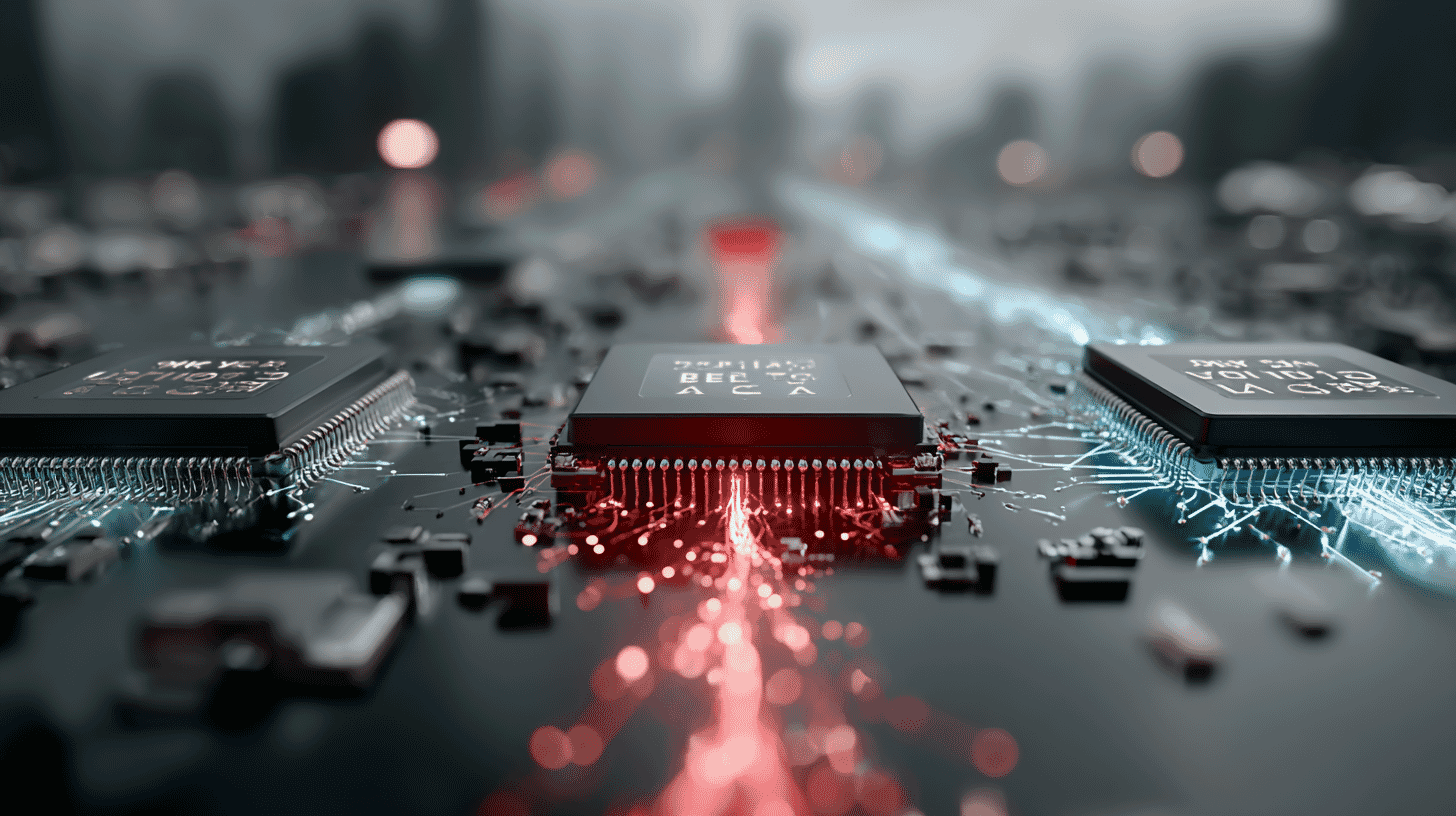
NVIDIA's "Rubin" delivers 5x the inference performance of Blackwell. AMD is touting a "1,000x jump in AI performance" with its 2027 next-gen GPU, and Intel has struck back with its U.S.-made "18A" process. Here's the full picture of the next-generation AI chips unveiled at CES 2026, and the three-way battle for semiconductor supremacy.
CES 2026: A Turning Point in the AI Chip Race
In January 2026, at CES 2026 in Las Vegas, NVIDIA, AMD, and Intel each unveiled their next-generation platforms. From the data center to the consumer PC, every domain saw gains in AI processing power.
All three led with system-level optimization and ecosystem breadth rather than raw chip performance. The main battleground is shifting from "individual product performance" to "which platform you run AI on."
NVIDIA: The Vera Rubin Platform
Six Chips in Coordinated Design
NVIDIA CEO Jensen Huang unveiled the next-generation AI platform "Vera Rubin" in his CES 2026 keynote. Named after astronomer Vera Rubin, who provided evidence for dark matter, it integrates six types of chips through "extreme co-design."
The six chips:
- Rubin GPU: 336 billion transistors. NVFP4 inference performance of 50 petaflops (5x Blackwell), and 35 petaflops for training (3.5x)
- Vera CPU: 88 custom ARM "Olympus" cores, supporting 176 threads
- NVLink 6 Switch: per-GPU bandwidth doubled to 3.6 TB/s
- ConnectX-9 SuperNIC: 1.6 Tb/s of per-GPU bandwidth
- BlueField-4 DPU: handles storage, networking, and security processing
- Spectrum-6 Ethernet Switch: enables scale-out connectivity
Performance and Serviceability
The Vera Rubin NVL72 rack houses 72 Rubin GPUs and 36 Vera CPUs, delivering 3.6 exaflops of NVFP4 inference and 2.5 exaflops of training. With HBM4 memory, per-GPU bandwidth reaches 22 TB/s, 2.8x that of Blackwell.
Huang said demand for AI computing is surging in both training and inference, and that token-generation cost can be cut to one-tenth of before. A cable-free, modular tray design also cuts service and component-swap time by up to 18x versus Blackwell. Rubin is already in volume production, with availability to partners planned for the second half of 2026.
Update: at GTC 2026 in March, NVIDIA added a seventh chip to the platform, the Groq 3 LPX low-latency inference accelerator.
AMD: "AI Everywhere, for Everyone"
The Helios Platform and Yotta-Scale Ambitions
AMD CEO Dr. Lisa Su laid out the vision "AI Everywhere, for Everyone" in the CES 2026 opening keynote, unveiling the data-center "Helios" rack-scale platform and the full Instinct MI400 series lineup.
Helios delivers up to roughly 3 AI exaflops per rack, with 31 TB of HBM4 memory and 43 TB/s of scale-out bandwidth. The roughly 3,200 kg double-wide rack, carrying 72 MI455X GPUs, holds more than 18,000 CDNA compute units. Su called it a "blueprint for yotta-scale computing."
A Preview of the MI500 Series
Drawing particular attention was a preview of the next-generation "Instinct MI500 series," slated for 2027. AMD declared the MI500 will deliver up to a 1,000x AI performance gain over the 2023 MI300X (an estimate based on comparing an 8-GPU node with a future MI500 rack). It will use the CDNA 6 architecture, a 2nm process, and HBM4E memory.
The enterprise MI440X integrates into existing infrastructure in an 8-GPU form factor. With the major OpenAI partnership announced in October 2025 (a 6 GW GPU supply) in the background, AMD's seriousness about the data-center business is clear. OpenAI President Greg Brockman also appeared on stage.
Update: AMD said at Advancing AI 2026 in July that Helios had entered full production, with shipments starting at the end of the third quarter.
Expanding into AI PCs
On the consumer side, AMD announced the Ryzen AI 400 and Ryzen AI PRO 400 series. Based on the Strix Point/Krackan Point generation, they feature an NPU of up to 50 TOPS and support Copilot+ PCs. A developer mini PC, "Ryzen AI Halo," was also shown, offering a local AI development environment with 128 GB of unified memory. AMD is also bringing the gaming desktop CPU "Ryzen 7 9850X3D" to market in the first quarter of 2026.
Intel: A Counterattack with the 18A Process
Core Ultra Series 3 (Panther Lake)
Intel announced the "Core Ultra Series 3" processors (codenamed Panther Lake). It is the first product on the Intel 18A (roughly 1.8nm-class) process, positioned as "the most advanced AI PC platform designed and manufactured in the United States."
Key features:
- New architecture: a hybrid of Cougar Cove (P-cores) and Darkmont (E-cores)
- Up to 16 CPU cores: 4 P-cores + 8 E-cores + 4 LP-E cores
- Xe3 GPU: up to 12 cores, with integrated graphics handling 1080p gaming
- 50 TOPS NPU: a neural processor dedicated to AI (NPU 5)
- 180 TOPS total: GPU (120 TOPS) + NPU (50 TOPS) + CPU (10 TOPS)
Performance and Market Rollout
Intel claims a 60% gain in multithreaded performance and a 77% gain in gaming performance over the Core Ultra 9 288V (Lunar Lake). Battery life reaches up to 27 hours.
More than 200 PC designs are planned, with global availability from January 27, 2026. The chips are also certified for embedded and industrial use, with an eye toward robotics, smart cities, and medical devices.
Comparing the Three Strategies and Market Impact
The Data Center Market
In the data-center AI chip market, NVIDIA holds the lead. That Vera Rubin is already in volume production translates directly into a timing advantage.
AMD, for its part, is pushing into the hyperscaler market on the back of its OpenAI contract and two open standards, UALink and Ultra Ethernet. Where NVIDIA sells a proprietary interconnect, AMD is selling the standards-based alternative.
The Consumer PC Market
In the AI PC market, competition among Intel, AMD, and Qualcomm has intensified. Each competes on NPU "TOPS," and running large language models locally is becoming a new criterion for choosing a PC.
Intel's Panther Lake foregrounds the strength of "in-house manufacturing" with the 18A process, signaling a push to reduce dependence on TSMC and to address geopolitical risk.
The numbers the three companies put on stage pose a question larger than which chip is fastest: which foundation to build on. Chip companies are moving from parts supplier to substrate for the whole AI stack, and that choice locks a buyer's capital spending in for years.
How is the AI chip race, and the spread of AI PCs, playing out in your country?
References
- https://pc.watch.impress.co.jp/docs/news/event/2079192.html
- https://blogs.nvidia.co.jp/blog/2026-ces-special-presentation/
- https://newsroom.intel.com/client-computing/ces-2026-intel-core-ultra-series-3-debut-first-built-on-intel-18a
- https://ir.amd.com/news-events/press-releases/detail/1272/amd-and-its-partners-share-their-vision-for-ai-everywhere-for-everyone-at-ces-2026
- https://nvidianews.nvidia.com/news/rubin-platform-ai-supercomputer







Global Discussion
16 comments