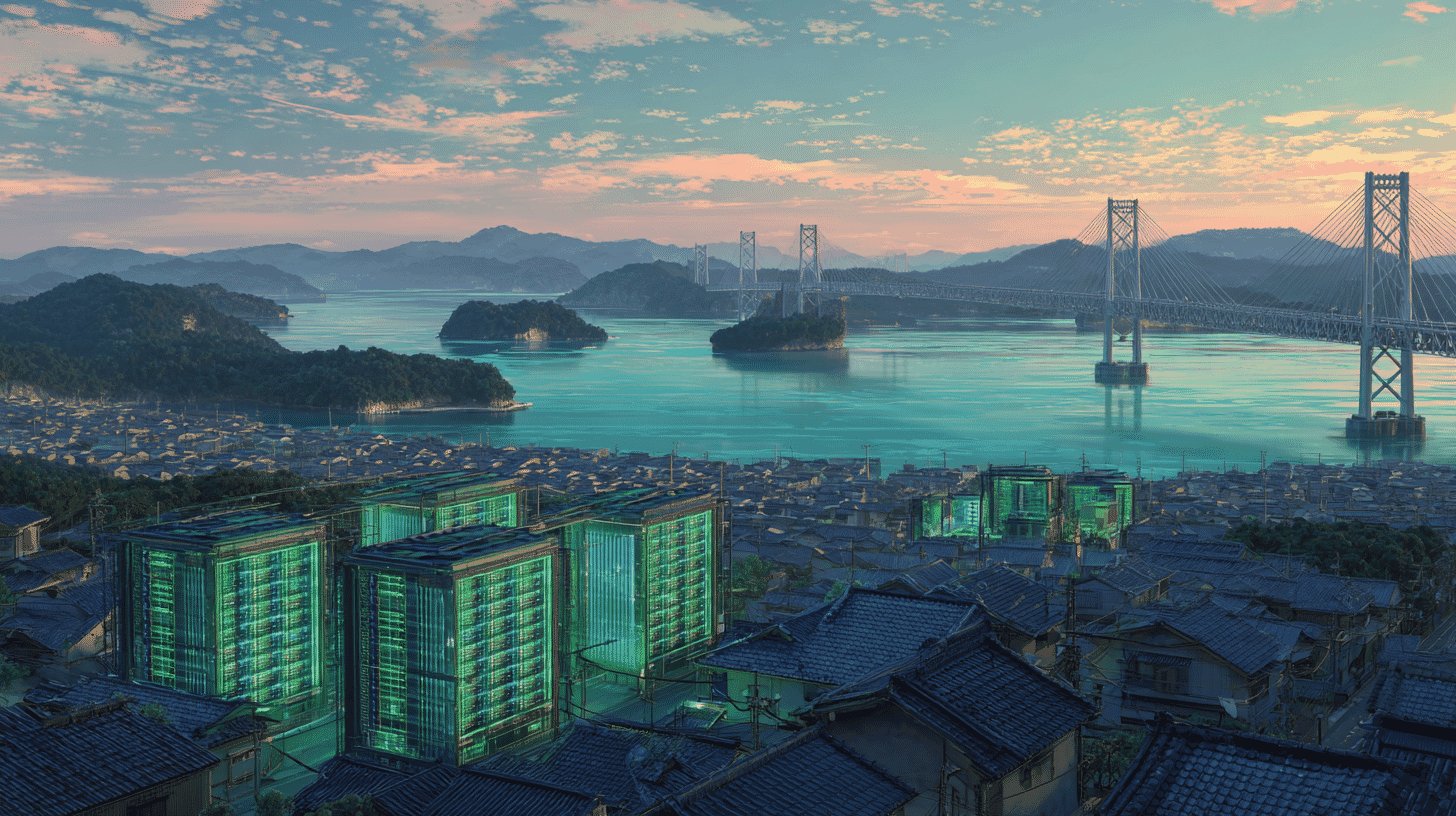
Kagawa Prefecture, famous for its udon noodles and Seto Inland Sea views, became the first local government in Japan to sign a partnership agreement with NVIDIA. With a population just over 900,000, how did this small prefecture on the island of Shikoku land a deal with the world's most valuable chipmaker? The answer lies in a strategy to fight rural decline with artificial intelligence.
A Historic First: Kagawa × NVIDIA Partnership
In February 2026, Kagawa Prefecture signed a comprehensive partnership agreement with NVIDIA's Japanese subsidiary. At the signing ceremony held at the prefectural office on February 17, Governor Toyohito Ikeda and Masataka Osaki, NVIDIA's Japan representative and a corporate vice president, signed the agreement. It is the first such partnership between NVIDIA and any local government in Japan.
The partnership focuses on three key pillars: attracting companies that utilize NVIDIA's GPUs to establish operations in Kagawa, promoting AI adoption among the prefecture's existing businesses, and collaborating on AI and IT talent development and technical consulting.
The agreement sits inside Kagawa's "Setouchi Business Attraction 100 Plan," an action plan drawn up in 2023 that looks five to ten years ahead and puts large-scale data centers and IT companies at the top of its recruitment list. At the signing, Governor Ikeda said the strength of the regions lies in making things, and that AI sharply amplifies that strength.
The AI Foundation Was Already in Place
The NVIDIA partnership did not come out of nowhere. Kagawa had been building AI infrastructure for more than a year.
In December 2024, HiReso Kagawa, a subsidiary of the GPU cloud operator HiReso Inc., opened the Chugoku-Shikoku region's first GPU-dedicated data center for AI development in Takamatsu City. Built inside a converted research facility of the Kagawa Industry Support Foundation, the 687-square-meter site runs 408 NVIDIA HGX H200 GPU servers. HiReso won NVIDIA's Best CSP Partner of the Year award in 2022.
A second GPU data center opened on March 3, 2026 in the town of Ayagawa, in the space beneath the gymnasium of the former Ayakami Junior High School, which closed in March 2022. The 1,008-square-meter site cost ¥11 billion (about $73 million) and runs NVIDIA H100 and A4000 GPUs, with higher-end hardware planned. Full operation is targeted for summer 2026. The classroom building is slated for a second phase that will house a memorial room for the old school and an open space for residents.
The Takamatsu site cost around ¥10 billion. In April 2024 it was certified under METI's cloud program supply-security scheme, which carries subsidies of up to ¥7.7 billion (about $50 million). It is a rare case where national economic security policy connects directly to regional industrial development.
Kagawa's Secret Weapon: An AI Professor from Udon Country
Kagawa's AI strategy has another powerful asset: Professor Yutaka Matsuo of the University of Tokyo, one of Japan's foremost AI researchers.
Professor Matsuo happens to be a native of Sakaide City in Kagawa Prefecture. The prefectural government appointed him as "Industrial AI Advisor," leveraging his expertise to provide guidance to AI companies operating in the region and facilitate connections through his extensive research network. Companies working on AI adoption and talent development are certified as "Matsuo Industrial AI Advisor Certified Kagawa AI Promotion Companies."
When HiReso became the first such company, NVIDIA Japan business division head Hideki Iwanaga attended the ceremony as a guest. The personal groundwork for the current partnership was already laid at that point.
Understanding "Sovereign AI"
The broader context is the global turn toward sovereign AI: keeping control of AI infrastructure, models, and data inside a country or region for the sake of industrial competitiveness and economic security.
In December 2025, Japan's cabinet approved the country's first Artificial Intelligence Basic Plan, committing more than ¥1 trillion (about $6.5 billion) over five years from fiscal 2026 to domestic AI development. METI is planning roughly ¥1 trillion in support for a new company built around SoftBank with dozens of Japanese firms, Preferred Networks among them, aimed at foundation models strong in Japanese.
Kagawa's approach can be seen as a "regional version" of this national strategy. The idea of local governments proactively owning AI computing resources and making them available to regional industries represents a shift from merely "using" AI to "creating" AI locally.
AI as a Lifeline for Rural Japan
Behind Kagawa's embrace of AI lies a crisis shared by rural communities across Japan.
Population decline driven by an aging society and low birth rates is accelerating nationwide, and young people keep leaving for the big cities. Kagawa's estimated population stood at 901,428 on June 1, 2026, down for the 24th consecutive month. Its economy has leaned on labor-intensive industries such as agriculture, manufacturing, and shipbuilding, which makes the workforce shortage bite harder each year.
The strategy is straightforward: hiring alone cannot close a labor gap this size, so raise productivity with AI, and put the AI industry itself in the region so young people have a local career path. HiReso's data center in Shika Town, Ishikawa Prefecture, running since 2019, gave local job seekers who felt there was no work worth doing an actual option.
Japan's AI Infrastructure Boom
Kagawa's initiative is part of a massive wave of AI infrastructure investment sweeping across Japan.
Microsoft is investing $2.9 billion in Japan between 2024 and 2026, building AI infrastructure and training 3 million people in AI skills. AWS has committed $15.2 billion through 2027. SoftBank plans to invest over $40 billion through its "Stargate" project with OpenAI.
Much of this has concentrated in Tokyo and Osaka, but rising power and land costs, plus the case for spreading disaster risk, are pushing data centers into the regions. In Okuma Town, Fukushima Prefecture, an AI data center supports recovery from the 2011 earthquake and tsunami. HiReso itself opened a GPU data center in a closed school in Genkai Town, Saga Prefecture, in August 2025; Ayagawa is the second such conversion in Japan.
Kagawa read the trend early and turned it into an agreement with NVIDIA.
From Udon Prefecture to AI Prefecture: Challenges Ahead
Challenges remain. Data centers consume enormous amounts of electricity, and whether rural grids can carry AI industry growth, and how to square that with renewable targets, are open questions. Japan's push for what it calls watt-bit coordination, planning power and network capacity together, is the policy answer to exactly this problem.
Building facilities alone will not revitalize a region. Securing the skilled staff to run the centers, walking local businesses through actual AI adoption, and giving residents something they can feel are the three tests that decide whether this works.
Still, a prefecture of fewer than a million people has secured a partnership with a global semiconductor powerhouse. More is coming: ELEMENTS plans to bring a data center online in Sakaide City in fiscal 2027.
In Japan, local governments are increasingly turning to AI to combat population decline and drive economic growth. How is your country approaching AI strategy at the regional or local level? Are there examples of smaller cities or rural areas using technology to revitalize their economies? We'd love to hear your perspective.
This article was published from the February 2026 signing. Later developments, including the opening of the Ayagawa data center, were added as of July 2026.
References
- https://www.pref.kagawa.lg.jp/kigyoritti/topics/2025nv-renkeikyoutei.html
- https://yuchi-100plan.pref.kagawa.lg.jp/news/594/
- https://www.pref.kagawa.lg.jp/kigyoritti/topics/2024hai.html
- https://prtimes.jp/main/html/rd/p/000000066.000058027.html
- https://www.pref.kagawa.lg.jp/kigyoritti/topics/sangyoaisanyo.html
- https://www.nvidia.com/ja-jp/about-nvidia/press-releases/2024/japan-cloud-leaders-build-nvidia-ai-infrastructure-to-transform-industries/
- https://highreso.jp/press/40442/
- https://www.pref.kagawa.lg.jp/kigyoritti/topics/2026hairezo-ayagawa-kaisyo.html
- https://news.ksb.co.jp/article/16677357






Global Discussion
15 comments