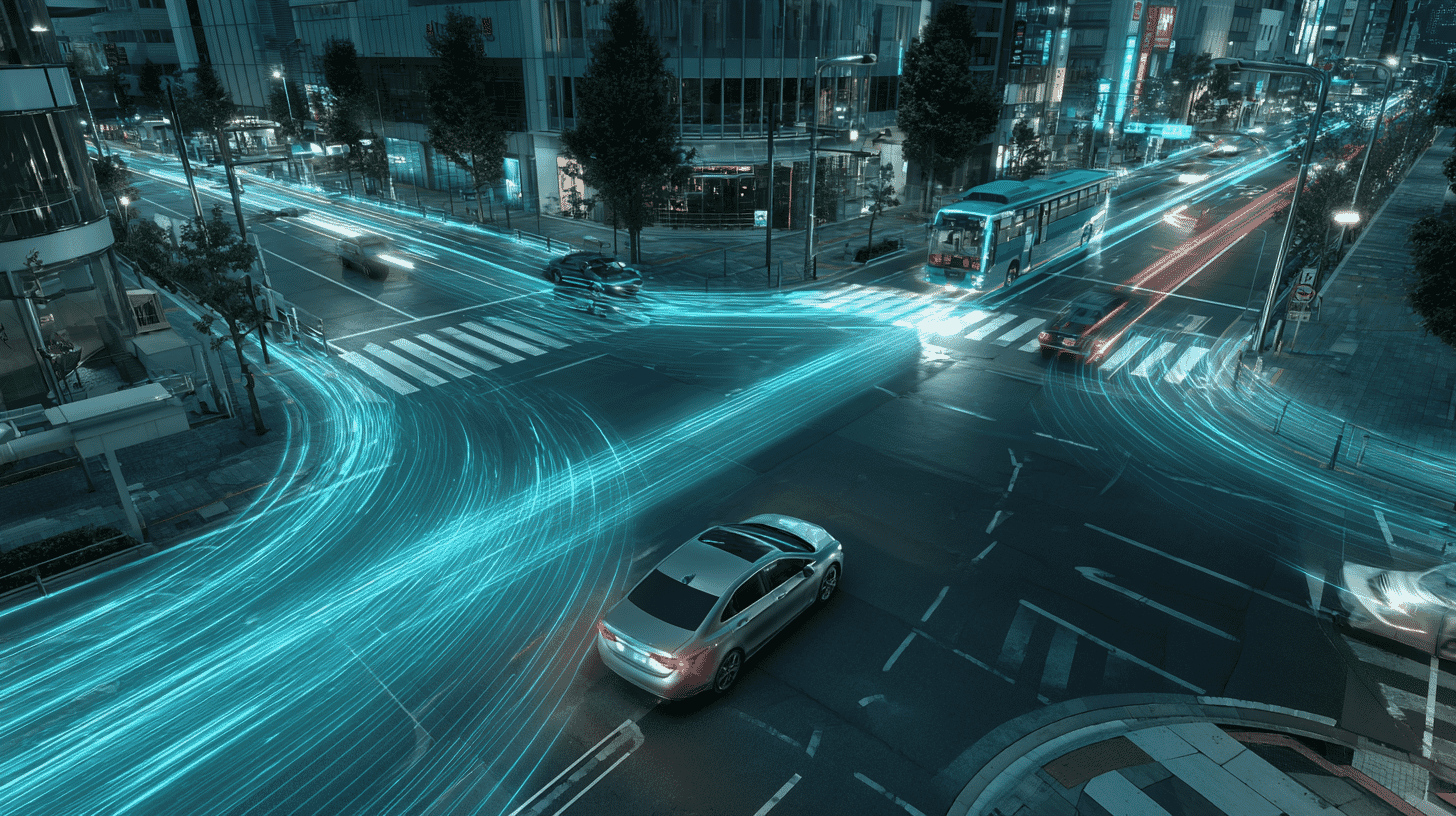
What if a traffic light could tell your car it is about to turn red before you even see it? A pedestrian might dart out from a blind intersection, or an oncoming car might be speeding toward a crossing. V2X technology lets your vehicle "know" about these invisible dangers through wireless signals, and Japan just took a major step toward deploying it nationwide with a new consortium founded by Kyocera, Toyota, and four other industry giants.
What Is V2X? When Vehicles Learn to "Talk"
V2X stands for "Vehicle-to-Everything," an umbrella term for technologies that enable vehicles to wirelessly communicate with the world around them. This includes V2V (Vehicle-to-Vehicle), V2I (Vehicle-to-Infrastructure), and V2P (Vehicle-to-Pedestrian) communication.
Picture this: as your car approaches a blind intersection, sensors installed along the road detect an oncoming vehicle or a pedestrian stepping off the curb. That information is instantly transmitted wirelessly to your car. No smartphone alert: the car itself becomes aware of the danger. This supplements what human senses (eyes and ears) cannot perceive, preventing accidents before they happen.
Japan allocated the 760MHz frequency band for ITS (Intelligent Transport Systems) use early on by global standards. In 2015, Toyota became the first automaker in the world to commercialize a V2X system called "ITS Connect," and it has since been integrated into passenger vehicles, ambulances, and other vehicles.
Why a New Consortium? Opening Roadside Units to Everyone
On February 9, 2026, six companies (Kyosan Electric Manufacturing, Kyocera, Sumitomo Electric Industries, Denso, Toyota Motor Corporation, and Nippon Signal) announced the establishment of the "760MHz ITS Roadside Unit Promotion Consortium." The founding general meeting was held on December 24, 2025, with Professor Eiji Hato of the University of Tokyo's Graduate School of Engineering serving as chairman.
Behind this consortium lies a significant regulatory shift. The "roadside units" (RSUs) that support V2X communication are wireless transmitters installed along roads. Previously, only the police could install and operate these units. However, as demand for autonomous driving infrastructure grew, regulations were amended to allow national and local governments as well as private businesses to deploy RSUs.
But new freedom brings new challenges. When multiple operators install RSUs independently, signals from nearby units can interfere with each other, similar to two radio stations broadcasting on adjacent frequencies creating static. This "radio interference" problem is precisely what the consortium aims to prevent by building a centralized RSU database, coordinating frequency usage among operators, and establishing protocols for preventing and resolving interference issues.
The Six Founding Members: A Strategic Assembly
The six founding companies represent a well-balanced coalition covering the entire V2X ecosystem.
Toyota Motor Corporation pioneered commercial V2X in 2015 with ITS Connect. Denso, Toyota Group's core components manufacturer, develops V2X communication modules. Kyocera, a major communications equipment and electronic components company, has pursued ITS research for years. Sumitomo Electric Industries brings expertise in fiber optics and communication infrastructure, with a strong presence in road and traffic systems. Kyosan Electric Manufacturing and Nippon Signal are Japan's leading traffic signal manufacturers responsible for deploying physical traffic infrastructure.
In essence, the consortium unites vehicle-side technology companies (Toyota, Denso), communication and component specialists (Kyocera, Sumitomo Electric), and the companies that actually install and manage intersection equipment (Kyosan, Nippon Signal). This comprehensive coverage is what gives the consortium its practical power.
Why 760MHz? The Physics Behind the Frequency Choice
Different frequency bands have different characteristics. Japan's choice of 760MHz for V2X offers a key advantage for road environments: lower frequencies "bend" around obstacles like buildings more effectively (a property called diffraction). This means signals are less likely to be blocked at complex urban intersections where visibility is poor.
Meanwhile, the global trend is moving toward the 5.9GHz band for V2X. Europe, the United States, China, and South Korea are all developing infrastructure in this range. Japan's government is also preparing for 5.9GHz deployment around 2030, with trial runs already underway on the Shin-Tomei Expressway.
So 760MHz represents Japan's "current foundation" already in operation, while 5.9GHz is the "next-generation foundation" for advanced autonomous driving. This consortium focuses on scaling up the current foundation nationwide, a critical stepping stone.
Government Targets: Road Safety and Autonomous Driving by 2030
Japan's government has set ambitious targets for 2030: reducing annual traffic fatalities to 1,900 or fewer and serious injuries to 20,000 or fewer. Additionally, the plan calls for scaling Level 4 autonomous driving (vehicles that can operate without human intervention under specific conditions) for buses, taxis, and trucks to 10,000 vehicles by fiscal year 2030.
Approximately 40% of fatal traffic accidents in Japan occur at or near intersections, precisely the scenario V2X technology addresses. By linking roadside sensors with vehicle systems, V2X can warn drivers about pedestrians they might miss, prevent red-light running, and reduce head-on collisions at intersections.
The consortium plans to actively recruit government agencies, local municipalities, and private operators as members, establishing shared rules for pre-installation coordination and troubleshooting.
V2X Around the World: Different Roads, Same Destination
V2X deployment is a global trend, but each region takes a different approach.
China leads in C-V2X (Cellular V2X) technology. In 2024, the government selected 20 cities for a "Vehicle-Road-Cloud Integration" pilot project, and V2X integration in new vehicles is expanding rapidly. The United States saw the FCC allocate the 5.9GHz band for C-V2X, with numerous pilot projects underway. Europe plans to include V2X features in Euro NCAP safety ratings, expected from 2027, creating market incentives for automakers. South Korea officially adopted C-V2X in 2023 and is testing deployments across roughly 2,400 km of expressway.
The global V2X communication module market was valued at approximately $1.3 billion in 2025 and is projected to reach nearly $5 billion by 2034, a sign of the technology's growing momentum worldwide.
The "Invisible Infrastructure" of Self-Driving Society
When people think about autonomous driving, they tend to focus on the cameras, LiDAR sensors, and AI chips inside the vehicle. But safe autonomous driving cannot be achieved by the car alone. Information flowing from the road to the vehicle, and real-time sharing between vehicles. This "invisible infrastructure" is what truly enables a self-driving society.
This consortium represents the next chapter in Japan's V2X journey, which began with Toyota's ITS Connect over a decade ago. It transforms what started as a single automaker's innovation into an industry-wide, government-supported initiative to build communication infrastructure across the nation.
Japan is advancing its autonomous driving vision through "san-kan-gaku" (産官学), a collaborative approach linking industry, government, and academia, addressing not just technology but regulations and standards in parallel. How is V2X or autonomous driving infrastructure progressing in your country?





Global Discussion
15 comments