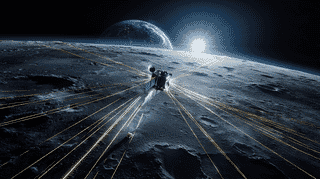
NEC plans several hundred laser-linked satellites, the Yomiuri reports. Japan's Kirari made a two-way laser link in 2005, but Starlink now has about 11,100. Why Japan still wants its own.
Meta's 7,000 km US-France cable Petal targets 1 petabit per second in 2029, built by NEC and Sumitomo. Labs reach 19 cores, so why two? Repeater power.
From mid-August 2026 SoftBank will fly a 65-metre helium airship from New Mexico across the Pacific and hold it about 20 km above Japan, testing voice, SMS and data from a flying base station that covers up to 200 km across. Commercial service is targeted from 2027. Here is how it differs from satellite direct-to-phone, why Loon died, and the business problem SoftBank has not solved.
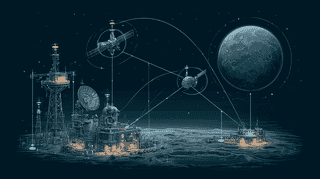
When Artemis II passed behind the Moon, the crew went 40 minutes without a signal. A sustained lunar presence needs always-on infrastructure, not one-shot mission links. We trace what KDDI, the carrier that once relayed Japan's international calls, is building with laser comms and multi-hop relays, and ask how close it really is.
Terahertz promises jaw-dropping 6G speeds, yet a passing body can kill the link. NICT just demonstrated the world's first system that auto-switches between millimeter and terahertz waves. The real breakthrough isn't a speed record but knowing when to give up on speed.
What is NTT, one of Japan's largest telecom conglomerates, really building behind a decade of re-consolidation and its coming split of Docomo? We lay out the facts, then predict the 'final form' that emerges and the backbone it plans to earn from, comparing it with AT&T's failed media bet, SoftBank's reinvention, and India's Reliance playbook to find the real key to whether it works.
Light travels faster through air than glass. By hollowing out the core, OKI, Lightera and Keio University demonstrated a world-first wideband single-fiber bidirectional link. Commercialized, it could cut network power by up to 90 percent. We unpack the race, where Microsoft is already in via its Lumenisity buy, as AI devours electricity.
Free-space optics sends data on beams of light without cable. The idea dates back to Bell's 1880 photophone. Here is why a 140-year niche technology is now moving toward disaster recovery and remote connectivity, from Taara to Japan's NEC and NICT.
6G's high-frequency waves can't penetrate walls, so NTT invented a 3.5-micrometer liquid-crystal sheet you stick on windows that electrically bends radio waves to kill indoor dead zones. At one-tenth the thickness of conventional designs, it can be mass-produced on existing LCD factory lines. Japan just pulled ahead in the global RIS race where Nokia and Samsung are also sprinting.
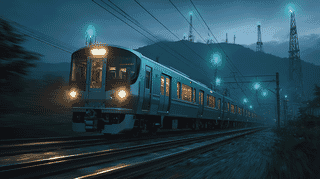
JR Kyushu's new RK System will control trains over public cellular networks starting 2028—a Japan-first approach. How it compares to Europe's ERTMS and America's PTC, and what it means for aging societies everywhere.
NTT and JAXA have completed the world's first orbital demonstration of satellite MIMO communication and IoT sensing technology aboard a low-Earth orbit satellite. By applying MIMO, the same technology that speeds up your smartphone, to space, they aim to double satellite data transmission capacity. The breakthrough could bring IoT connectivity to mountains, oceans, and remote islands where no cell towers exist.
Japanese lunar startup ispace has unveiled 'Lunar Connect,' a communication and positioning service using lunar orbiting satellites. Partnering with KDDI for ground stations and planning 5 satellites by 2030, ispace is pivoting from a transport company to a space infrastructure provider. The new unified ULTRA lander marks another strategic shift.
Japan's QST and NTT achieved a world-first: real-time communication under 100 microseconds for fusion plasma control. Learn how this JT-60SA breakthrough connects to IOWN and ITER.
SoftBank Group is betting big on Physical AI, merging telecom infrastructure with robotics. From its $5.4B ABB acquisition to AI-RAN partnerships with NVIDIA, Arm, and Yaskawa, here's how Japan's tech giant plans to make robots think and move in real time.
NTT Docomo launches 'docomo Starlink Direct' on April 27, 2026, offering free satellite-to-smartphone communication for 22 million subscribers. Using SpaceX's Starlink constellation of 650+ satellites as cell towers in space, the service covers mountains, remote islands, and seas across Japan. We compare it with KDDI's pioneering au service and T-Mobile's U.S. rollout.
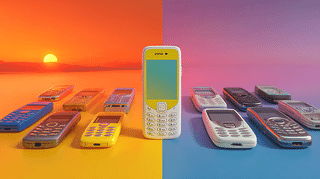
On March 31, 2026, NTT Docomo's 3G shutdown renders Japan's beloved garakei flip phones permanently unusable. Explore the rise and fall of Japan's unique mobile culture that gave the world emoji, mobile internet, and camera phones — and why over 500,000 users are losing their connection.
NTT has developed multi-core optical fiber technology that quadruples submarine cable capacity without changing cable structure. Achieving 192 cores (48 fibers × 4 cores) with deployment targeted for 2029, this Japanese innovation addresses the explosive data demands of the AI era. We explore the technology alongside Big Tech's submarine cable investment race.
Furukawa Electric's Lightera begins mass production of the world's highest-class 13,824-core ultra-high-density fiber optic cable. Learn how this Japanese innovation doubles transmission capacity for hyperscale AI data centers.
The NTT-led IOWN Global Forum has signed a comprehensive partnership with ETSI, Europe's telecom standards body, revealed at MWC Barcelona 2026 and following a February tie-up with the Open Compute Project. Where does a photonics-electronics technology promising one hundredth the power and one two-hundredth the latency stand in a 6G standards race between the US, China and Europe? A look at the forum's 170-plus members and its roadmap.
Murata Manufacturing, SoftBank, and CC-Link Partner Association achieved the world's first TSN over 5G connectivity demonstration by a telecom operator, reaching an average time synchronization accuracy of 122 nanoseconds, over 7x better than the international standard requires. A major step toward wireless smart factories and Physical AI.