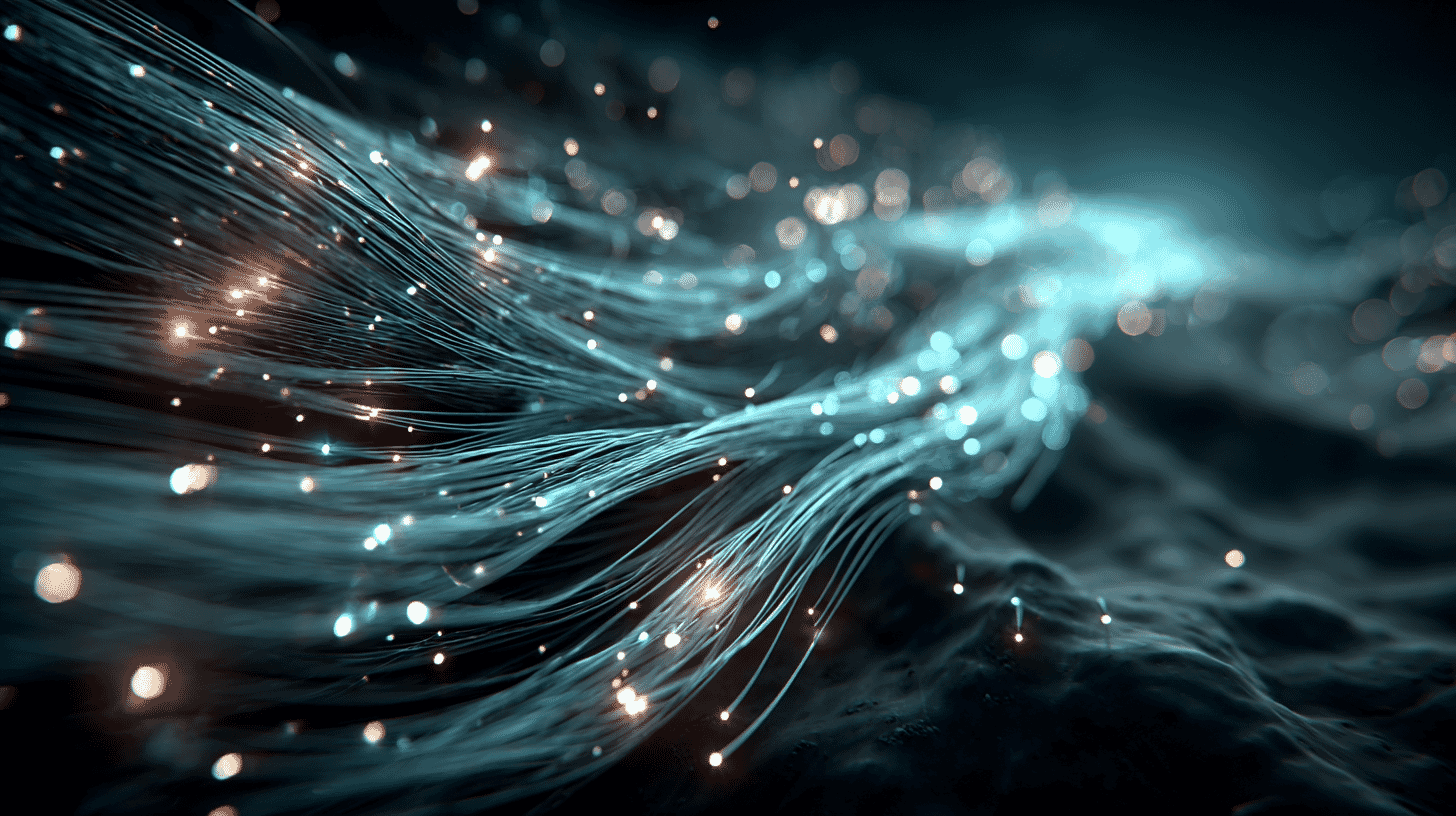
Every time you stream a video, send an email or ask an AI a question, your data travels through cables lying on the ocean floor, as deep as 8,000 meters. These submarine cables carry 99% of intercontinental internet traffic, and they are running out of room.
NTT has now figured out how to quadruple their capacity without making them any thicker. Here is why that matters.
The Internet's Hidden Backbone
Most people imagine the internet as something ethereal: data floating through the air, bouncing off satellites, traveling through the cloud. The reality is physical. As of early 2026, TeleGeography tracks more than 600 submarine cable systems, with over 1.5 million kilometers of cable in service, carrying 99% of intercontinental data traffic. From Tokyo to New York, from London to São Paulo, your data travels through fiber-optic cables thinner than a garden hose, resting on the ocean floor.
Japan alone is connected to the United States, Canada, Australia, and Southeast Asia through dozens of these undersea lifelines. When you use Netflix, Google, or ChatGPT, the data is racing through the Pacific Ocean at the speed of light, literally.
NTT's Breakthrough: Four Lanes Where There Was One
On March 13, 2026, Japan's NTT Corporation announced a technology that could reshape global internet infrastructure: a 4-core multi-core optical fiber (MCF) system for submarine cables that quadruples transmission capacity without changing the cable's physical structure.
Here's how it works in simple terms.
A conventional optical fiber is a glass strand about the thickness of a human hair, with a single "core", a pathway for light signals. A submarine cable houses up to 48 of these fibers, and that 48-fiber limit has long been considered the engineering ceiling.
NTT's innovation places four cores inside each fiber while maintaining the standard glass diameter of 125 micrometers. The result: 48 fibers × 4 cores = 192 cores, all packed into a cable just 20 millimeters wide, exactly the same size as today's cables.
Think of it like a highway tunnel: instead of widening the tunnel (which is nearly impossible at 8,000 meters underwater), NTT quadrupled the number of lanes inside.
Why You Can't Just Make Thicker Cables
It might seem logical to simply build bigger cables to carry more data. On land, that approach works. But submarine cables operate under extreme constraints that make this impractical.
These cables must withstand the crushing pressure at depths of 8,000 meters, equivalent to roughly 800 times atmospheric pressure. They need to function reliably for at least 25 years without maintenance access. And they must be compatible with specialized cable-laying ships whose equipment is designed for specific cable dimensions.
Changing the cable diameter would require redesigning not just the cable itself, but the entire ecosystem of ships, laying equipment, and repair infrastructure. Submarine cable projects already cost hundreds of millions of dollars, requiring ocean surveys, cable design and manufacturing, and weeks of ship-based installation. Quadrupling capacity at the same size is not just an improvement, it's an entirely different economic proposition.
World's Top Research Honor
NTT's achievement was recognized at OFC 2026 (the 51st Optical Fiber Communication Conference), held March 15–19 in Los Angeles, the world's largest conference for optical communications technology. The paper was accepted as a "top-score" paper, the highest recognition at the event.
What makes this especially significant is that NTT didn't just demonstrate a fiber in a lab. The company developed a complete commercial-ready system: the MCF submarine cable itself, plus joint boxes for connecting submarine cables to land cables, factory joint boxes for connecting submarine cables underwater, and termination racks for linking MCF to existing fiber in telecommunications stations.
This is a deployment-ready system, not a research prototype. NTT is targeting practical deployment around 2029, initially for domestic Japanese submarine cable routes.
IOWN: NTT's Vision for an All-Optical Future
The MCF technology is part of NTT's ambitious IOWN initiative (Innovative Optical and Wireless Network), launched in 2019. IOWN aims to replace electrical signal processing with optical technology across the entire communications chain, from undersea cables to data center switches to computer circuit boards.
NTT's targets for IOWN are striking: 100× improvement in power efficiency, 125× increase in transmission capacity, and 1/200th the latency compared to current networks.
IOWN is no longer just a concept. Commercial all-photonics network (APN) services launched in 2023, and NTT plans to begin providing commercial samples of photonics-electronics convergence (PEC) switches for data center use in fiscal year 2026. The submarine MCF system represents IOWN's reach extending to the global backbone, the ocean floor itself.
Why This Matters Now: AI's Insatiable Appetite for Data
The urgency behind submarine cable expansion has a single, overwhelming driver: artificial intelligence.
Training large AI models like GPT and Gemini requires massive data transfers between geographically distributed data centers. As AI workloads grow, so does the demand for intercontinental bandwidth. According to TeleGeography, investment in new submarine cable projects is expected to reach approximately $13 billion between 2025 and 2027, nearly double the amount invested in the preceding three years.
Meta's head of network infrastructure has stated it plainly: AI requires three things, compute, data, and connectivity. The submarine cable building boom is a direct response to the third requirement.
Big Tech's Underwater Arms Race
The major investors driving this boom are not traditional telecom companies, they are Silicon Valley's hyperscalers.
Google has invested in more than 30 submarine cables worldwide and is the world's largest private owner of undersea cable infrastructure. Meta has announced Project Waterworth, a 50,000-kilometer cable system spanning five continents with an estimated budget of over $10 billion. Amazon Web Services launched its first independent submarine cable project, Fastnet, connecting the U.S. to Ireland.
Together, Google, Meta, Amazon, and Microsoft are estimated to own or lease roughly half of all undersea bandwidth globally. Approximately 60 new submarine cables are planned through 2027, marking an unprecedented construction boom.
A decade ago, submarine cables were built by telecom carrier consortiums. Today, individual tech companies are large enough to finance entire transoceanic cables on their own, a fundamental shift in how the world's digital infrastructure is owned and controlled.
Japan's Strength: NEC and the Big Three
In this global infrastructure race, Japanese companies hold a remarkably strong position.
Only a handful of companies in the world can manufacture and lay submarine cables. By METI's numbers for cumulative distance laid between 2011 and 2024, France's Alcatel Submarine Networks holds about 40%, the US firm SubCom about 31% and Japan's NEC about 21%, with the three together accounting for more than 90%. China's HMN Tech has reached about 8%, largely in developing markets. NEC manufactures submarine cables through its subsidiary OCC in Kitakyushu and is one of the few total suppliers able to handle everything from route survey to equipment and installation. Its cumulative distance laid comes to roughly 450,000 kilometers, about eleven times around the Earth.
In June 2025, NEC President Takayuki Morita said that given the strength of Pacific and Asian demand, a 40% global share was not out of reach. The Japanese government's Digital Overseas Expansion Strategy 2030 sets a national goal of raising domestic companies' share to 35%, with support for acquiring cable-laying ships and expanding production capacity. Ship availability is the piece NEC most wants help with: demand for laying vessels has outrun supply.
If NTT's multi-core fiber reaches commercial deployment, it becomes an asset for Japan's cable industry too: the technology Japanese, the manufacturing and laying Japanese as well.
Economic Security on the Ocean Floor
Submarine cables have become a matter of national security. The French government effectively nationalized Alcatel Submarine Networks in late 2024 by purchasing its shares from Nokia. In the U.S., SubCom counts the Department of Defense among its key clients.
Japan's decision to support NEC's submarine cable business reflects a growing recognition that control over undersea communications infrastructure is a geopolitical imperative. NTT's MCF technology positions Japan to maintain leadership in a foundational layer of global digital infrastructure, one that cannot be replicated by software or satellites.
What 2029 Could Look Like
When NTT's MCF system reaches deployment around 2029, the telecommunications landscape will look vastly different. 6G networks (expected to be 10× faster than 5G) will be approaching reality. AI models will be orders of magnitude larger. Demand for video streaming, metaverse applications, autonomous vehicles, and edge computing will have grown exponentially.
For consumers, the impact could manifest as faster internet speeds and potentially lower costs. Quadrupling capacity per cable dramatically reduces the cost per bit, and those savings can eventually reach end users.
The exciting, and humbling, reality is that all of our most advanced digital experiences ultimately depend on physical infrastructure: glass fibers, copper shielding, and polyethylene coatings, resting in darkness on the ocean floor 8,000 meters below the surface. NTT's multi-core fiber is a Japanese innovation designed to ensure that backbone keeps up with our ever-growing digital ambitions.
How much attention does submarine cable infrastructure get in your country? What do you think about the race to build the internet's physical backbone in the AI era? We'd love to hear your perspective.
References
- https://group.ntt/jp/newsrelease/2026/03/13/260313a.html
- https://www.gizmodo.jp/2026/03/ntt-multi-core-optical-fiber.html
- https://cloud.watch.impress.co.jp/docs/news/2092925.html
- https://internet.watch.impress.co.jp/docs/news/2093155.html
- https://www.cnbc.com/2025/11/08/big-tech-ai-underwater-cables.html
- https://www.submarinecablemap.com/






Global Discussion
13 comments