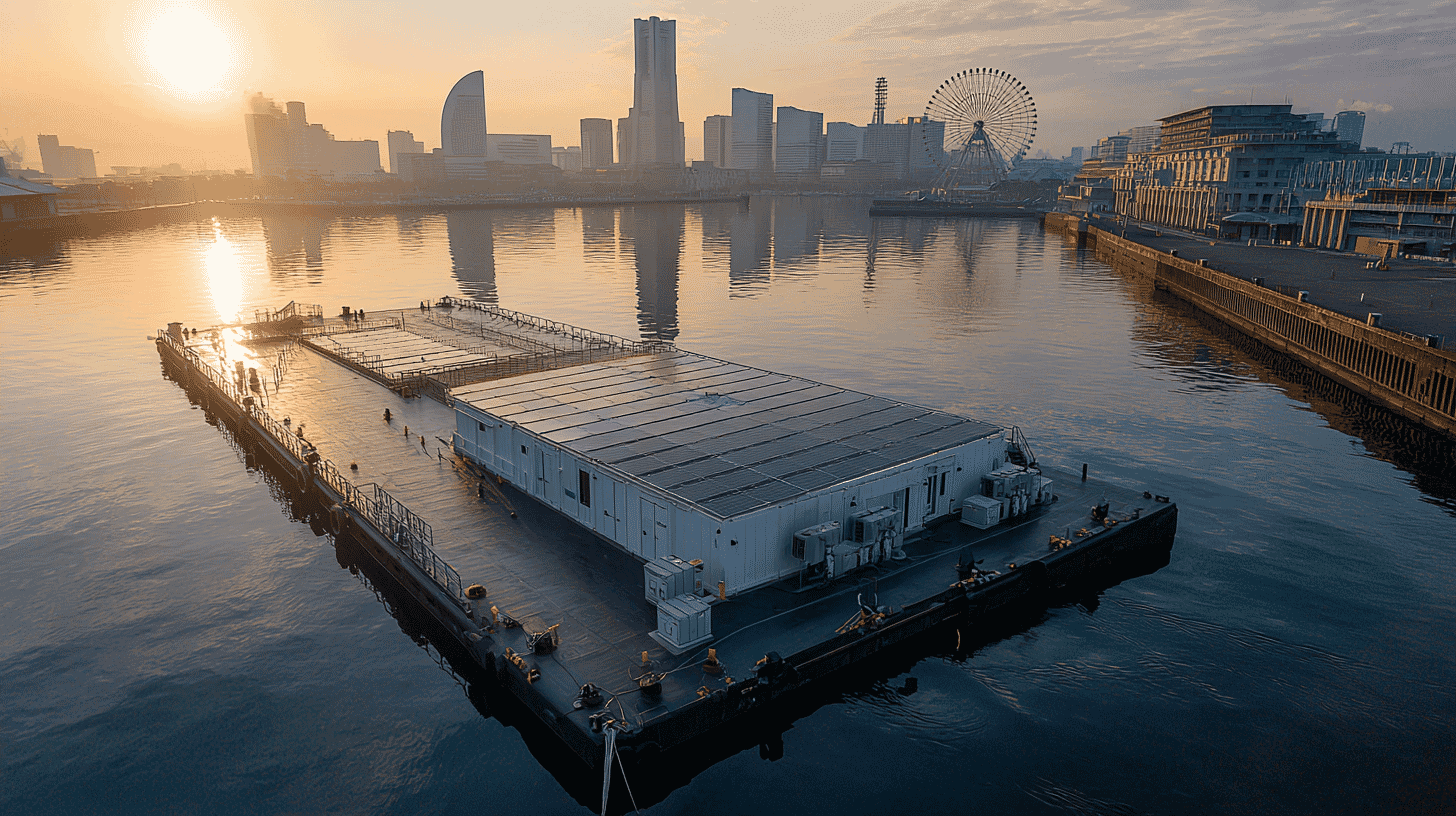
March 25, 2026, Yokohama Port. For over 50 years, the Osanbashi Pier has welcomed cruise ships from around the world. Now, quietly docked beside it, a "world first" has started humming: on a 25 × 80-meter floating platform sit a container-type data center, solar panels, and a battery array. Not a single power cable connects this box to the grid; it runs entirely on sunlight. This is Japan's off-grid maritime AI infrastructure experiment, a joint venture between NYK Line, NTT Facilities, Eurus Energy, MUFG Bank, and the City of Yokohama.
What Makes This a "World First"
Floating data centers are not a new idea. Back in 2018, Microsoft's Project Natick sank a server capsule off Scotland's Orkney Islands. China has been commercially operating an underwater data center off Hainan Island. Just earlier this month, Japanese shipping giant MOL and tech conglomerate Hitachi announced an MOU to develop floating data centers by converting retired cargo ships.
The Yokohama project is different from all of them. Rather than sinking servers to the seafloor or repurposing an entire ship, this initiative places a containerized data center on a small port-side float, powered solely by solar panels and batteries. It's the world's first demonstration of a floating data center running entirely on renewables, operating completely off-grid. That off-grid architecture, zero kilowatt-hours from the commercial power grid, is what distinguishes it from every previous attempt.
The significance has already been recognized by Japan's government. In February 2026, this initiative won the Minister of Internal Affairs and Communications Award at the Japan Open Innovation Grand Prize, a major national R&D recognition.
The Five-Way Partnership
What stands out about this demonstration isn't just the technology, it's the lineup of partners.
- NYK Line: Overall project leadership. Brings 141 years of shipping expertise and maritime mooring technology
- NTT Facilities: Data center design, construction, and operation. Involved in roughly 70% of Japan's data center construction
- Eurus Energy Holdings: Renewable energy technology verification. Operates wind and solar projects globally
- MUFG Bank: Business co-creation and financial support, leveraging the megabank's deal-making capabilities
- City of Yokohama: As a national leading port for carbon-neutral port formation, exploring marine renewable energy applications
Shipping, telecom, renewables, finance, and government, the fact that five such different sectors came together is remarkable in itself. And each partner brings capabilities aligned with their actual expertise.
The float itself is a "mini-float" originally owned by the City of Yokohama for disaster response, repurposed rather than newly built. That frugality is very much in keeping with the experimental spirit. Through the end of fiscal 2026 (March 2027), the team will evaluate salt resistance, operational stability under vibration, and optimized energy management for the solar-plus-battery configuration.
NYK vs. MOL: Two Shipping Giants, Two Different Bets
One of the most intriguing aspects is that Japan's two largest shipping companies have entered the floating data center space at nearly the same time, with fundamentally different approaches.
| Aspect | NYK-led consortium (this project) | MOL × Hitachi (April 1 announcement) |
|---|---|---|
| Approach | Port mini-float + container DC | Full conversion of retired ships |
| Power source | 100% solar + battery (off-grid) | Grid power + seawater cooling |
| Status | Operational since March 2026 | MOU stage, targeting 2027 launch |
| Scale | Portion of 25m × 80m float (demo) | 54,000 m² (largest-DC-class) |
| Selling point | 100% renewables, carbon neutrality | Scale, speed, cost |
| Target markets | Domestic carbon-neutral ports | Japan, Malaysia, US |
The two projects look less like competitors and more like complementary strategies. MOL goes for "scale," while NYK pursues "sustainability." As AI-era data center demand fragments into multiple use cases, having two parallel Japanese solutions emerge may prove to be a strength rather than a duplication, a portfolio approach to a complex problem.
Why "100% Renewable" Matters for AI
Data center power consumption is exploding. A single ChatGPT query reportedly consumes roughly ten times the electricity of a Google search, and as generative AI models grow more capable, the data centers running them get hungrier. Japan's national grid coordinator OCCTO projects that peak power demand from data centers and semiconductor plants could rise roughly 13-fold between fiscal 2025 and fiscal 2034.
Reconciling that demand surge with Japan's 2050 carbon-neutrality goal is genuinely hard. Major tech clients like Apple require their partner data centers to run on 100% renewables, but Japanese data centers concentrated in the Tokyo metropolitan area typically rely on coal and LNG thermal power. The result is what some call the "ESG paradox": the world's ostensibly greenest tech firms end up running on Japan's most carbon-intensive electricity.
The Yokohama project is a head-on response to that paradox. Off-grid, with no tie to the commercial power grid, it can guarantee "zero fossil fuel" across the entire chain from generation to consumption. The scale is small, but the technical question it answers, "can a data center actually run entirely on renewables?", is a big one.
Looking ahead, if this system can be co-located near offshore wind farms, wind power could feed servers with virtually no transmission loss. Japan's exclusive economic zone is the world's sixth largest at roughly 4.47 million square kilometers. Treating that vast ocean as potential "data center real estate" opens a path for metropolitan Tokyo's DC demand to migrate to coastal waters.
Yokohama's Bet on the "Carbon-Neutral Port"
Yokohama's role in this project goes beyond just providing the location. Yokohama Port has been designated by Japan's Ministry of Land, Infrastructure, Transport and Tourism as one of the leading ports for Carbon-Neutral Port (CNP) formation, and the floating data center fits directly into that strategic framework.
Ports are already hubs of industrial activity, logistics, and energy, Japanese ports account for roughly 6% of the country's CO2 emissions. Decarbonizing them yields outsized gains. Incorporating data centers into the CNP concept is, for Yokohama, an experiment in designing the next-generation port economy. Deputy Mayor Toshihide Hirahara attended the official launch ceremony on March 25.
That said, questions remain. The float is moored at a quay inside the port, which is less "offshore" than "in-harbor." Extending this concept to open waters introduces an entirely different set of technical challenges, wave action, swells, typhoons. Scaling up is another issue: one container's worth of DC capacity on a 25 × 80-meter float is nowhere near what commercial deployment would require. This demonstration is a first step to prove feasibility. The real fight comes after.
A Small Box, A Big Question
The container sitting on that floating platform at Osanbashi Pier is one possible answer to the questions the global data center industry is wrestling with: Where does the power come from? How do we secure land? Can decarbonization and AI growth actually coexist? The road to commercialization is still long, but the fact that the world's first attempt to run a data center on 100% renewables has started from a Japanese port is itself newsworthy.
Japan is trying to turn its constraints, a small island nation surrounded by ocean, into assets. How is your country approaching AI-era power demand and data center siting challenges?
References
- https://www.nyk.com/news/2026/20260325_02.html
- https://www.city.yokohama.lg.jp/city-info/koho-kocho/press/kowan/2025/dc_2.html
- https://solarjournal.jp/policy/63363/
- https://www.itmedia.co.jp/news/articles/2603/25/news118.html
- https://cloud.watch.impress.co.jp/docs/news/2096907.html
- https://www.nyk.com/news/2025/20250327_03.html
- https://www.nyk.com/stories/04/02/20250725.html







Global Discussion
14 comments