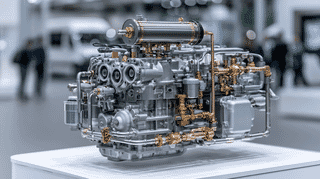
Ammonia burns slowly and needs about 500 times more ignition energy than iso-octane. Daihatsu turns part of it into hydrogen on the car. Why it starts with kei cars, and which problems it still lists as open.
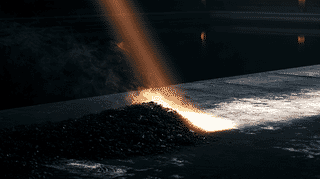
Furukawa Electric and Ryuki Engineering heated PFAS-laden activated carbon above 1,100°C with a fiber laser and hit 99.999% destruction in a test. Throughput and the fate of the fluorine were not disclosed.
Bridgestone left F1 in 2010 and lost a bid to return in 2023. From December it supplies every Formula E car, on tyres it says are 65% recycled and renewable, a figure that partly relies on mass-balance accounting.
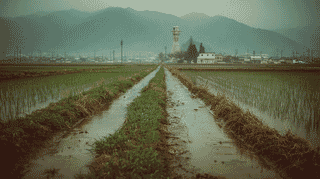
Extinct in Japan's wild in 1971, the Oriental stork now numbers 728, and only 49 were released. Most hatched in the wild, fed by low-pesticide paddies that cost farmers work and yield. Now they nest on power poles.
Japan made 'mottainai' a global word, yet its restaurants often refuse to box up leftovers. A 2024 government guideline shows why: legally, you are meant to eat it on the premises.
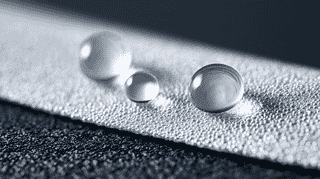
Kyoto University's deep foam photolithography makes white out of air instead of titanium dioxide, prints it at about 20,000 dpi and repels water without PFAS. Why the timing is European, and what Japan tried before.
Google and Microsoft park cold data on magnetic tape. Shipments dipped in 2025, then jumped 57% in the first quarter of 2026, and the business behind those cartridges belongs to a photo film company.
Hokkaido University and Japan's forestry institute modelled all 349 ski areas in the country. At 4°C of warming, only seven stay open 100 days a year on natural snow. At 2°C, 53 do.
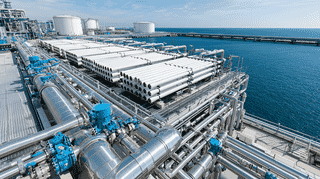
Desalination makes about 35 trillion liters of fresh water a year and discards roughly 50 trillion liters of brine. A Tokyo lab drips it onto molten tin and recovers magnesium oxide, 280 times concentrated.
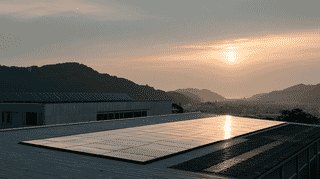
Japan's Environment Ministry will stop subsidising the purchase of conventional solar panels for new projects from fiscal 2027. The stated reason was not carbon but industry: the money was benefiting factories abroad.
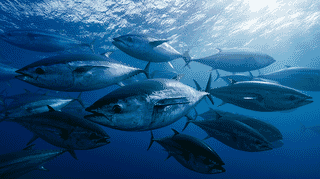
A kawakawa hybrid made bluefin tuna sperm at eight months, and rainbow trout now spawn Chinook salmon yearly. Inside Japan's 20-year surrogate broodstock effort and Kindai's 32-year tuna project.
Kobe University isolated seven bacterial strains from PFAS-polluted river sediment in Osaka. Three cut PFOS by up to 17.8%; one removed up to 97% of PFHxS in real landfill leachate. Degradation or adsorption? Unsettled.
Pacific fishing nations agreed on August 18, 2026 to raise the quota for bluefin tuna over 30 kilograms by 25 percent, to 14,836 tons in the western Pacific, and to cut the quota for juveniles by 6 percent.
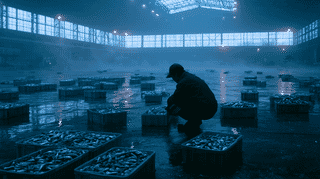
Japan's 2025 seafood output fell to 3,577,400 tonnes, the lowest since 1956, while FAO puts world production at 235 million tonnes. Comparing quota rules with Norway and the US shows why fewer fishermen isn't the answer.
Researchers at the Institute of Science Tokyo have created a surface electrene: a crystal whose outermost layer is a sheet of loose electrons, with a work function lower than cesium. It survives open air because nitrogen caps it, then leaves as ammonia. Here is what it means for green fertilizer, and how it compares with the electrochemical routes pursued in China, Europe and the US.
NEC and New York University estimate that flood defenses on the Rockaway Peninsula could avoid up to $800 million in losses, pricing everything from transit disruption to residents' mental health in a bid to pull private money into climate adaptation.
Mitsubishi Gas Chemical has signed an MOU with Australia's Gold Hydrogen to study green methanol made from natural hydrogen in South Australia. Here is why a Tokyo chemical maker is going to the wellhead abroad, what the Toyota-ENEOS consortium is really buying, and how the global race for natural hydrogen is splitting along national lines.
Toray's new TSW-K/M/V RO membranes remove over 99.9% of salt and enough boron to run seawater desalination in a single pass, trimming energy, equipment and cost. Here's why it matters worldwide.
Kubota says its existing waste-melting furnaces destroyed three regulated PFAS at over 99.999 percent, with greenhouse-gas markers below detection. We check whether 'destroying forever chemicals' is really the breakthrough it sounds like.
JR East will phase out magnetic short-distance train tickets in spring 2027, replacing them with QR-code paper tickets. We break down the environmental and cost reasons, why almost no one will notice, and the small ritual that is quietly disappearing.